You have decided to instruct a firm, but you need to know what happens next. A debt collection law firm Dubai search should lead to clear answers about evidence, procedure, fees, and enforcement. Those questions determine whether the proposed action fits your debt.
Quick Answer
A debt collection law firm in Dubai reviews the documents, confirms the debtor’s identity, checks jurisdiction, and recommends a recovery strategy. The process may begin with a formal demand or settlement discussions before the appropriate court or dispute procedure.
A payment order requires a qualifying debt and a prior demand giving at least five days to pay. Other routes can include an ordinary claim, mandatory conciliation where applicable, arbitration, or execution of a qualifying unpaid cheque.
After obtaining an enforceable instrument, counsel can seek lawful execution measures through the competent authority. Recovery depends on the evidence, procedure, available defenses, and reachable assets. The engagement letter should clearly explain scope, fees, reporting, and decisions requiring your approval.
Articles 143 to 150 of Federal Decree-Law No. 42 of 2022 govern the payment order framework. Article 667 of Federal Decree-Law No. 50 of 2022 concerns qualifying cheque execution. Dubai Law No. 18 of 2021, as amended, is relevant to conciliation.
Stage 1: Intake and File Review
- The contract, invoices and statement of account.
- Delivery, completion or service records.
- Any cheques, guarantees or security.
- Correspondence, including reminders and any acknowledgment of the balance.
- The debtor’s license details or identification.
A firm should tell you at this point whether the evidence supports a fast route or whether the debt looks contested.
Still Waiting for a Debtor to Pay?
Before spending more time on reminders, get your contract, invoices, payment records, acknowledgments, and outstanding balance reviewed to identify the strongest recovery route.
Stage 2: Strategy and Advice
The firm checks whether the debt is fixed, due, and supported by written evidence. It assesses any cheque, forum clause, conciliation requirement, and known assets.
This review should produce a reasoned choice of procedure and a realistic cost estimate. Ask what additional evidence could change that recommendation.
Stage 3: Formal Demand
The demand sets out the debt, its basis and a deadline, and it is often the point at which payment or negotiation begins. It also creates a record the court will see. A demand should be delivered in a provable way, such as registered post with acknowledgment of receipt, notarization, or another method the contract allows.
Stage 4: Filing and Hearings
Once the route is chosen, the firm prepares the filing, arranges Arabic translation of key documents and manages the procedural steps. In contested cases, the court may appoint an expert to review the accounts. Throughout this stage, the firm should be telling you what each step is for and what decision it needs from you.
Stage 5: Execution
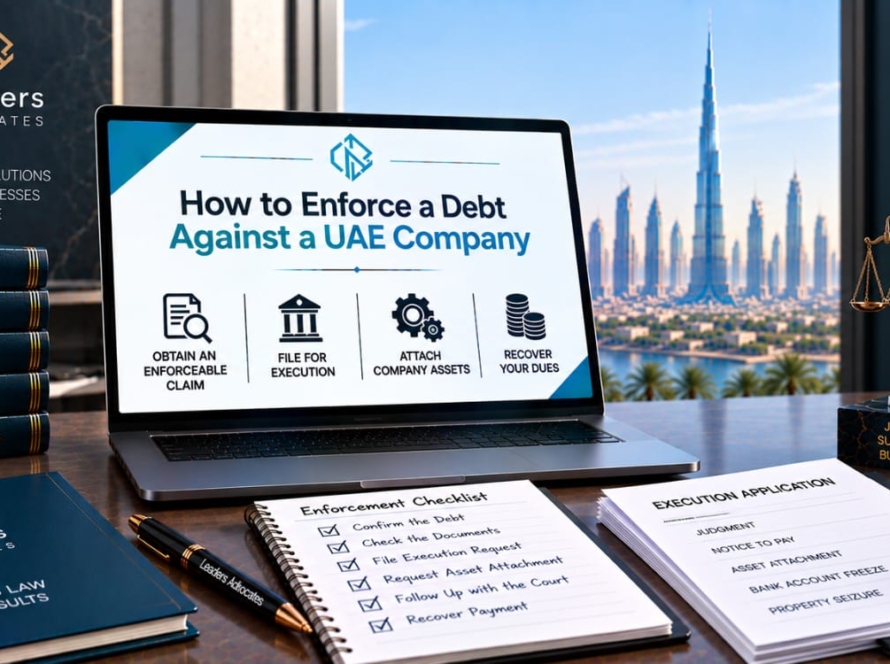
A judgment, enforceable settlement or qualifying cheque moves to the execution judge. The debtor is notified and given a short period to pay. Subject to legal requirements, counsel may request attachment of bank accounts, property, vehicles, shares, or sums owed by third parties.
Articles 324 to 327 govern travel restrictions and related conditions. The generally applicable AED 10,000 threshold alone does not justify a travel ban against an individual.
What Lawful Collection Practices in the UAE Exclude
- Harassment, threats or contacting people unconnected with the debt.
- Claiming criminal consequences for ordinary non-payment.
- Seizing property without a court order.
- Holding a debtor’s passport or documents as leverage.
- Publishing the debtor’s details to pressure payment, which can create separate legal risk.
Fees and Reporting
An engagement letter should define scope, professional fees, and disbursements, including court and translation costs. It should explain any lawful success element and the consequences of early settlement. Ask how often you will receive updates and in what form, particularly if you have several files.
Agree on responsibility before the first demand
The engagement should name the person responsible for your file and explain who can authorize decisions. Ask whether the quoted work includes negotiations, filing, appeals, and execution. Those stages may require separate instructions and budgets.
Provide the firm with identification and corporate authority documents it requests. A representative may need an appropriate power of attorney. Confirm the required form before an urgent filing depends on missing paperwork.
Tell counsel about previous demands, settlement offers, payments, and proceedings. An earlier instruction to another firm can affect the practical handover. Explain where original cheques and signed agreements are held.
Ask for a written strategy tied to the evidence
A useful strategy identifies the route, supporting documents, missing information, expected expenses, and next decision. It should distinguish obtaining an enforceable instrument from collecting money through execution.
If a payment order is proposed, ask which records establish the debt and amount. If an ordinary claim is proposed, ask what needs determination. The answer should relate to your file rather than a general description of debt recovery.
A cheque route requires the cheque and bank return evidence. An arbitration route requires analysis of the agreement and applicable rules. A mandatory conciliation step must be addressed before filing where required.
Discuss assets early. Counsel may need information about accounts, property, commercial operations, or receivables that can be investigated lawfully. A creditor’s belief that the debtor is wealthy is not an enforcement plan.
Prepare a complete intake package
- Provide a short chronology with the contract and payment dates.
- Include the current balance and show how it was calculated.
- Separate principal, interest, penalties, and other claimed charges.
- Identify each disputed invoice and the debtor’s stated reason.
- List security, guarantors, and any existing case numbers.
- Explain known deadlines and signs of financial distress.
Send readable documents in a logical order. Keep originals secure and obtain an inventory when they are transferred. Clear file preparation can reduce repeated requests and prevent incorrect assumptions.
Understand what the formal demand should say
The demand should identify the parties, legal basis, amount, and payment instructions accurately. It should also explain the response requested. Counsel must use a delivery method suitable for the intended procedure.
The five-day minimum associated with payment orders does not establish a universal deadline for every demand. Contractual requirements and other procedures may differ. Ask when the period begins and how receipt will be evidenced.
Give the firm any response promptly, including partial payments or complaints. A payment received after the demand changes the balance. A new performance allegation may require records from your operations team.
Not Sure Which Debt Recovery Route Fits Your Case?
Payment order, ordinary claim, conciliation, arbitration, and cheque execution all have different requirements. Get the evidence and procedure checked before filing in the wrong forum.
Know which decisions remain yours
Counsel may ask whether to accept a discount, approve expert costs, pursue an appeal, or fund an enforcement application. Agree how those decisions will reach you and who can respond.
A settlement offer should be compared with probable net recovery and collection risk. The highest proposed judgment amount may not produce the best commercial result. Ask counsel to explain the assumptions behind the recommendation.
If business staff communicate directly with the debtor, coordinate those messages with counsel. Unplanned concessions or inconsistent figures can complicate the file. Preserve new communications instead of relying on verbal summaries.
Review progress using meaningful milestones
An update should state what happened, what remains outstanding, and the next action. Hearing dates alone do not explain progress. You need to know whether service, evidence, a decision, or enforcement is the present obstacle.
For a portfolio of debts, use consistent reporting fields. Record the balance, procedural stage, next deadline, approved spend, and actual funds recovered. Distinguish a settlement promise from cleared money.
Ask for revised advice when circumstances change. A new defense, insolvency filing, or unsuccessful asset search may alter the economics. Continuing the original strategy without review can add expense without improving recovery.
Common Mistakes
- Sending incomplete documents at intake, which delays everything.
- Expecting a firm to bypass mandatory conciliation.
- Failing to respond quickly at decision points.
- Handing over original cheques without a receipt.
- Assuming enforcement measures follow automatically from judgment.
How a lawyer manages execution and closure
After an enforceable instrument is available, the lawyer assesses the appropriate execution applications. Available measures depend on the legal conditions and identifiable assets. They are neither automatic nor interchangeable.
If the debtor enters insolvency proceedings, the firm should review the effect on individual enforcement. If assets are abroad, local advice may be needed in the destination. Those developments can change both cost and timing.
When funds arrive, reconcile the amount collected against principal, awarded sums, and agreed fees. Obtain the necessary closure documents and confirm the status of related files. Retain a final account for your records.
Professional Perspective
Faris Raian of Leaders Advocates notes that clients often expect the first filing to be decisive, while important decisions may arise later during expert review, settlement discussions, or execution.
A debt recovery strategy should therefore identify the key decision points, evidence requirements, costs, and enforcement options from the beginning rather than focusing only on filing the first claim.
This helps the client understand when approval will be needed for issues such as settlement, expert costs, appeals, asset-related applications, or execution measures.
Relevant Legal Services
The appropriate service depends on the dispute and the stage reached. The following practice areas address different parts of the file.
- Debt Recovery Lawyers in Dubai: Assessing the unpaid balance, recovery procedure, and available execution options.
- Litigation Lawyer in Dubai: Handling contested claims, expert evidence, procedural applications, and court decisions.
- Arbitration Lawyers in Dubai: Reviewing arbitration clauses and coordinating claims within the agreed dispute process.
Relevant Success Story
The firm’s Success Stories page lists a successful loan recovery matter in Dubai. It offers a relevant example of a reported recovery outcome.
Every matter depends on its own facts, documents, and legal circumstances. A previous outcome does not guarantee a similar result.
Frequently Asked Questions
Final Takeaway
A useful recovery engagement explains the next action, its cost, and its purpose. Provide a complete file and ask for a strategy covering execution. The appropriate route and likely outcome depend on the evidence and the debtor’s position.
Won the Case but Still Haven’t Recovered the Money?
A judgment does not automatically produce payment. Execution may require asset searches and applications involving bank accounts, property, vehicles, shares, receivables, or other lawful measures.