

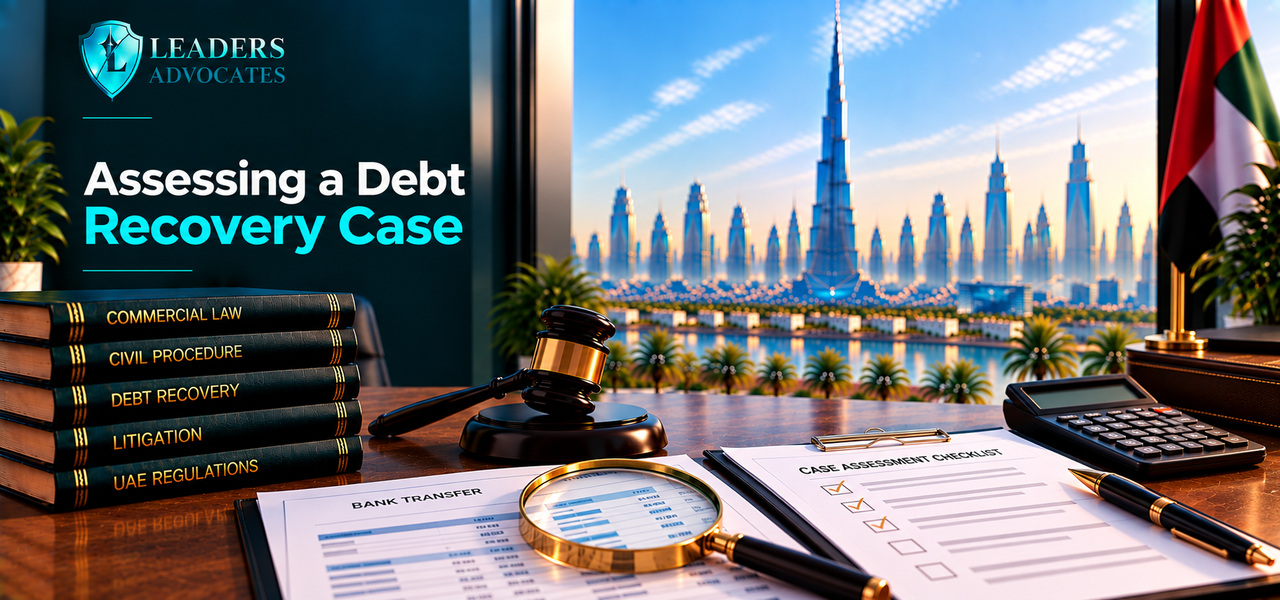

The question how does a debt recovery lawyer assess a case UAE arises when invoices remain unpaid but the creditor does not know whether filing is worthwhile. A signed invoice alone may not answer that question.
A proper assessment tests legal liability, proof, procedure, timing, and recoverability. A strong judgment has limited value if the wrong entity was sued or the debtor has no reachable assets.
Quick Answer
A lawyer answering how does a debt recovery lawyer assess a case UAE should apply six tests. First, identify the exact debtor and any guarantor. Second, test the evidence under Federal Decree-Law No. 35 of Third, confirm that the amount is fixed and due. Fourth, identify the correct court, center, or arbitration forum. Fifth, check every limitation and procedural deadline. Article 92 of Federal Decree-Law No. 50 of 2022 provides a five-year period for denied claims between merchants, unless a shorter period applies. Finally, evaluate assets, costs, defenses, and realistic collection prospects.
Prepare a single chronological file before demanding payment or filing. It should connect the contract, performance, invoices, acknowledgments, payments, and current balance without unexplained gaps.
Ask the lawyer for a written assessment of route, evidence gaps, likely defenses, cost stages, and enforcement prospects. Gather missing proof before litigation when possible. The best route depends on the facts and documents.
How Does a Debt Recovery Lawyer Assess a Case in the UAE? The Six Tests
Test 1: Identify the Correct Debtor
The name used in emails may be a trading brand rather than the legal entity. The lawyer should compare the trade license, contract, invoices, purchase orders, bank account, and signature block.
A group logo does not make every group company liable. A shareholder or manager is not automatically personally responsible for a company’s debt.
The review should identify guarantors, joint debtors, and any assignment. It should also test whether the signatory had authority and whether liability was accepted personally.
Suing the wrong party wastes time and fees. Correct identity is therefore the first gate, not an administrative detail.
Test 2: Determine Whether the Debt Can Be Proved
Federal Decree-Law No. 35 of 2022 governs evidence in civil and commercial transactions. Article 53 recognizes electronic evidence, with further provisions addressing its forms and probative value.
Article 66 generally requires writing for a transaction above AED 50,000 or of indefinite value. It also restricts witness evidence alone from proving the existence or termination of that transaction, subject to exceptions.
The lawyer should test formation and performance separately. A contract proves terms. Delivery notes, completion certificates, timesheets, acceptance emails, and usage records may prove performance.
Invoices show what was charged, but they may not prove delivery or acceptance alone. A debtor’s written acknowledgment can materially strengthen the claim.
Electronic records must be preserved in context. Export complete email threads and messages. Keep original files, dates, sender details, and attachments where possible.
Test 3: Confirm That the Debt Is Due and Quantified
A valid obligation may not yet be payable. The lawyer will examine credit periods, milestones, conditions, retention, set-off clauses, and notice requirements.
The amount must reconcile. A statement of account should show every invoice, credit note, payment, refund, and agreed adjustment.
Interest or late charges require a legal and contractual basis. The assessment should separate principal from claimed additions and explain any calculation.
A genuinely disputed amount may require an ordinary claim. A fixed, due, documented amount may support a more streamlined route.
Test 4: Select the Correct Forum and Procedure
The contract may select onshore courts, DIFC Courts, ADGM Courts, or arbitration. Jurisdiction cannot be assumed from the creditor’s office address alone.
Subject matter also matters. Rental disputes, employment claims, construction disputes, and regulated financial matters may follow specialized routes.
Dubai Law No. 18 of 2021, as amended, governs Dubai’s Center for Amicable Settlement of Disputes. Mandatory conciliation may apply to matters within its assigned jurisdiction.
For a fixed, due debt supported by writing, Articles 143 to 150 of Federal Decree-Law No. 42 of 2022 regulate payment orders. Article 143 requires a demand for payment before the petition, with at least five days allowed.
A returned cheque may allow execution under Article 667 of Federal Decree-Law No. 50 of 2022. The lawyer should still examine defenses, endorsements, return reason, and the underlying documents.
Test 5: Check Limitation and Procedural Time
There is no single limitation period for every UAE debt. The period depends on the transaction, parties, and any special statute.
Article 92 of Federal Decree-Law No. 50 of 2022 provides that claims concerning obligations between merchants are not heard after five years from maturity when denied. The rule is subject to lawful excuse and shorter statutory periods.
Transport, insurance, employment, rental, and other specialized claims can have different time rules. Appeal, grievance, and objection deadlines are separate and usually much shorter.
The assessment should identify the maturity date, any acknowledgment, partial payment, interruption issue, and exact procedural event. Do not rely on a general statement that a debt is old.
Test 6: Evaluate Recoverability
Winning and collecting are different stages. The lawyer should ask what is known about bank accounts, vehicles, real property, shares, receivables, employment income, and business activity.
Known assets do not guarantee attachment. Ownership, existing security, priority claims, exemptions, and location affect recovery.
If the debtor appears insolvent, Federal Decree-Law No. 51 of 2023 on Financial Restructuring and Bankruptcy may affect individual enforcement and creditor strategy. The identity and legal status of the debtor matter.
Settlement can be rational where assets are limited. The correct discount depends on evidence, timing, enforcement cost, and the reliability of security offered.
Wondering If Your Debt Is Worth Pursuing?
Message Leaders Advocates on WhatsApp for a realistic first assessment of your case.
Choosing the Recovery Route
The lawyer should compare at least four routes. A demand letter may produce payment or useful acknowledgment. Conciliation may create an enforceable settlement where applicable.
A payment order may fit a fixed, due, written debt after the required demand. An ordinary claim may be necessary where liability, performance, amount, or set-off is contested.
Cheque execution may move faster when statutory conditions are met. Arbitration must be considered where a valid arbitration agreement governs the dispute.
The recommended route should be explained in writing. It should include expected stages, known deadlines, evidence gaps, and possible escalation.
Practical Steps Before the Assessment
- Obtain the debtor’s exact licensed name and current trade-license details.
- Prepare the signed contract, amendments, and relevant terms.
- Match each invoice to delivery, completion, or acceptance evidence.
- Produce a clean statement of account and bank reconciliation.
- Export complete emails and messages containing admissions or objections.
- Collect cheques, guarantees, acknowledgments, and return memos.
- Identify jurisdiction, arbitration, and notice clauses.
- List known assets, guarantors, and insolvency warning signs.
Organize the file chronologically. A concise index saves review time and often exposes gaps before they become defenses.
Evidence and Documents Needed
The core file usually includes incorporation records, identity documents, the contract, purchase orders, invoices, and delivery evidence. Add correspondence about quality, delay, set-off, or alleged breach.
Financial records should show payments and the final balance. If the debtor has acknowledged the debt, preserve the complete communication and its technical context.
For a cheque, include both sides of the instrument, the return memo, and any execution notice. For a guarantee, include the signed original and every amendment affecting the principal obligation.
If the claim crosses borders, add governing-law clauses, foreign company records, and evidence of service addresses. Translation requirements should be budgeted early.
Common Mistakes and Risks
- Suing a brand name instead of the liable legal person.
- Relying on invoices without proof of performance or acceptance.
- Ignoring set-off, defects, or counterclaims raised in correspondence.
- Filing in court despite a valid arbitration clause.
- Assuming all commercial claims have the same limitation period.
- Spending heavily before considering the debtor’s assets.
- Withholding unfavorable documents from the assessing lawyer.
A lawyer cannot give a reliable view from selected documents. Unfavorable material often determines the likely defense and should be reviewed at the start.
Not Sure You Have Enough Evidence?
Send us what you have on WhatsApp and we’ll help you identify the gaps before you file.
How a Lawyer Can Help
A lawyer can convert a large file into a provable legal narrative. The assessment should distinguish missing evidence from evidence that probably cannot be repaired.
Faris Raian, Managing Partner at Leaders Advocates, has noted that one missing document often controls the assessment. Proof of delivery or a written balance acknowledgment commonly becomes decisive.
His preserved practical contribution is to obtain that evidence before filing where possible. Starting with an incomplete record can invite a defense that better preparation might have avoided.
A lawyer can also compare routes, estimate costs by stage, and set realistic enforcement expectations. No responsible assessment should guarantee recovery.
Relevant Legal Services
- Debt recovery lawyers in Dubai can assess liability, procedure, settlement, and enforcement options.
- Litigation lawyers in Dubai can manage contested proceedings, experts, appeals, and execution strategy.
- Civil lawyers in Dubai can analyze contracts, evidence, defenses, and civil remedies.
Relevant Success Story
The firm’s Success Stories show how evidence and procedure influence strategy. They do not guarantee recovery in another file. Every matter depends on its facts, documents, and legal circumstances.
Ready for a Documented Case Assessment?
Get a clear view of your forum, limitation period, and recovery odds. Contact Leaders Advocates on WhatsApp.
FAQs
Final Takeaway
The answer to how does a debt recovery lawyer assess a case UAE is a disciplined sequence: debtor, proof, maturity, forum, time, and assets. Route selection comes afterward.
The safest next step is a complete, honest document review. Prospects depend on the facts, documents, defenses, deadlines, and realistic ability to enforce.