


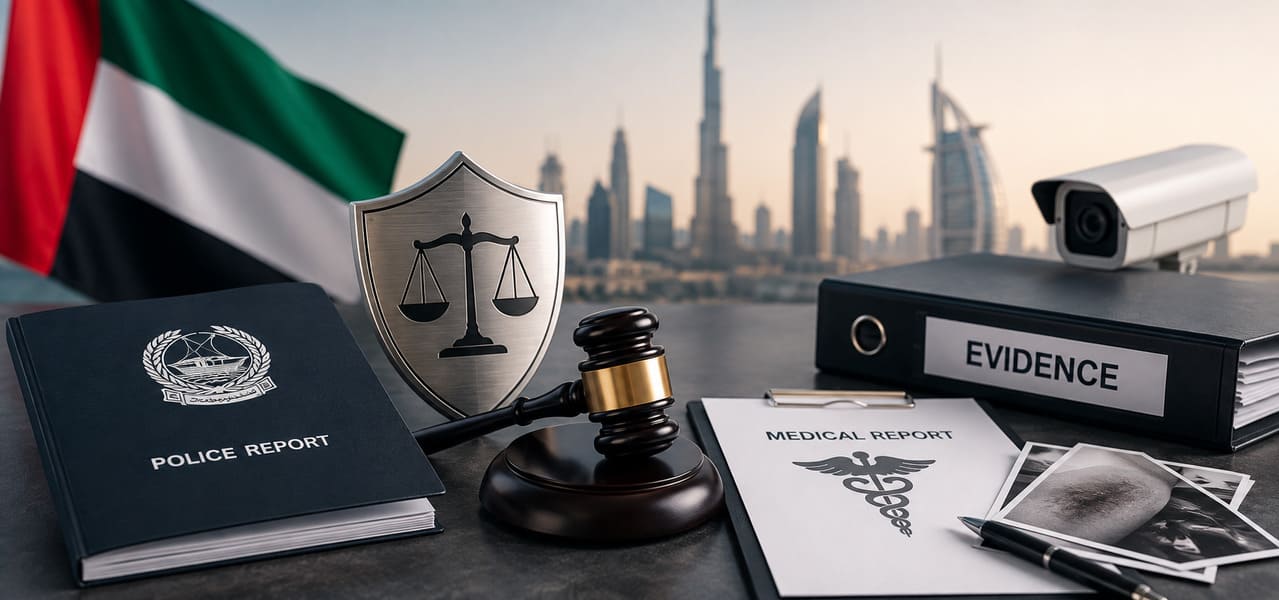

To file a physical assault case in the UAE, begin with safety and medical care, then make a prompt police complaint while the facts and witness details are still available. The medical record can be central because Article 390 of the UAE Crimes and Penalties Law distinguishes the penalty according to the harm and the period of illness or inability to perform personal work.
The police take the initial complaint and statements, gather available evidence, and refer the file to the Public Prosecution. A criminal defense lawyer in Dubai can advise on the case and legal process. The prosecution then evaluates the legal classification, including what is the punishment for murder in the UAE, and whether the evidence supports formal charges. The difference between kidnapping and abduction under UAE law may also depend on the specific facts and legal classification. A complainant should preserve records carefully, while an accused person should obtain advice quickly and avoid direct contact with the other party.
Filing a physical assault case in the UAE usually starts with immediate medical attention and a prompt police complaint. Keep the medical report, photographs, witness details, messages, CCTV information, and a factual chronology.
The police take initial statements and gather available evidence before referring the file to the Public Prosecution, which decides the charge and whether the case should continue.
Article 390 treats an assault causing illness or inability to perform personal work for more than 20 days more seriously. Where the harm does not reach that level, the law provides detention for up to one year and a fine of up to AED 10,000.
A convicted foreign national may also face deportation depending on the offence, sentence, and statutory exceptions.
About Faris Raian
Faris Raian is the Founder, Managing Partner, and Senior Legal Consultant at Leaders Advocates. He brings more than 15 years of experience across commercial, corporate, real estate, family, and criminal law in UAE courts, with experience relevant to physical assault complaints, medical and digital evidence, police and prosecution procedure, criminal defense, and connected compensation claims.
Physical Assault Case
Need Legal Guidance After a Physical Assault in the UAE?
Whether you are filing a complaint or responding to an allegation, early legal guidance can help you understand the police process, preserve important evidence, and prepare for the Public Prosecution stage.
Step 1: Get Medical Attention
Beyond your own wellbeing, a documented medical examination is genuinely central to how an assault case gets evaluated. UAE law specifically distinguishes cases based on the injury’s severity, including whether it caused incapacitation for more than 20 days, so the medical report isn’t a formality, it actively shapes how the case is classified.
Step 2: File a Police Report Promptly
- In person at the nearest police station, or through your emirate’s smart policing app or portal.
- Provide a clear, factual account of what happened, when, where, and by whom.
- Give any witness details you have, names and contact information, while memories are still fresh.
Step 3: The Case Moves to the Public Prosecution
Once reported, the matter is referred to the Public Prosecution, which reviews the evidence, the medical report, witness statements, and any other documentation, and decides whether to proceed with formal charges against the accused.
How Severity Actually Affects the Case
UAE law treats assault differently depending on the actual harm caused. Where the injury results in incapacitation for more than 20 days, this is treated more seriously, with correspondingly higher penalties for the person responsible than a less severe incident would carry.
What Happens to a Convicted Foreign National
Deportation can follow an assault conviction for a non-citizen, mandatory where the sentence involves a freedom-restricting penalty for a felony, and at the court’s discretion for a misdemeanour, unless the person is the spouse or first-degree relative of a UAE citizen, which generally shields them from deportation except in state security matters.
If You’ve Been Accused, Act Quickly Too
- Engage a criminal defense lawyer immediately, rather than waiting to see how serious the matter becomes.
- Do not contact the complainant directly while the case is ongoing.
- Preserve any evidence supporting your own account, and comply with any bail or travel restrictions in place.
What to Record Before or Immediately After the Police Complaint
A useful complaint is factual, chronological, and specific. Record the date, approximate time, location, people present, words or conduct remembered, the injuries noticed, and every step taken afterward. If an exact detail is uncertain, identify it as uncertain instead of filling the gap with an assumption.
Keep the original medical papers and any police reference number together. Preserve photographs in their original form, including the date information available on the device. If clothing, damaged property, or another physical item may matter, avoid altering or disposing of it before obtaining guidance from the authorities.
Witness information should be recorded promptly. A name, telephone number, workplace, vehicle detail, or description of where a person was standing may help the police locate the witness. Do not coach a witness or ask them to repeat a preferred version; each person should give their own account.
- A dated chronology of the incident and the steps taken afterward.
- Medical reports, prescriptions, invoices, and follow-up appointments.
- Original photographs, messages, call records, and location information.
- Witness names, contact details, and where each witness was positioned.
- The police complaint number and every later prosecution or court reference.
Why the 20-Day Injury Threshold Matters Under Article 390
The legal issue is not simply whether contact occurred. Article 390 focuses on the result of the assault and whether the resulting illness or inability to perform personal work exceeded 20 days. That is why medical documentation and the course of recovery can affect the way the allegation is classified.
Where the harm exceeds the stated threshold, the law provides imprisonment and a fine. If the result does not reach that degree of seriousness, the lighter paragraph provides detention for no more than one year and a fine not exceeding AED 10,000. An assault on a pregnant woman resulting in miscarriage is treated as an aggravating circumstance.
The treating doctor’s role is to document the medical condition, not to decide guilt. The prosecution and court examine the medical evidence with statements, witness accounts, recordings, and any defense evidence before deciding the legal result.
- The type, location, and progression of the documented injury.
- The period of illness or inability to perform personal work.
- Follow-up examinations and whether the condition changed over time.
- Any allegation of miscarriage or another aggravating result.
- Whether the medical evidence is consistent with the competing accounts.
How the File Moves from Police to the Public Prosecution
Police receive the complaint, take initial statements from the complainant and witnesses, and gather the available evidence. Depending on the file, this may include medical records, photographs, messages, CCTV, location material, or statements from the accused. The exact steps depend on the emirate and the facts.
The Public Prosecution supervises the criminal investigation and evaluates the legal classification. It may request further investigation, hear additional statements, consider release or restriction issues, and decide whether the evidence supports referral to the criminal court.
A complainant should keep contact details current and respond to official requests. An accused person should comply with any summons, bail condition, or travel restriction and should not treat silence after the first report as proof that the matter has ended. Official file status matters more than informal assumptions.
Preserving Digital, CCTV, and Witness Evidence
Digital material can disappear quickly. CCTV may be overwritten, messages may be deleted, and devices may be replaced. Record where cameras were located and notify the police or lawyer promptly so that a lawful preservation request can be considered. Do not attempt to access another person’s account or system.
Keep complete conversations rather than only selected screenshots. The account name, number, date, time, surrounding messages, and original device may become relevant to authenticity. If a file is exported, keep the original on the device and record who created the copy and when.
A witness should be identified, not managed. Avoid group chats in which witnesses compare memories or agree on wording. Independent accounts are generally more useful than coordinated statements that later appear rehearsed or influenced.
- Identify nearby cameras and the business or person controlling them.
- Keep original devices and complete message threads where possible.
- Do not edit, annotate, crop, or repeatedly forward the only available copy.
- Record who collected each file and how it was stored.
- Give witness details to the police without coaching the witness.
Evidence Matters
Medical Reports, CCTV, Messages, and Witnesses Can Shape the Case
Leaders Advocates can review the available medical and digital evidence, police complaint, witness information, and prosecution status to assess the legal position and next steps.
What an Accused Person Should Do After an Assault Complaint
An accusation should be addressed promptly and calmly. Preserve messages, video, location history, receipts, witness details, and any medical material supporting the defense account. Do not delete content merely because it appears embarrassing or unrelated; deletion can create a separate evidentiary problem.
Do not contact the complainant to negotiate, argue, apologize, or demand withdrawal while the case is active. A direct message can be misunderstood, breach a restriction, or become additional evidence. Communications should proceed through the appropriate legal and official channels.
For a foreign national, deportation exposure requires a case-specific review. The source distinguishes mandatory deportation for a felony carrying a freedom-restricting sentence from discretionary deportation for a misdemeanour, subject to the statutory exception for a spouse or first-degree relative of a UAE citizen outside state-security matters.
Filing or responding to a physical assault case in the UAE? Faris Raian and the team at Leaders Advocates can review the medical record, police complaint, witness and digital evidence, prosecution stage, and the legal options available to the complainant or accused person.
Common Mistakes
- Delaying medical attention, weakening the documented evidence a case actually relies on.
- Waiting too long to file the police report, while details and witness availability fade.
- Contacting the other party directly while the case is active, which can genuinely complicate the proceedings.
- Publishing the allegation, names, medical records, or evidence on social media while the case is active.
- Keeping only cropped screenshots and losing the complete conversation or original device context.
- Assuming an informal apology, settlement discussion, or period of silence automatically closes the criminal file.
Relevant Legal Services
A Criminal Defense Lawyer in Dubai can address the police, prosecution, and defense stages. A Civil Lawyer in Dubai can assess a connected compensation or civil claim. A Litigation Lawyer in Dubai can manage contested proceedings and evidence.
People Also Ask
A strong physical assault file begins with safety, medical documentation, a prompt and accurate police complaint, and careful preservation of witnesses and digital material. The legal classification depends on the proven facts and injury, so both complainants and accused persons should act through official channels and obtain timely advice.
Complaint or Defense
Filing or Responding to a Physical Assault Case in the UAE?
Get case-specific guidance on the police complaint, Public Prosecution proceedings, injury evidence, defense options, and potential consequences before taking your next step.