

A child can report abusive parents in the UAE directly and does not need a parent’s permission to ask for protection. If the child is in immediate danger now, the first call should be 999. For child-protection reporting, the Ministry of Interior’s 116111 hotline is available around the clock.
The report may also be made through the Ministry of Interior Child Protection Centre website or the Hemayati app. A tenancy lawyer in Dubai can advise on related housing issues, including can a landlord evict a tenant in Dubai and can landlord terminate tenancy agreement early. The most important step is to use a safe channel promptly, explain what is happening clearly, and avoid any attempt to collect evidence that would expose the child to more danger.
Can a Child Report Abusive Parents in the UAE?
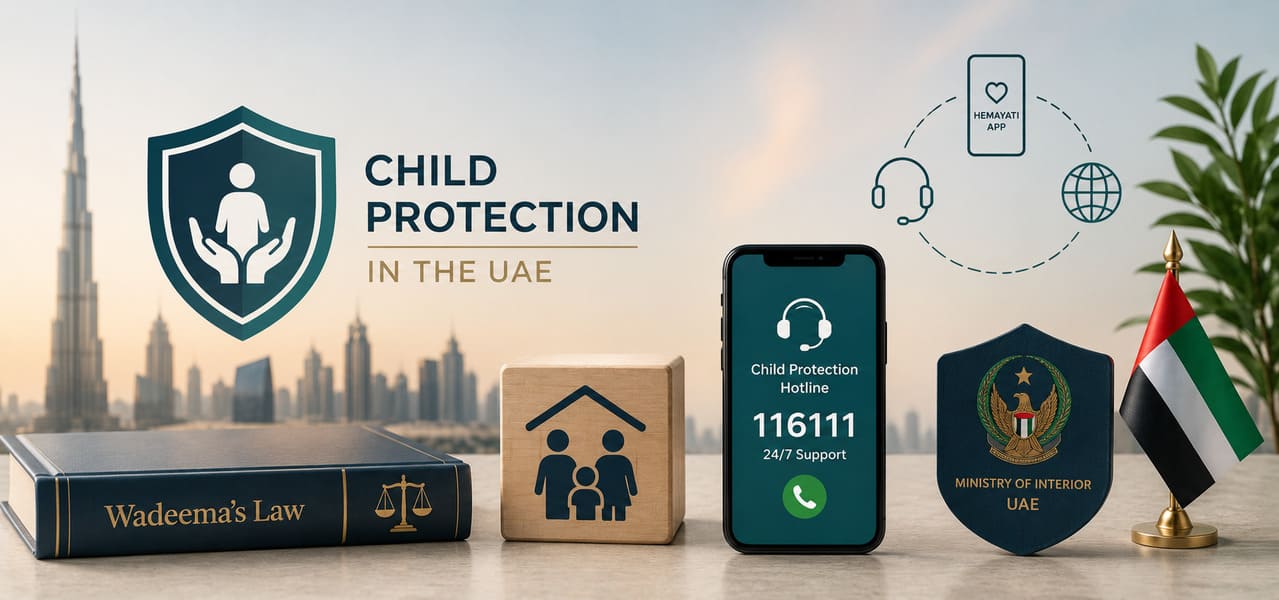
Yes. A child can report abusive parents in the UAE directly through the Ministry of Interior’s Child Protection Centre hotline on 116111, available 24 hours a day, seven days a week. A report may also be made through the Child Protection Centre website or the Hemayati app.
If the child is in immediate danger, call 999 first.
Federal Law No. 3 of 2016, known as Wadeema’s Law, protects children regardless of nationality or residency status and covers physical, sexual, verbal, emotional, and psychological abuse.
Reporting is confidential, and a person who reports in good faith is protected from retaliation. In serious cases, child-protection specialists have authority to remove the child from the home where necessary for safety.
The Law Behind This: Wadeema’s Law
Federal Law No. 3 of 2016, widely known as Wadeema’s Law, exists specifically to protect every child in the UAE, regardless of nationality or residency status, from physical, sexual, verbal, emotional, or psychological abuse. It was introduced following the death of a young Emirati girl after severe abuse by her father, and it reshaped how child protection works here.
Under Article 3, this protection applies without discrimination as to a child’s origin, sex, home country, religion, social status, or disability.
Need Legal Guidance After a Child Protection Report?
Emergency and child-protection channels should always come first. Our UAE family-law team can then advise on the related legal, custody, guardianship, or protection issues.
Reporting Isn’t Optional for Adults, and It’s Available Directly to Children Too
The law places a genuine legal obligation on adults, parents, teachers, healthcare providers, and anyone entrusted with a child’s care, to report suspected abuse. Failing to do so, where someone is legally required to report, can itself be treated as an offense.
That obligation on adults doesn’t close the door on a child reaching out directly. The hotline exists precisely so a child, or anyone concerned about a child, has a genuine, confidential way to get help without needing an adult’s permission first.
How to Actually Reach Out
- Call 116111, the Ministry of Interior’s Child Protection Centre hotline, available 24 hours a day.
- Use the Hemayati app, available on Android and iOS, built specifically for reporting child protection concerns.
- Contact the Ministry of Education’s Child Protection Unit, where the concern relates to a school-aged child, particularly relevant if a teacher or school staff member is the one reaching out.
- Call 999 where the situation is a genuine emergency.
What Happens After a Report Is Made
Reports are handled confidentially, and the law specifically protects whoever made the report, whether a child themselves, a family member, a teacher, or a neighbor, from retaliation or social consequences for reporting in good faith.
Where the situation is serious enough, child protection specialists have the authority to remove a child from the home to keep them safe, even against a parent’s wishes.
How to Report Abusive Parents in the UAE Safely
The first question is whether danger is immediate. If the child may be harmed now, cannot safely remain where they are, or needs urgent help, call 999. The child should move toward a safe adult or public place only if doing so does not increase the risk.
Where the situation is not an immediate emergency, 116111 provides the direct child-protection route described in the source. The child can call personally, and another concerned person can also report. The Child Protection Centre website and Hemayati app provide additional channels when a call is not the safest or most practical method.
The child does not need to decide whether the conduct meets a legal definition before speaking. A simple, truthful description of what happened, who was involved, where the child is, and whether they feel safe gives the protection team a starting point for responding.
- Call 999 first if there is immediate danger or an urgent threat to life or safety.
- Call 116111 for the Ministry of Interior Child Protection Centre.
- Use the Child Protection Centre website or Hemayati app when appropriate.
- Tell a trusted teacher, healthcare professional, relative, or other safe adult.
- Do not warn the abusive person before reporting if that could increase the risk.
What a Child or Concerned Adult Can Say in the Report
A report can begin with the basic safety facts. Give the child’s name if it is safe to do so, their location, the person causing concern, what happened, when it happened, and whether the child is currently with that person. If the child has an injury or needs medical help, say that clearly at the start.
It is acceptable to say that some details are unknown or difficult to explain. The reporter should distinguish what they saw or heard directly from what another person told them. That helps the protection team understand the source of each concern without requiring the child to produce a complete legal statement.
If the child cannot speak freely, they can say that the device, room, or conversation is not private. A safe adult making the report should avoid confronting the parent first when confrontation could place the child under more pressure or lead to the loss of a safe reporting opportunity.
- Where the child is and whether they are safe at that moment.
- What happened and whether it has happened before.
- Who was present or may have seen or heard the incident.
- Whether there are injuries, threats, or an urgent need for medical assistance.
- How the protection team can make safe contact without alerting the abusive person.
Preserving Information Without Increasing the Child’s Risk
Safety comes before documentation. A child should not secretly record, retrieve a device, return to a room, or challenge a parent if doing so may expose them to further harm. A report can be made based on the child’s account and the information already available.
Where a safe adult already has relevant messages, photographs, school records, medical information, or dates, those items can be kept together without editing them. The adult should record how the material was obtained and avoid sharing it widely. Confidential handling protects the child’s privacy and reduces unnecessary exposure.
A short chronology may help a teacher, relative, healthcare provider, or lawyer understand recurring events. It should use dates where known, state who was present, and avoid speculation. The chronology is a support for the report, not a reason to delay contacting the protection channel.
- Keep existing messages or records in their original form where safely possible.
- Write down dates, locations, and names without asking the child to repeat the account unnecessarily.
- Do not post allegations, images, or identifying details on social media.
- Limit access to people who genuinely need the information for the child’s safety.
- Report promptly even when the available record is incomplete.
How Trusted Adults and Schools Can Help
A trusted adult can help the child reach 116111, call 999 in an emergency, or use another reporting channel. The adult’s role is to listen calmly, avoid blaming questions, and tell the child that asking for help was the right step. Promising absolute secrecy is not helpful when protection requires a report.
Teachers and school staff may be in a position to notice changes, receive a disclosure, or help a child contact the Ministry of Education’s Child Protection Unit. The source material also emphasizes that the reporting obligation applies broadly, including to adults, parents, teachers, healthcare providers, and people entrusted with a child’s care.
A safe adult should not conduct their own interrogation. Repeated detailed questioning can place pressure on the child and make a difficult account harder to give. Record the child’s words accurately, address immediate needs, and pass the concern to the proper protection channel.
What May Happen After a Child Abuse Report
Reports are handled confidentially, and the law protects a good-faith reporter from retaliation. The child, family member, teacher, neighbor, or other concerned person should give safe contact details and explain any risk created by a return call, message, or visit.
The response depends on the seriousness and circumstances described. Child-protection specialists can assess safety and determine the protective steps that are required. Where the risk is serious enough, the source material states that specialists have authority to remove the child from the home even against a parent’s wishes.
The reporter should keep any reference details provided and remain available for safe follow-up. They should not treat a report as permission to publicize the allegation or confront the parent. The purpose of follow-up is to support the protection process and the child’s immediate welfare.
Unsure What Happens After the Report?
Our family-law team can explain the next legal steps, organise the available records, and advise where the safety concern also affects custody, guardianship, or other family proceedings.
When a Family Lawyer Can Support the Next Steps
A family lawyer does not replace the emergency or child-protection channels. The lawyer can explain the legal setting, help an adult understand the reporting and protection process, organize relevant records, and advise where the safety issue also affects custody, guardianship, or other family proceedings.
The first consultation should identify the child’s present location, immediate risk, reporting already completed, people with safe contact, and any current court or family matter. Bring the available records, but do not wait for a complete file if the child needs protection now.
Concerned about a child’s safety in the UAE? Use 999 for immediate danger or 116111 for child-protection reporting. Faris Raian and the team at Leaders Advocates can advise on the related family-law and protection questions without delaying the urgent safety step.
Common Mistakes
- Assuming a child needs an adult’s permission or involvement to report abuse themselves.
- Waiting to see if the situation improves rather than reporting suspected abuse promptly.
- Not knowing that reporting is confidential and legally protected from retaliation.
- Questioning the child repeatedly instead of recording the first account and using the proper protection channel.
- Trying to collect messages or recordings when doing so could expose the child to greater danger.
- Publishing identifying details or allegations online instead of keeping the report confidential.
Relevant Legal Services
A Domestic Violence Lawyer in Dubai can advise on protection concerns within a family relationship. A Family Lawyer in Dubai can explain the connected family-law process. A Child Custody Lawyer in Dubai can advise where the safety concern affects custody or contact arrangements.
People Also Ask
A child can report abusive parents in the UAE directly, confidentially, and without waiting for permission. Use 999 for immediate danger and 116111 for the Child Protection Centre, and keep every later step focused on the child’s safety and privacy.
Need Family-Law Support for a Child Safety Matter?
Leaders Advocates can advise on the family-law consequences of a child-protection concern, including custody, contact, guardianship, and related court proceedings.