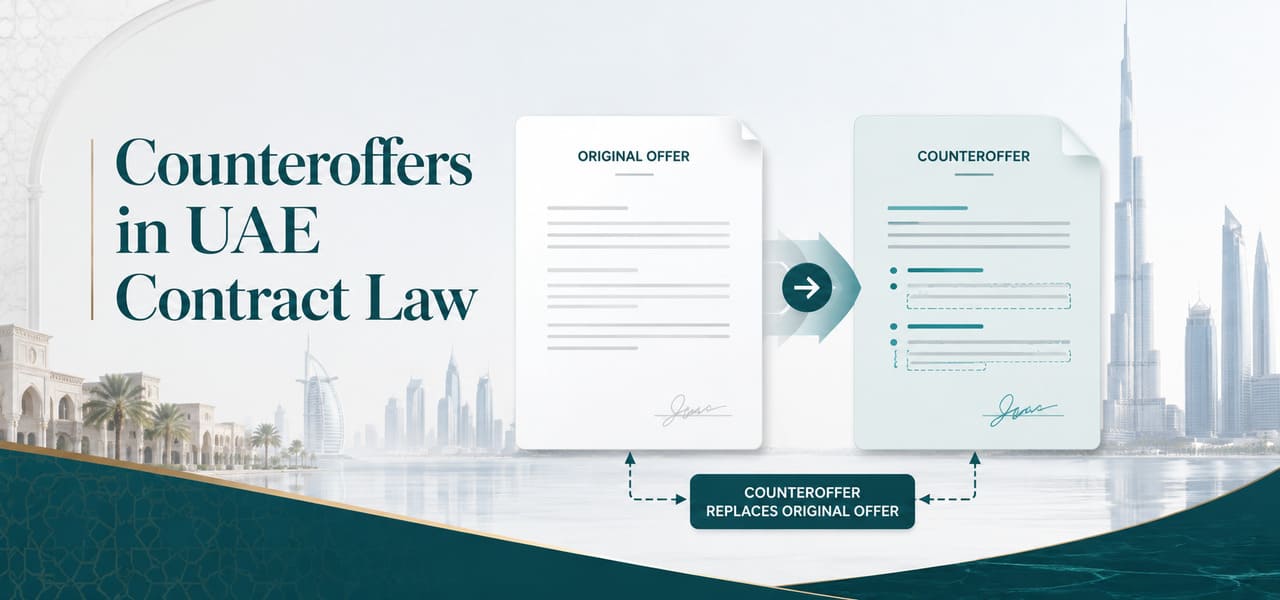

Counteroffers in Contract Law UAE can have an important legal effect because a counteroffer may replace the original offer with revised terms.
Under UAE contract law, it carries a genuine legal consequence many people don’t realize: it doesn’t just add new terms to the table, it actually rejects and terminates the original offer entirely.
So how do counteroffers actually work under UAE contract law?
A counteroffer is treated as a rejection of the original offer, replacing it with a new offer on the amended terms. A contract lawyer in Dubai can advise on who is the best contract lawyer in Dubai, whether is force majeure covered by insurance in the UAE, and how limitation of liability clauses in the UAE may affect contractual risk. The original offer can no longer simply be accepted once a counteroffer has been made, since it no longer legally exists, the counteroffer has taken its place, and the party who made the original offer must now decide whether to accept, reject, or counter the new terms.
This guide covers how this actually plays out in a negotiation, and the common mistake it causes. Our detailed guide on the UAE Civil Transactions Law covers the broader framework contract formation sits within.
How do counteroffers work in UAE contract law?
A counteroffer legally terminates the original offer, replacing it entirely with a new offer on the amended terms, generally reflecting the mirror-image principle that runs through contract formation under the Civil Transactions Law: for a valid acceptance to form a binding contract, it must match the offer’s terms exactly, without material changes. Once a counteroffer is made, the party who made the original offer cannot simply go back and accept the original terms as though the counteroffer never happened, the original offer is gone.
This has a genuinely practical consequence worth understanding in any negotiation: if you propose a counteroffer and the other party doesn’t accept it, you cannot simply fall back on their original offer expecting it’s still available, it may no longer be, unless they’ve specifically kept it open or you’ve clarified this explicitly. Careful, explicit communication during back-and-forth negotiation, confirming in writing what’s actually still on the table at each stage, avoids a genuine dispute later over what terms were actually agreed.
The safest working method is to treat every material revision as a separate version. Record who sent it, when it was sent, which terms changed, how long it remains open, and what response was received.
Article by Ekaterina Butseva
Ekaterina Butseva, Founder Partner at Leaders Advocates, draws a firm line between commercial discussion and legal acceptance. This article carries that distinction through the negotiation record: each revised price, deadline, or obligation is treated as its own version because a counteroffer can change which terms remain legally open even while the conversation appears to be continuing.
Why a Counteroffer Rejects the Original Offer
UAE contract formation generally follows the mirror-image principle, an acceptance must match the offer’s terms exactly to actually form a binding contract. A counteroffer, by proposing different terms, doesn’t meet this standard, so instead of being treated as an acceptance with modifications, it’s treated as a rejection of the original offer paired with a new offer of its own.
The practical issue is not limited to a document titled “Counteroffer.” A negotiation record may contain emails, marked-up drafts, messages, purchase proposals, letters of intent, price revisions, delivery changes, or payment amendments. The record should make it clear which communication is being relied on as the operative offer.
The firm’s explanation of when a contract is legally binding in the UAE provides connected reading on agreement and enforceability.
The Practical Trap This Creates
If you counteroffer during a negotiation and the other side doesn’t accept your new terms, you can’t simply assume their original offer is still sitting there waiting for you to accept it after all. Legally, it may no longer exist, having been rejected the moment you made your counteroffer.
This trap becomes harder to identify when the parties negotiate through several channels. A price may be discussed by telephone, a delivery date changed by email, and a revised draft circulated through a messaging application. Without one written record tying those changes together, each party may believe a different version is still open.
Keep informal discussions separate from the final confirmation. After a call or meeting, send a neutral written summary identifying the terms discussed and asking the other party to confirm whether the summary is accurate.
How to Avoid the Trap
- Communicate explicitly during negotiation about what remains open at each stage.
- Confirm in writing whether an original offer is being kept open despite a counteroffer being discussed.
- Don’t assume silence, or continued discussion, automatically means an earlier offer remains available.
Negotiating a contract and want to make sure the offer-and-counteroffer process is properly documented? A UAE commercial lawyer from our team can review your negotiation and draft clear terms.
Negotiating Contract Terms?
Make Sure You Know Which Offer Is Still Legally Open
A counteroffer can replace an earlier offer and change which terms remain available for acceptance. Our UAE contract lawyers can review the negotiation record, versions, deadlines, and written responses before you commit.
Create an Offer and Counteroffer Record
A short negotiation ledger can prevent a long dispute. For every communication, record:
- The date and time it was sent or received.
- The person and organisation that sent it.
- The document or message title and version number.
- The price, scope, payment, delivery, duration, and other terms that changed.
- Whether the communication says the earlier offer remains open.
- Any expiry time or response deadline written in the document.
- Whether the response accepted, rejected, questioned, or changed the terms.
- The final document said to contain the complete agreement.
Use the actual files rather than rewriting every term from memory. The ledger should point to the original email, attachment, message export, or signed document.
Distinguish a Question From a Changed Term
A negotiation often includes requests for information, comments, and suggested wording. The practical risk arises when the parties do not identify whether a message is asking for clarification or proposing a different term.
Use direct language. If the sender is only requesting an explanation, state that no revised term is being proposed. If the sender intends to change price, quantity, timing, liability, or another term, identify the change and attach a clean revised version.
Do not rely on colored text or tracked changes alone. Add a short list of the amendments so the recipient can see what must be accepted or rejected.
Keep the Commercial Terms Complete
A clear counteroffer should not change one headline figure while leaving the related terms uncertain. A revised price may affect tax wording, payment dates, quantities, delivery obligations, financing, security, or termination rights.
Review the whole commercial package before sending the revision. Check that defined terms, schedules, attachments, and signature blocks match the new proposal. Label superseded drafts so they are not accidentally signed later.
Before You Send Revised Terms
Does Your Counteroffer Clearly Show What Changed?
Price, payment dates, delivery obligations, liability, warranties, and termination rights can all shift in a revised draft. Our legal team can help check the full document, identify material amendments, and make the version history clear.
What to Check Before Saying “Accepted”
- Identify the exact offer or counteroffer being accepted.
- Check its date, version number, sender, recipient, and any expiry wording.
- Compare the response with every material term in that version.
- Confirm that no new price, condition, date, qualification, or exception has been added.
- Attach or refer to the complete document rather than an isolated message.
- Preserve the acceptance and proof of delivery in the negotiation file.
- Move the agreed terms into the final contract and check the signature copy against them.
Documents to Preserve
- Every offer, counteroffer, and revised draft.
- Email chains and complete message exports.
- Meeting notes and written summaries of calls.
- Version histories showing what changed.
- Attachments, schedules, specifications, and price sheets.
- Any wording that keeps an earlier offer open.
- Expiry notices, withdrawals, rejections, and acceptances.
- The final signed agreement and the file sent for signature.
Do not delete the drafts merely because a final document was signed. Earlier communications may be needed to reconstruct how the parties moved from the original offer to the signed terms.
Common Mistakes
- Assuming you can fall back on an original offer after making a counteroffer that wasn’t accepted.
- Not documenting clearly which terms are actually on the table at each stage of negotiation.
- Treating a counteroffer as simply an addition to the original offer, rather than a full replacement of it.
- Using several channels without creating one chronological negotiation record.
- Sending a marked-up draft without identifying the material changes.
- Saying “accepted” without attaching or naming the exact version being accepted.
- Allowing an old draft to remain in circulation after later terms are proposed.
- Treating continued discussion as proof that a previous offer is still available.
Build a Clear Negotiation Record
Counteroffer disputes often begin with a simple record-keeping problem: the parties remember the discussion differently, or each side is looking at a different version of the draft. A clear negotiation record keeps the commercial conversation understandable without changing the legal explanation in this article.
For every offer and counteroffer, record:
- The date and time it was sent.
- The person who sent it and the person authorised to receive it.
- The exact draft, attachment, or schedule that accompanied the message.
- Every term that changed, even if the change appears minor.
- The response deadline, if the sender included one.
- Whether the response was an acceptance, rejection, clarification, or further counteroffer.
Use descriptive file names instead of labels such as “final” or “latest.” A name containing the document title, version number, and date makes it easier to reconstruct the sequence. Keep the email or message that transmitted each version with the document itself. This helps the parties see the context in which a change was proposed.
Review the Whole Counteroffer Before Responding
Do not review only the clause that first attracted attention. A counteroffer may change the price but also adjust a payment date, delivery obligation, warranty, limitation, notice method, or termination right. Read the complete revised document and compare it line by line with the previous offer.
Prepare a short change list before responding. Separate points that are accepted from points that still require discussion, and make sure the written response identifies the correct version. If the parties want the original offer to remain available while they explore alternatives, that intention should be stated clearly rather than assumed.
Before signature, reconcile the final document against the agreed change list. Check all schedules, annexes, definitions, dates, names, amounts, and signature blocks. A well-organised review reduces the risk of signing a document that contains an earlier position or an unapproved amendment.
People Also Ask
Conclusion
So, how do counteroffers work under UAE contract law? They reject and replace the original offer entirely, a genuine trap if you assume otherwise. A UAE commercial lawyer from our team can help document your negotiation clearly.
Treat negotiation as a sequence of identifiable documents. Clear versions, complete records, and explicit language about what remains open reduce uncertainty over which terms were actually offered and accepted.
Before You Say “Accepted”
Make Sure You Are Accepting the Correct Version
One added condition, date, qualification, or exception can change the legal effect of a response. Our lawyers can compare the final offer, counteroffer, attachments, and acceptance wording before the agreement is signed.