


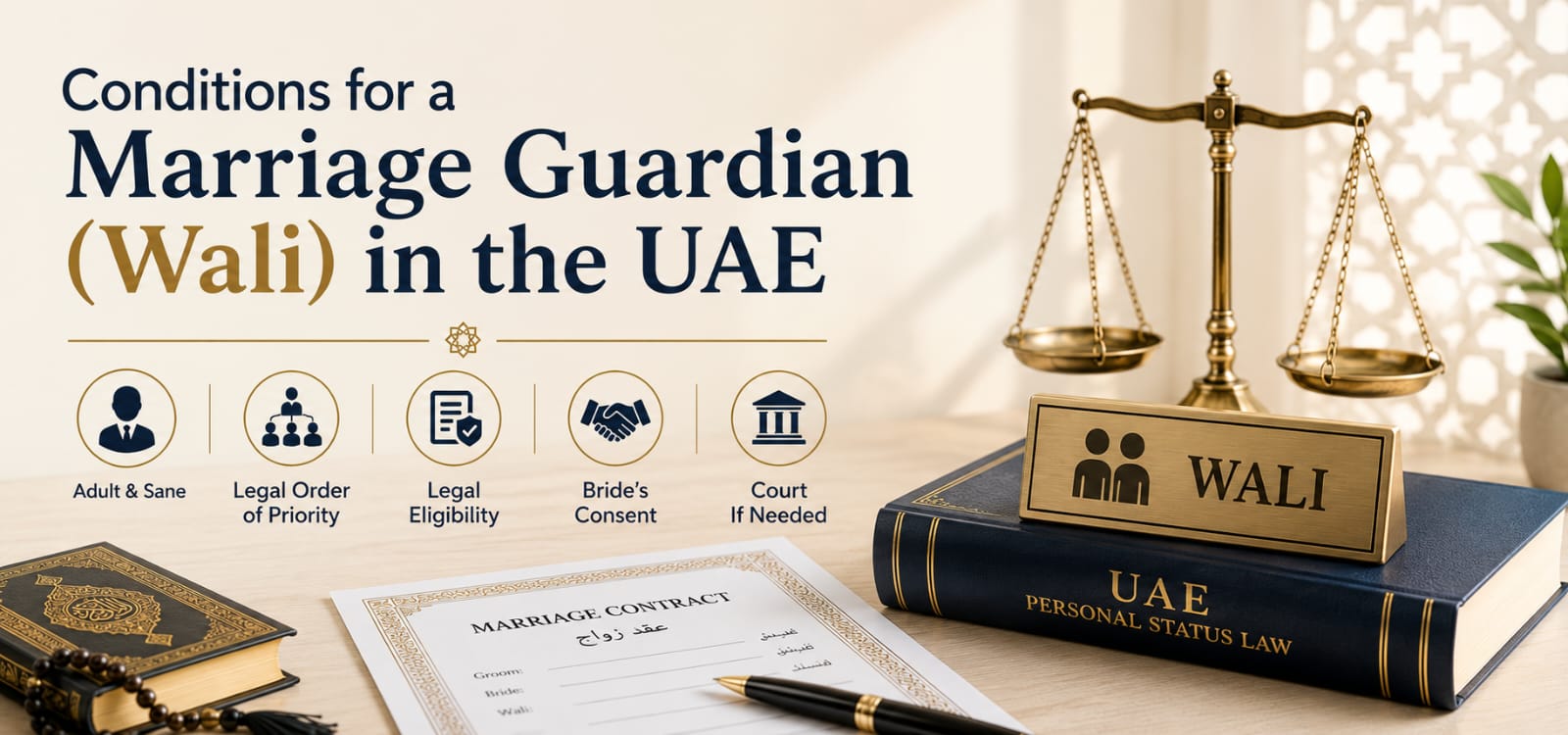

Conditions for a Marriage Guardian in the UAE are now set out in Federal Decree-Law No. 41 of 2024 on Personal Status, which took effect on 15 April 2025. The law does not allow any male relative to take the role merely because he is available. It defines the guardian’s personal eligibility, establishes an order of priority, preserves the woman’s consent, and gives the court power to act when a guardian is unavailable or prevents a suitable marriage without proper justification.
The current rules also contain an important exception for a non-citizen Muslim woman whose national law does not require a guardian. A marriage lawyer in Dubai can help determine how that exception applies, while those seeking representation may also consider who is the best marriage lawyer in Dubai. The analysis should also address questions such as do you need any permission for a second marriage in the UAE and how engagement under UAE personal status law may affect the circumstances. That means the answer cannot be based only on family custom or a generic checklist. Nationality, religion, age, the marriage contract, the identity of the proposed guardian, and the reason for any refusal or absence must all be checked before the marriage application is filed.
Under Article 23 of Federal Decree-Law No. 41 of 2024, a marriage guardian must be sane, adult, and male. Article 21 then determines who has priority, beginning with the father, followed by the person the father designates, the paternal grandfather, the son, the full brother, and specified paternal relatives, with a judge available where the legal route requires court appointment.
The statute does not list Islam as a separate Article 23 condition for the wali, although Article 27 requires Muslim witnesses when the husband is Muslim. A woman’s consent remains essential.
If a guardian, including her father, blocks a marriage to a compatible man she accepts with an appropriate dowry, Article 24 permits the court to conduct the marriage, transfer guardianship, or authorise a suitable person.
Temporary absence does not automatically let a relative bypass the statutory order.
Conditions for a Marriage Guardian (Wali) in the UAE Under Current Law
Article 23 states three personal conditions for a wali: he must be of sound mind, he must have reached legal adulthood, and he must be male. These are the statutory eligibility conditions. The provision does not separately list Islam, and the distinct Muslim-witness rule in Article 27 should not be imported into the guardian rule.
Eligibility is only the first question. A person may be an adult man with full mental capacity and still not be entitled to act because a person with higher priority exists, because no lawful transfer has occurred, or because the documents do not prove the relationship or appointment. The court and marriage officer look at both personal eligibility and legal authority.
The guardian is not the person who chooses the husband on the woman’s behalf. Article 26 makes the wife’s consent a condition of a valid marriage. Article 21 also prevents a guardian from marrying his daughter without her consent and requires that consent to be proved in the marriage contract. The role supports the legal formation of the contract; it does not replace the bride’s decision.
The Marriage Guardian Requirement and Its Expat Exception
Article 18 identifies the pillars of marriage as the offer and acceptance and, where the wife is Muslim, the guardian. However, the same provision creates an exception for a non-citizen Muslim wife if the law of her nationality does not require a guardian for marriage. This is a legal exception, not a general exemption for every expatriate woman.
A foreign Muslim woman relying on the exception should be ready to establish her nationality and the relevant position under her national law in the form accepted by the UAE court or marriage authority. Depending on the file, that may involve a legal opinion, consular material, an official extract, authentication, and Arabic translation. An online summary of foreign law is unlikely to be enough where the exception determines validity.
Because the exception depends on nationality and the accepted proof of foreign law, marriage lawyers in Dubai can review the documents before the marriage application is submitted.
The exception should also be separated from the UAE civil marriage routes available to eligible non-Muslims. A non-Muslim civil marriage is governed by its own legislation and procedure. It should not be described as a waiver granted by a Muslim wali or as an application of the Article 18 exception.
The Legal Order of Guardians Under Article 21
The current order is more detailed than the familiar shorthand of father, grandfather, brother, and uncle. Article 21 begins with the father. It then recognises the person he designates, followed by the paternal grandfather however high, the woman’s son, and her full brother. The statute next allows a selection from a defined group of paternal relatives and descendants, and ultimately a court appointment or the judge where necessary.
- The father has first priority, subject to the woman’s consent and the other validity requirements.
- A person he designates comes next. The appointment and its scope should be proved rather than assumed.
- The paternal grandfather, however high, follows in the statutory sequence.
- The woman’s son may have priority before brothers and more distant paternal relatives.
- A full brother appears before the later selection group specified by Article 21.
- The selection group includes a grandson however low, a paternal half-brother, sons of full or paternal half-brothers however low, and paternal uncles of the degrees stated by the law.
- Where the statutory route cannot operate through a relative, the court can appoint an eligible person or the judge can act as guardian.
This order matters because a marriage application can be delayed if a lower-priority relative appears without proof that the prior guardian died, lacks capacity, cannot attend or be notified, was validly bypassed by a court, or gave the relevant designation or authority. The marriage officer should not have to reconstruct the family tree from verbal statements on the appointment day.
Before the Marriage Application
Not Sure Who Has Legal Priority to Act as Wali?
The correct marriage guardian depends on the statutory order, family relationships, eligibility, and any valid designation or court transfer. Our UAE family lawyers can review the documents before the marriage application is filed.
What Happens When Two Relatives Have the Same Degree?
Article 21 addresses equal-degree guardians. The woman may choose between eligible persons of the same degree. If she does not make a choice, the statute allows any of them to conclude the contract. This prevents a dispute between equally ranked relatives from becoming an indefinite barrier.
The equal-degree rule does not permit someone from a lower rank to ignore an eligible higher-ranking guardian. It also does not eliminate the woman’s consent or the need to prove relationship and identity. If relatives dispute who belongs to the same degree, or challenge another person’s capacity, the issue should be resolved before the marriage appointment.
A Father’s Designation Is Different From a General Power of Attorney
Article 21 expressly places the person designated by the father after the father in the order. That statutory designation should be distinguished from an ordinary representative who signs or attends under a power of attorney. A representative acts within delegated authority, while a marriage guardian acts because the law or a court recognises his guardianship status.
The document must therefore match the intended function. It should identify the parties, the marriage-related authority granted, any conditions, its duration, and whether the father is designating a guardian or merely appointing someone to complete a procedural act. A foreign document may need notarisation, legalisation or apostille treatment where applicable, UAE formalities, and certified Arabic translation.
Absence, Travel, and Inability to Attend
A common mistake is to assume that if the father is travelling, the next relative automatically becomes wali for the ceremony. Article 21 provides a court route where the guardian cannot attend or cannot be notified. On the request of the woman or another interested person, the court may transfer guardianship to the next guardian. The temporary absence itself does not create an informal transfer.
If the guardian can participate through a legally accepted remote method, issue a valid authority, or complete another approved procedure, a transfer may not be necessary. Article 25 recognises that offer and acceptance may occur in the same legally recognised session, including through accepted remote or equivalent means. The court or marriage service should confirm the permitted method for the specific application.
Evidence of unavailability may include travel records, failed service, inability to locate the guardian, medical evidence, detention records, or proof that contact is genuinely impossible. Convenience, family disagreement, or a desire to avoid discussion is not necessarily the same as legal inability to attend or be notified.
Death, Incapacity, and Missing Guardians
Where a higher-ranking guardian has died, a death certificate and documents establishing the next relationship may be required. Where incapacity is alleged, the marriage authority may require a judgment or reliable official evidence rather than a family assertion. If the guardian is missing, service and status evidence may be needed before the court transfers the role.
The file should show a complete chain from the woman to the proposed wali. Birth certificates, family books, civil-status extracts, succession records, and other official evidence may be relevant. Differences in spelling or transliteration across passports and certificates should be addressed through accepted translations or correction documents.
When the Judge Acts as Marriage Guardian
Article 22 states that the judge is the guardian of a person who has no guardian. It also prevents the judge from marrying himself to his ward, which protects against a direct conflict of interest. The judge’s role is a legal safeguard, but it is not an automatic administrative substitution whenever a family member fails to attend.
Court involvement may arise because no guardian exists, because the court has transferred guardianship after inability to attend or notify, or because an eligible guardian unjustifiably prevents the marriage. The application should identify the correct legal basis. A request based on absence requires different evidence from a request based on obstruction.
Unjust Refusal and the Court’s Power Under Article 24
Article 24 deals with obstruction, sometimes described as adhl. If a guardian, including the father, prevents a woman from marrying a compatible man whom she accepts with an appropriate dowry, the court may marry her on her request or on the request of an interested person. It may also transfer guardianship or authorise an appropriate person.
The court will not normally decide such a case from the single statement that the family disagrees. The woman should identify the proposed husband, show her clear approval, address compatibility, explain the dowry, document the guardian’s refusal or conditions, and respond to any welfare or legal concern the guardian raises. The guardian should be served and given an opportunity to present his position.
Not every refusal is necessarily unjust. A valid legal impediment, lack of the woman’s consent, prohibited degree of relationship, identity problem, or another statutory obstacle may defeat the application. Conversely, personal dislike, social pressure, demands unrelated to the woman’s welfare, or repeated delay may support court intervention when the statutory elements are proved.
Where refusal, absence, or disputed priority requires court action, experienced family lawyers in Dubai can identify the correct personal status procedure and the evidence needed for the application.
The Woman’s Consent Cannot Be Replaced
The guardian’s signature does not cure a marriage concluded without the wife’s consent. Article 26 lists consent among the validity conditions, while Article 21 requires proof of the daughter’s consent when her guardian concludes her marriage. The file should record consent clearly and in the form required by the marriage authority.
Pressure can be direct or indirect. A woman who says she does not consent should not be treated as agreeing merely because relatives approved the match, a wedding was arranged, gifts were exchanged, or a dowry was discussed. If capacity or coercion is disputed, the court may need evidence beyond a standard application form.
Age, Court Permission, and a Large Age Difference
Under Article 19, marriage capacity is generally reached at 18 Gregorian years. A person below 18 needs court permission under the statutory process. If the guardian refuses the underage request, the law provides for court review rather than allowing another relative to bypass him informally.
The current law also requires court permission where a man is more than 30 years older than a virgin bride. That is an additional approval issue, not a change to the ordinary order of guardians. The court considers the circumstances and welfare of the proposed marriage before permission is granted.
Offer, Acceptance, and Witnesses Are Separate Requirements
Article 25 requires compatible offer and acceptance in the same legally recognised session. The expressions must show a present, unconditional marriage and must not make the union temporary. A future date, an unresolved condition, or wording that creates a time-limited marriage can affect validity.
Article 26 also requires identification of the spouses, absence of a legal prohibition, the wife’s consent, the guardian’s offer where required for a Muslim wife, and two witnesses. Article 27 says the witnesses must be sane adult men who hear and understand the contract. When the husband is Muslim, the witnesses must be Muslim. These witness conditions should not be restated as though they were all Article 23 wali conditions.
Guardian Cannot Attend?
Do Not Assume the Next Relative Can Automatically Act
Travel, absence, incapacity, or inability to contact a guardian may require a valid authority or formal court process. Our marriage lawyers can review the available route and the evidence needed to avoid delays.
Documents Commonly Needed
The official checklist and the facts of the case control. A straightforward application and a contested guardianship case will not require identical evidence. Foreign certificates commonly need authentication and certified Arabic translation, and the authority may ask for originals or digitally verifiable records.
- Passports, Emirates IDs, residence evidence, and current contact details for the spouses and proposed guardian.
- Birth certificates, family records, or other documents proving the relationship and statutory rank of the wali.
- A death certificate, incapacity order, missing-person evidence, or service record where a prior guardian cannot act.
- The father’s designation or a carefully drafted power of attorney where either is relied upon.
- Evidence of the foreign national law if a non-citizen Muslim woman invokes the Article 18 exception.
- Premarital medical documents and civil-status evidence required by the marriage service.
- Dowry terms, the proposed husband’s identification, and information relevant to compatibility if refusal is disputed.
- Certified Arabic translations and the required authentication for foreign documents.
A Practical Court Process for Guardian Disputes
- Identify whether the issue is no guardian, inability to attend or notify, incapacity, disputed priority, or unjust refusal.
- Map the statutory order under Article 21 and collect proof of every relevant relationship or designation.
- Confirm the woman’s consent, the proposed marriage, the dowry, and any compatibility evidence.
- Prepare authenticated and translated civil-status, identity, foreign-law, and authority documents.
- File the correct request before the competent personal status court or through the approved marriage service.
- Complete service on the guardian and respond to requests for additional evidence or attendance.
- Obtain the court order transferring guardianship, authorising a person, or allowing the judge to conclude the marriage.
- Complete and document the marriage through the official channel within the period and form required by law.
Common Errors That Delay a Wali Application
- Using the old simplified hierarchy and overlooking the father’s designee, the woman’s son, or the Article 21 selection group.
- Calling Islam an express Article 23 condition when the current provision lists sanity, adulthood, and male sex.
- Confusing the Muslim-witness requirement in Article 27 with the guardian’s personal conditions.
- Assuming travel automatically transfers the role without a court order or approved authority.
- Submitting a general power of attorney that does not cover the required marriage act.
- Failing to prove the wife’s consent or treating family approval as a substitute.
- Relying on foreign-law summaries without authentication, translation, or a form accepted by the UAE authority.
- Filing an obstruction claim without evidence of the proposed spouse, compatibility, dowry, and refusal.
Final Checklist Before the Marriage Appointment
- Confirm which marriage law and procedure apply to both spouses.
- Decide whether a guardian is legally required and whether the non-citizen exception is relevant.
- Identify the correct guardian under the complete Article 21 order.
- Verify sanity, adulthood, male sex, identity, and relationship documents.
- Resolve absence, designation, incapacity, or refusal through the correct court route.
- Record the woman’s free and informed consent.
- Prepare the dowry terms, witnesses, medical documents, translations, and authentication.
- Check the marriage service instructions and keep the documented marriage record.
The safest approach is to establish authority before booking the final marriage appointment. If the family structure, foreign nationality law, absence, or refusal makes the position unclear, contact Leaders Advocates for an assessment based on the current statute and the actual documents.
A marriage lawyer in Dubai can also check whether the matter requires a wali, a court transfer of guardianship, or reliance on the expatriate exception.
Frequently Asked Questions
Marriage Being Blocked?
Is a Guardian Refusing a Marriage You Freely Accept?
Where refusal becomes a legal obstruction issue, the court may need to examine consent, compatibility, dowry, the guardian’s reasons, and the supporting evidence. Our UAE family lawyers can assess whether court intervention or transfer of guardianship may be appropriate.


1 Comment