


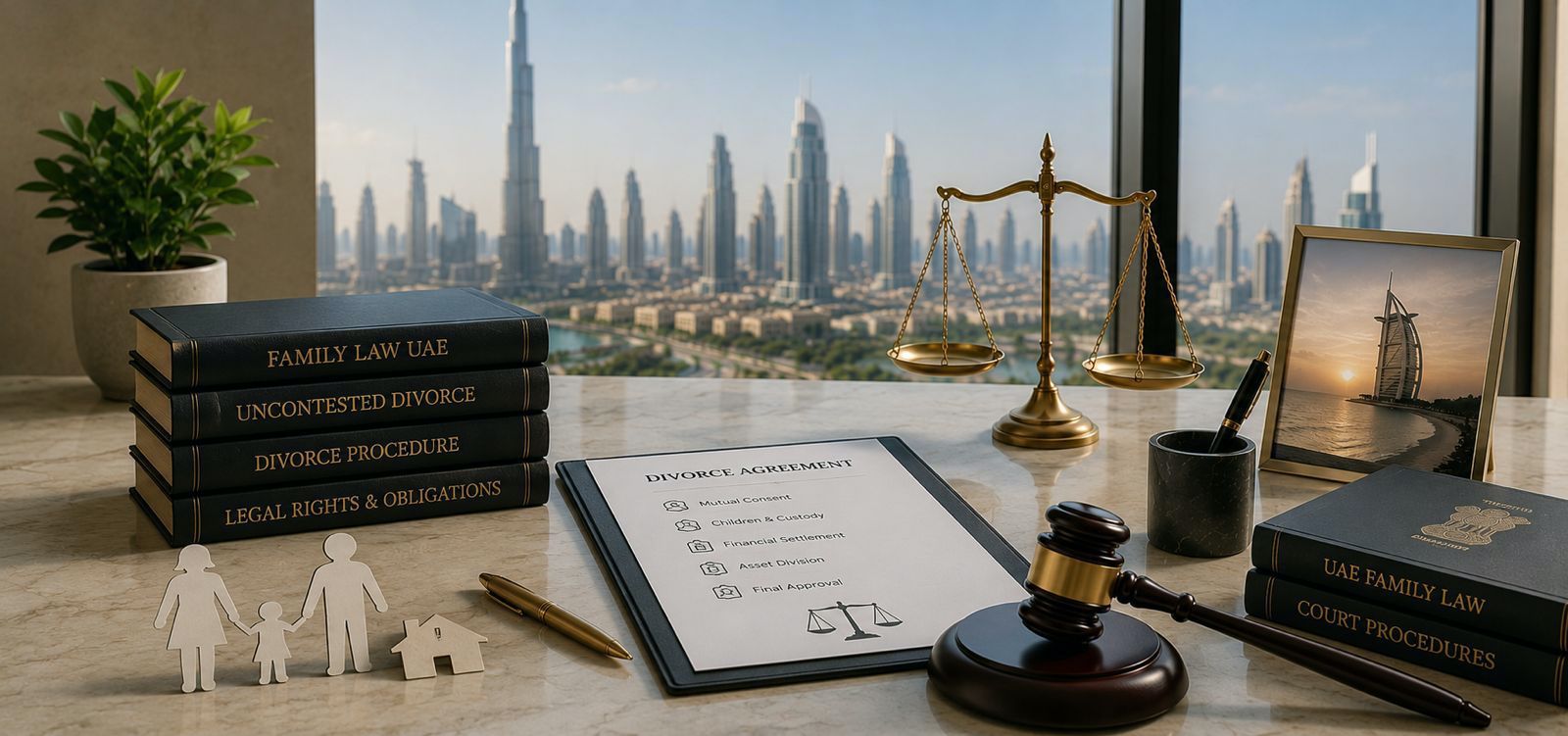

A couple may agree to divorce and assume that nothing can go wrong. Problems often appear later when custody, maintenance, overseas property, or a foreign marriage certificate was not handled in an enforceable way.
An agreement makes the process easier, but it does not remove the need for a court order or accurate settlement terms.
Quick Answer
A lawyer is not legally required for an uncontested divorce in Dubai. Couples may represent themselves, although the divorce must still be completed through the UAE court system. Self-representation may suit a simple case with complete documents, no children, no property, and full agreement. Legal review becomes more important where the case involves custody, maintenance, foreign documents, overseas assets, a choice of law, or any risk that the agreement may later be disputed.
Confirm the legal track, collect the required documents, and write every agreed term clearly before filing. Do not rely on a verbal understanding about children, money, or assets. Divorce lawyers in Dubai can review the settlement without turning an agreed case into a dispute and can confirm that the final order will be usable later.
Which Law Applies to You
Our guide on judicial separation vs divorce in the UAE explains this further.
Before anything else, confirm which legal track governs your divorce, since the process differs meaningfully between them.
• Muslim couples: Federal Decree-Law No. 41 of 2024 on Personal Status. Mandatory conciliation before the Family Guidance Committee, with a reconciliation period recently shortened from 90 to 60 days, before referral to court if unresolved.
• Non-Muslim couples: Federal Decree-Law No. 41 of 2022 on Civil Personal Status. Filed directly with the Civil Family Court, generally without referral to a Family Guidance Committee. No fault or harm needs to be proven, and a decision is often issued at the first hearing.
• Non-Muslims in Abu Dhabi specifically: Can still use Abu Dhabi Law No. 14 of 2021, the original Non-Muslim Family Court framework, now optional alongside the federal 2022 civil track.
• Expatriates generally: May request that their home country’s personal status law apply instead, provided certified translations of the relevant foreign provisions are submitted.
The non-Muslim civil track under the 2022 law is generally the fastest and most streamlined uncontested route currently available in the UAE.
Want to Keep Your Divorce Uncontested?
If you and your spouse agree on the divorce, a legal review can help make sure your settlement terms are clear, complete, and ready for court approval.
Can You Represent Yourself?
You can read more about this in our guide on relocating a child after divorce in the UAE.
Yes, and this is built into how the process works, not just a technical possibility.
Private divorces conducted entirely outside the court system are not permitted in the UAE. Court involvement is always required. Within that requirement, though, parties are free to attend without a lawyer, and Family Guidance Committee conciliation sessions are typically attended by the couple directly, without legal representation at that early stage.
Where both sides agree on the terms, a settlement can be drafted and signed before the conciliator, and under the 2022 civil law specifically, a properly notarized agreement can sometimes be approved by a registrar without a conventional hearing at all.
Removing lawyers from the earliest conversations is meant to level the dynamic between spouses and encourage a faster, calmer agreement on straightforward issues like asset division or a visitation schedule.
The Uncontested Divorce Process
If you’re comparing your options, our guide on who is the best female divorce lawyer in dubai is a useful starting point.
The exact sequence depends on which track applies, but the general shape is similar.
Divorce lawyers in Dubai can provide a limited review of the documents and settlement terms, even where both spouses intend to complete the remaining process themselves.
• Gather your documents. Marriage certificate, attested and translated if issued abroad, Emirates IDs, passports, proof of residency, and any relevant financial or custody documents.
• File your application. Muslim couples file with the Family Guidance Committee. Non-Muslim couples generally file directly with the Civil Family Court under the 2022 law.
• Attend conciliation, where required. For Muslim couples, this stage is mandatory. Genuinely mutual-consent cases often resolve quickly here.
• Submit or finalize your settlement terms. Covering custody, maintenance, and any asset division, drafted clearly enough to be enforced later if needed.
• The court reviews and approves the agreement. For eligible non-Muslim cases, this can happen at the first hearing.
• The divorce is registered and a certificate issued.
Not Sure If You Need a Divorce Lawyer?
Children, overseas assets, foreign documents, or a choice of law can make an otherwise simple divorce more complicated. Get professional guidance before filing to avoid costly problems later.
When a Lawyer Matters
The legal system does not require a lawyer for any of the above. Certain situations still make one worth the cost, because the risk of getting it wrong is higher than the fee.
• Foreign-issued documents. A marriage certificate, or a foreign court order, generally needs certified translation and sometimes attestation before a UAE court will accept it.
• Choosing between UAE and home-country law. As an expatriate, you may be entitled to have your home country’s personal status law applied instead. Working out whether that produces a better outcome for your specific situation is a technical question.
• Custody and maintenance terms that need to hold up. A verbally agreed arrangement is not the same as a properly drafted order a court, and if necessary, an enforcement process, will recognize later.
• Assets outside the UAE, or a marriage originally registered in another country, which can raise cross-border recognition questions a straightforward local filing does not anticipate.
• Anything that might not stay uncontested. If there is any realistic chance your spouse’s position shifts once the process starts, entering with your own settlement terms already properly drafted protects you either way.
If your split has no children, no property, and a full agreement on every term, self-representation is a reasonable option. Add any one of the factors above, and a lawyer’s review becomes cheap insurance against a much costlier problem later.
Uncontested vs. Contested Divorce
The difference between the two paths is substantial, and it is the single biggest reason couples try to keep a divorce uncontested wherever possible.
• Typical timeline: 4 to 6 weeks from filing to decree, assuming complete documents. 6 to 12 months or more to a first-instance judgment, plus further time for any appeal
• Court involvement: Often a single hearing, sometimes registrar approval only under the 2022 civil law. Multiple hearings, evidence submission, and judicial fact-finding
• Typical cost driver: Filing fees and any document translation or notarization. Legal fees scale significantly with hearings, evidence, and case complexity.
Common Mistakes Couples Make Without a Lawyer
Self-representation works well for simple cases. A handful of recurring errors show up when it is attempted in situations that were not simple.
• Agreeing to custody or maintenance terms verbally or informally, without a properly drafted, court-recognized order.
• Submitting foreign documents without the certified translation a UAE court requires, causing delays.
• Not considering whether home-country law might apply and simply defaulting to UAE law without checking.
• Assuming an agreement is final and binding before it has been reviewed and approved by the court.
• Overlooking assets or property held outside the UAE when finalizing the settlement.
• Treating the process as adversarial by default, when the system is specifically designed to let agreed cases move quickly without conflict.
Frequently Asked Questions
An uncontested divorce can be handled without a lawyer when the case is genuinely simple and every term is documented. The risk rises as soon as children, property, foreign law, or enforcement is involved.
The objective is not to add conflict. It is to ensure that the agreement being approved by the court is complete, clear, and enforceable.
Ready to Move Forward With Your Divorce?
An uncontested divorce can be straightforward when the documents and settlement terms are handled correctly. Get advice on the right legal track, required documents, and terms that need to be protected before
you file.


2 Comments