


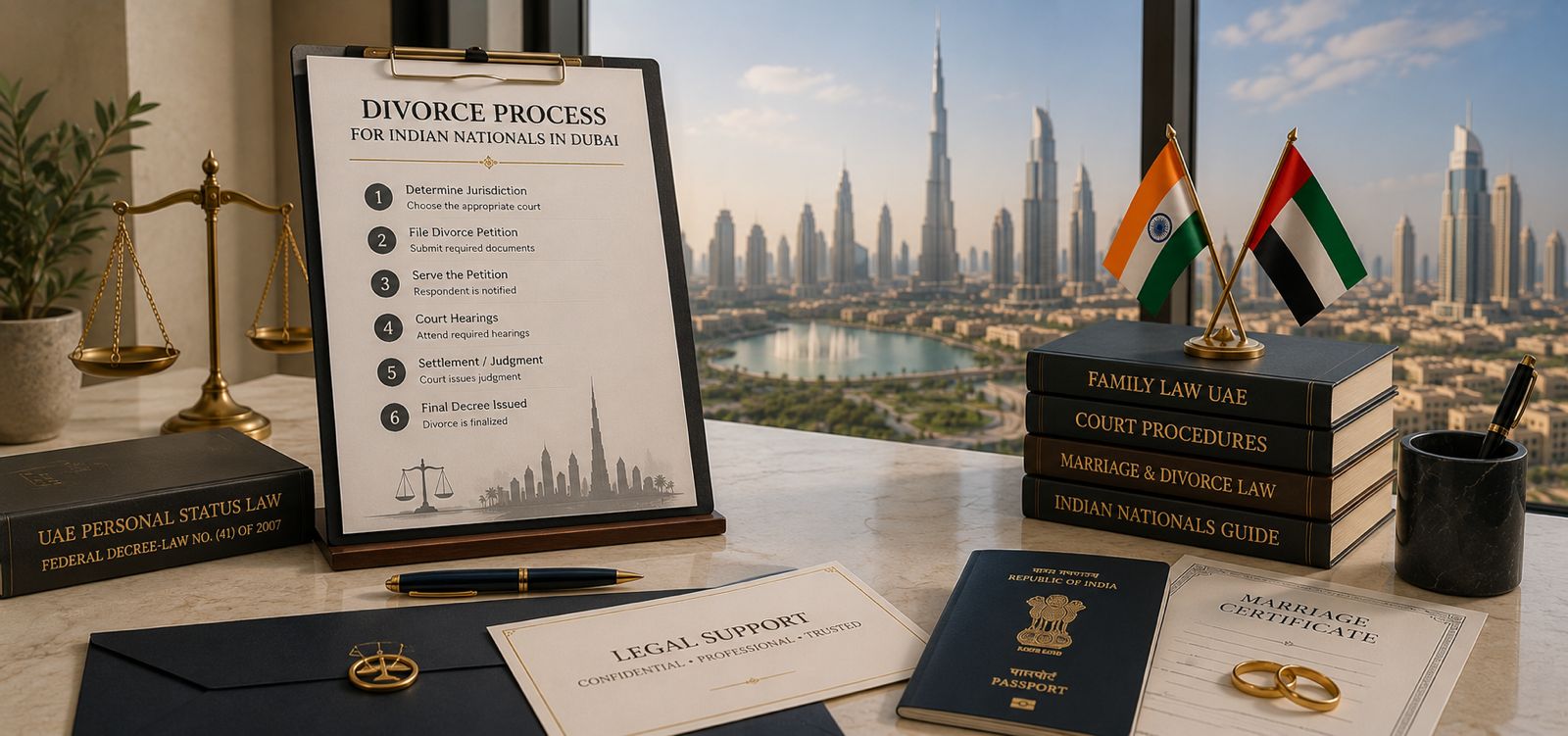

An Indian couple can obtain a divorce in Dubai and still face a serious problem later: the decree may be challenged when it is used in India. That risk can affect remarriage, custody, inheritance, and property rights.
The filing route must therefore address two questions from the start: which law governs the marriage and whether the final UAE decree will be recognized in India.
Quick Answer
An Indian national may file for divorce in Dubai through the relevant UAE family court process. The applicable personal law can depend on religion and how the marriage was solemnized, including the Hindu Marriage Act, Indian Divorce Act, Special Marriage Act, Foreign Marriage Act, or Sharia principles. The relevant foreign law may need certified and legalized translation. A UAE decree is not automatically recognized in India, so mutual participation, correct legal grounds, attestation, and possible recognition proceedings in India should be planned before the case begins.
Identify the law governing the marriage, choose between a UAE filing and a direct Indian filing, and prepare the marriage certificate, identity documents, translations, and proposed settlement. Avoid an ex parte route where mutual participation is possible. A family lawyer in Dubai with cross-border experience can structure the UAE case to reduce the risk of later challenge in India.
Step 1: Identify the Applicable Indian Law
Our related guide on who is the best female divorce lawyer in dubai can help you make that decision.
This is the real starting point, and it depends on religion and how the marriage was solemnized, not simply on holding an Indian passport.
• Hindu, Jain, Buddhist, or Sikh: The Hindu Marriage Act, 1955
• Christian, Parsi, or Jewish: The Indian Divorce Act, 1869
• Interfaith couples, or a marriage registered without religious ceremony: The Special Marriage Act, 1954
• Married at an Indian embassy or consulate abroad: The Foreign Marriage Act, 1969
• Muslim: Sharia principles, applied directly, since these are broadly uniform across jurisdictions
For non-Muslim couples, the relevant Indian law’s provisions need to be submitted to the UAE court as a certified, legalized translation authenticated by a recognized translator and the Ministry of Justice, not simply summarized.
Worried Your Dubai Divorce May Not Be Recognized in India?
A UAE divorce decree is not automatically accepted in India. Get your marriage, applicable Indian law, jurisdiction, and recognition risks reviewed before you file.
Step 2: File Through the UAE Court Process
This connects closely with our guide on sharia law divorce in the UAE.
Once you know which law applies, the UAE process itself follows a fairly standard sequence.
• File with the Family Guidance Section of the Dubai Personal Status Court. Either spouse can initiate this.
• Attend mandatory reconciliation. Both parties are summoned to a session with a family counsellor. This stage is not optional.
• If reconciliation fails, the case is referred to the Personal Status Court itself.
• Submit your claim, including the certified translation of your applicable Indian personal law where relevant, and present your evidence at the scheduled hearings.
• The court issues its judgment, applying either Sharia principles or the submitted personal law, as applicable to your case.
For custody and financial matters not otherwise agreed between the parties, UAE law generally applies by default, unless the couple specifically requests and establishes that a different law should govern those specific issues.
Step 3: Choose Mutual Consent or a Contested Case
Our related guide on spousal maintenance after divorce in the UAE goes into this further.
This choice affects both how quickly the UAE process moves and, more importantly, how safely the result will travel back to India.
Where both spouses agree on the divorce and its terms, the case can move quickly, in some reported instances within about a month once the parties are ready to proceed. Both parties being present, or properly represented and accepting the UAE court’s jurisdiction, is what makes this route strong.
A contested case where one spouse does not appear and has not accepted the UAE court’s jurisdiction results in a default judgment. That judgment is valid and enforceable within the UAE. It is also considerably more exposed to challenge once it reaches India.
Will India Recognize the Dubai Divorce?
If you need professional guidance, divorce lawyers in dubai can help you understand your options.
This is the part of the process most worth getting professional advice on before you proceed, not after.
A family lawyer in Dubai can coordinate the UAE pleadings, the Indian-law evidence, and the post-judgment attestation steps so the two legal systems are considered together.
India is not treated as a reciprocating territory with the UAE for the purposes of automatic judgment enforcement under Indian civil procedure. That means a UAE divorce decree is not simply stamped and accepted by an Indian court. It is assessed.
The governing principle traces back to the Indian Supreme Court’s ruling in Y. Narasimha Rao, which held that a foreign matrimonial decree may not be recognized in India where the jurisdiction the foreign court relied on, or the grounds it applied, do not conform to the couple’s applicable Indian matrimonial law.
In a reported case, the Bombay High Court found that a Dubai court’s judgment involving two Indian, Hindu nationals governed by the Hindu Marriage Act was not binding or enforceable in India, precisely because it had not been reached in a manner consistent with that Act’s requirements.
It has real, documented consequences, including for people who remarried in reliance on a foreign divorce decree that their former spouse later successfully challenged as invalid in India.
Genuine mutual consent cases, properly conducted with both parties actively involved, fare considerably better under this test than default or ex-prate judgments. But “mutual consent divorce from the UAE is valid in India” is a generalization, not a guarantee that applies automatically to every case.
Protecting Yourself After the UAE Judgment
A few concrete steps meaningfully reduce the recognition risk described above.
• Get the UAE judgment attested by the UAE Ministry of Justice and the Ministry of Foreign Affairs.
• Have it legalized at the Indian Consulate in Dubai afterward.
• Ensure the case record clearly shows genuine mutual consent, with both parties’ active participation properly documented, not just a default judgment on paper.
• Where the stakes are significant, particularly before remarrying, consider filing a declaratory suit in an Indian family court specifically to have the foreign decree formally recognized, rather than assuming attestation alone is sufficient.
• After a mutual consent decree, send notice and the divorce certificate to the relevant Marriage Officer in India, which supports using the decree for property division and remarriage purposes there.
Planning to File for Divorce in Dubai?
Before filing, make sure the correct Indian law applies to your marriage and that your UAE divorce can be properly documented for recognition in India. A family lawyer in Dubai can review your situation and help you.
Choose the safer route before you begin.
Common Mistakes to Avoid
A handful of recurring errors show up specifically in Indian nationals’ UAE divorce cases.
• Assuming any UAE divorce decree is automatically valid in India, regardless of how it was obtained.
• Proceeding with a default or ex-prate judgment when the other spouse could realistically be reached and involved instead.
• Skipping the UAE Ministry of Justice, Ministry of Foreign Affairs, and Indian Consulate attestation chain after judgment.
• Remarrying based on a UAE decree without first securing proper recognition in India, given the real, documented risk of a later successful challenge.
• Submitting an informal summary of Indian law instead of a properly certified, legalized translation.
• Not considering that filing directly in India, even from abroad using a power of attorney, might be the safer route for a specific situation.
Frequently Asked Questions
A Dubai divorce may be valid in the UAE without being automatically accepted for every purpose in India. Recognition risk should be managed before filing, not after remarriage or a property dispute.
The safest route is the one that matches the law governing the marriage, records both parties’ participation, and completes the required attestation or recognition steps.
Don’t File a Dubai Divorce Without Checking the India Recognition Risk
Our family lawyers in Dubai can review your marriage, applicable Indian personal law, proposed divorce route, and post-judgment recognition requirements before you take the next step.


3 Comments
Mahendra Singh
Already divorced in Sharjah, can I submit the declaration suit in India as both party involved in case. I’m
Leaders Advocates
Thank you for contacting us. We would be pleased to assist you with your matter.
To properly advise you and assess the appropriate legal procedure, please contact us via WhatsApp or email and share the relevant documents relating to your case. We would also appreciate some additional details regarding your circumstances so that our legal team can review your situation accurately.
We look forward to hearing from you and assisting you further.