


Quick Answer
When a developer fails to complete a property in Dubai, legal action depends on the project’s official status. A delayed active project, an unfinished project, and a project cancelled by RERA do not follow the same route.
Review the sale and purchase agreement, Oqood registration, escrow payment records, completion reports, and all developer notices. Then confirm whether the dispute belongs before the Special Tribunal under Decree No. 33 of 2020, Dubai Courts, or arbitration.
Possible remedies include completion, compensation, termination, a refund, or recognition of the buyer’s rights in a liquidation. Do not stop installments or file in a forum until the contract and regulatory status have been checked.
About the Legal Contributor
Faris Raian is a Founder Partner at Leaders Advocates.
His work includes UAE real estate disputes, contract claims, and enforcement strategy.
In an unfinished-project matter, he starts with the project’s official status, the sale and purchase agreement, the buyer’s payment record, and the forum that has jurisdiction.
That sequence helps the buyer pursue a remedy that the correct authority can actually grant.
A buyer may see an inactive construction site, missed milestones, and no reliable completion date. From the outside, a delayed project and an abandoned project can look the same.
Dubai law treats them differently. The project’s regulatory status affects the forum, the available remedy, and the documents the buyer must prepare.
Start with official project information. Then compare it with the sale and purchase agreement, payment schedule, escrow records, and the buyer’s current obligations.
Do not begin with a demand for a refund alone. First identify which authority can decide the dispute and whether the buyer wants completion, compensation, termination, or participation in a liquidation.
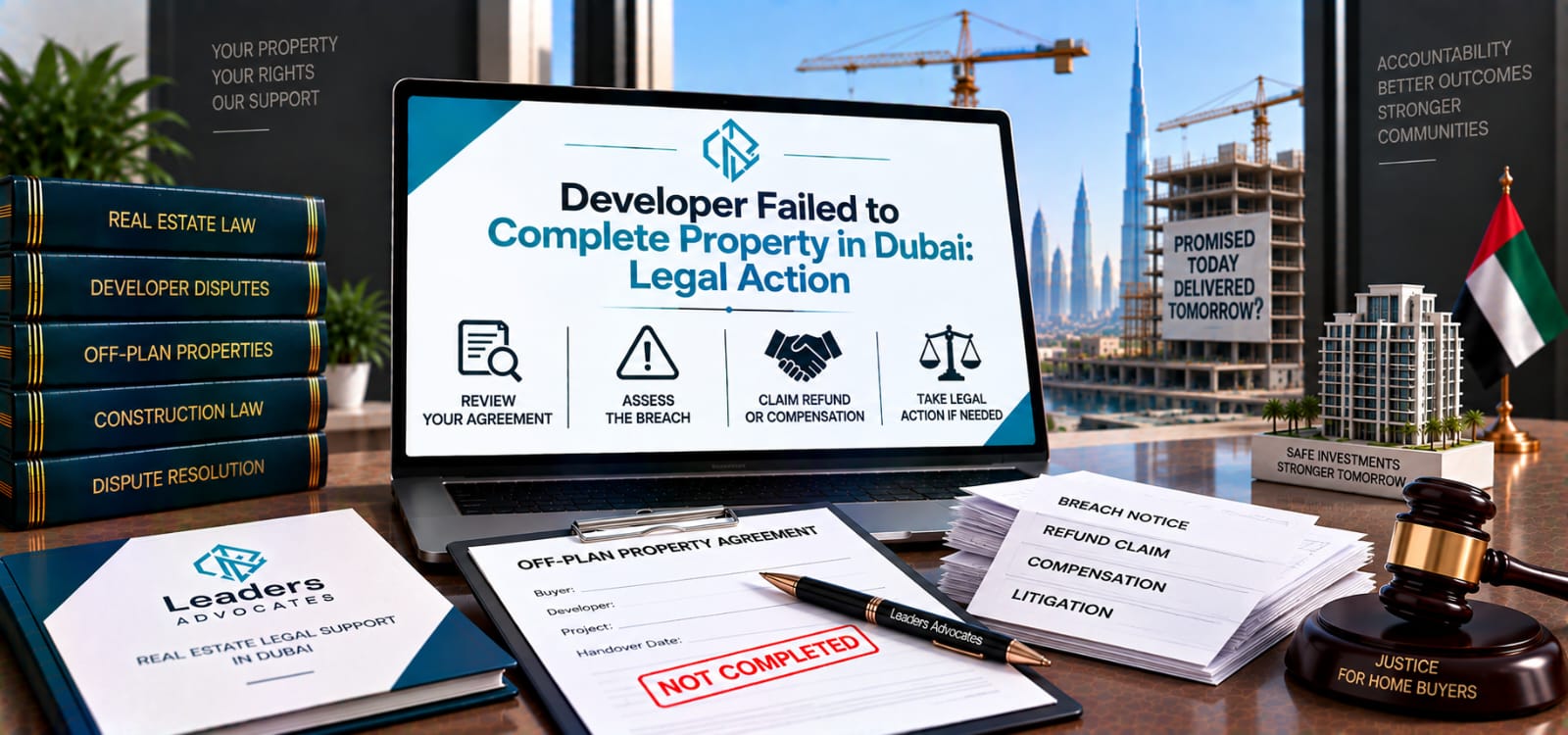
Developer Failed to Complete Property Dubai Legal Action
The phrase covers several legal situations. The developer may be late but still building. Work may have stopped. RERA may have cancelled the project, or a special committee may be handling it.
Each situation needs a separate case map. Filing in the wrong forum can lead to dismissal, delay, and duplicated cost.
Confirm the Project’s Official Status
Check the project through official Dubai Land Department channels. Compare the registered information with the developer’s messages and the condition of the site.
The project may fall into one of these broad categories:
- Active but delayed, with construction continuing.
- Stalled or unfinished, with work suspended.
- Cancelled by a reasoned RERA decision.
- Referred to a committee or tribunal process.
Do not rely only on an agent, marketing brochure, or social media group. Ask for the official project status and reported completion percentage.
Review the Sale and Purchase Agreement
The SPA is the starting point for an active-project dispute. Read the completion date, grace period, extension language, force majeure clause, notice method, payment schedule, termination clause, and dispute-resolution clause.
Some contracts use an anticipated date. Others state a fixed date plus an extension period. The legal position cannot be assessed from the headline handover date alone.
Check every addendum. A later payment plan, revised completion letter, or handover document may change the original terms or include a waiver.
Check Oqood and Escrow Records
Keep the Oqood registration and proof of each payment. Payments made for an off-plan project should be traced to the correct project escrow account.
Law No. 8 of 2007 governs project escrow accounts in Dubai. Escrow records matter when the buyer seeks a refund or needs to show compliance with the payment schedule.
If money was paid to another account, record who requested it and why. Do not assume the payment is protected without checking the actual transfer details.
Not Sure If Your Payments Are Protected?
Send us your SPA and escrow records on WhatsApp and we’ll tell you exactly where your project stands.
Identify the Correct Forum
An unfinished or cancelled project may fall within the Special Tribunal for Unfinished and Cancelled Real Property Projects under Decree No. 33 of 2020. Where the Tribunal has jurisdiction, other Dubai courts, including the DIFC Courts, cannot hear the dispute.
The Tribunal’s decisions are final and are executed through Dubai Courts. Claims before it are exempt from judicial fees under the governing framework.
An active project with a contractual delay may proceed through Dubai Courts, subject to any required preliminary step. A valid arbitration clause may lead to arbitration if it is properly relied on.
The Special Tribunal Route
The Tribunal route is not simply another court option. Its jurisdiction can be exclusive.
The buyer should confirm whether the project has entered that framework before filing elsewhere. A compensation claim filed in the wrong venue may need to be started again.
Prepare the SPA, payment records, Oqood certificate, official project status, notices, and the remedy requested. The claim should also explain how the buyer’s rights fit the project’s current process.
What Happens After RERA Cancels a Project
Law No. 13 of 2008, as amended by Law No. 19 of 2017, requires the developer to refund purchaser payments when RERA cancels the project by a reasoned decision. The refund process operates with the escrow framework.
A legal right to a refund does not mean payment arrives immediately. The project accounts, available funds, liquidation process, and purchaser claims can affect the practical result.
Keep the buyer’s contact details current. Missing a request for documents or a claims deadline can weaken an otherwise valid position.
Project Cancelled by RERA?
Find out fast whether you qualify for a refund and how to protect your place in the claims process.
Choose the Remedy Before Drafting the Claim
A buyer should decide what a successful result would look like. The available choices may include:
- Termination and recovery of amounts paid.
- Completion of the unit with compensation for proven delay.
- Compensation for a material contractual breach.
- Recognition of the buyer’s rights in a liquidation.
- A negotiated transfer, replacement unit, or revised completion plan.
These remedies are not interchangeable. Some may be inconsistent, and each requires its own legal basis and evidence.
Compensation Needs Proof
Compensation is not automatic because the project is late or unfinished. The buyer normally needs to establish breach, responsibility, and loss.
Evidence may include rent paid for alternative accommodation, finance costs, lost rental income supported by reliable records, or another direct loss. General frustration or an unsupported estimate is rarely enough.
Federal Decree-Law No. 25 of 2025 has governed since June 1, 2026. The earlier Civil Transactions Law may remain relevant to older agreements under transitional rules.
Be Careful Before Stopping Installments
Stopping payment can create a second dispute. On an active project, the developer may use the Article 11 procedure under Law No. 13 of 2008 if the buyer defaults.
That process can involve notice through the Dubai Land Department and consequences linked to the project’s completion stage. Obtain advice before withholding an installment, even when the developer is late.
If the buyer has already stopped paying, prepare the reasons, notices, and payment history immediately. Do not hide the default from counsel.
Force Majeure Must Be Tested
A developer may rely on force majeure or another extension clause. The clause must be read with the actual event, its timing, its effect on construction, and any notice requirement.
A general reference to market conditions does not answer every delay. Ask what event occurred, when it began, how long it affected the work, and which records support the extension.
The buyer should also check whether the developer contributed to the delay. Contract wording and the full project timeline both matter.
Faris Raian‘s View on Stalled Projects
Faris Raian has explained that buyers sometimes file a compensation case while the project is moving toward the Special Tribunal. They can then lose time because the first forum cannot decide the matter.
His practical point is to confirm status before framing the claim. The forum, remedy, and evidence should be aligned from the beginning.
Build a Complete Evidence File
Prepare one indexed file containing:
- The SPA and every addendum.
- Oqood registration and unit details.
- Bank records and project escrow payment proof.
- Developer notices and revised completion dates.
- Official project status and progress records.
- Photographs and lawful site updates.
- Rent, finance, and other loss evidence.
- Arbitration, jurisdiction, and notice clauses.
- A dated chronology of the project and communications.
Keep the original documents. Use working copies for comments and calculations.
Need Help Building Your Evidence File?
Message us on WhatsApp and we’ll tell you exactly which documents matter most for your remedy.
Negotiation Before Filing
Negotiation may produce a practical result when the project can still be completed. The buyer may consider a fixed revised date, a replacement unit, a payment adjustment, or documented compensation.
Any settlement should identify the unit, amount, deadlines, security, default consequences, and the effect on existing claims. Do not sign a broad waiver in exchange for an uncertain promise.
If several buyers are affected, their objectives may differ. A group strategy should not replace individual review of each contract and payment record.
Filing and Enforcement Planning
Before filing, confirm jurisdiction, service details, Arabic translation needs, filing costs, and the evidence for each requested remedy. An overseas buyer may also need a suitable power of attorney.
Plan what happens after a favorable decision. A judgment or Tribunal decision may still require execution against available funds or assets.
Set a staged budget. Document review, filing, expert work, appeal where available, and execution are separate cost points.
Related Success Story
Leaders Advocates publishes a construction contract dispute involving successful client recovery in Dubai. The Leaders Advocates Success Stories page contains the available case summary.
That case involved different parties and documents. It does not guarantee a result, but it shows why contract evidence, the correct forum, and a clear recovery strategy matter.
Common Mistakes
- Filing before checking the project’s official status.
- Choosing a court without reviewing Tribunal jurisdiction.
- Ignoring an arbitration clause.
- Stopping installments without legal grounds.
- Relying on marketing dates instead of the SPA.
- Demanding compensation without loss evidence.
- Signing a revised agreement that waives earlier claims.
- Waiting too long to organize notices and payment records.
Final Takeaway
When a developer fails to complete a property in Dubai, legal action should begin with status, jurisdiction, and the buyer’s intended remedy. The contract and regulatory record must be reviewed together.
Confirm the forum before filing. Then build the claim around the payment trail, official project position, contractual breach, and provable loss.
Relevant Legal Services
- Off-Plan Property and Developer Dispute Lawyer in Dubai – for delayed, stalled, cancelled, or non-compliant projects.
- Real Estate Lawyers in Dubai – for SPA review, buyer rights, property claims, and negotiated solutions.
- Litigation Lawyer in Dubai – for court claims, forum disputes, expert evidence, and enforcement planning.
Follow Leaders Advocates on LinkedIn or Leaders Advocates on Facebook for more UAE legal updates.
Frequently Asked Questions
Developer Gone Quiet on Your Property?
Don’t wait or guess your next step. Message Leaders Advocates on WhatsApp now for a fast, confidential read on your case.