


A woman may have a private divorce agreement, a talaq pronounced by her husband, or an understanding that she will return the mahr in exchange for khula. She may reasonably believe the marriage has ended. The legal risk is that a private conversation and an official UAE divorce record are not the same thing.
The current framework for Muslim couples is Federal Decree-Law No. 41 of 2024, effective from April 15, 2025. It recognizes different ways a marriage may end, but documentation and court procedures protect legal status and later rights. The correct route depends on whether the husband has pronounced talaq, both spouses agree to khula or another settlement, or the wife needs a judicial divorce because no agreement exists.
Quick Answer
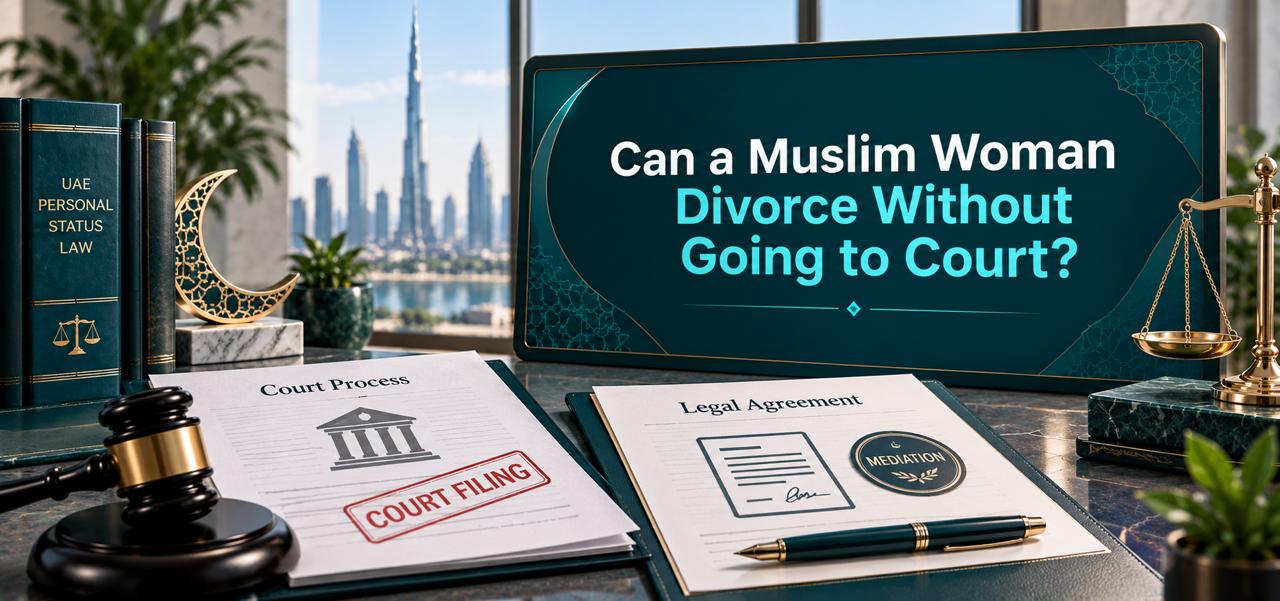
Can a Muslim woman divorce without going to court? She may begin the process outside court, but a private agreement or pronouncement is not a complete UAE legal record. A husband’s talaq may occur outside court, yet Article 58 of Federal Decree-Law No. 41 of 2024 requires him to document it before the competent court within 15 days. The wife may also bring a claim to prove the divorce.
Khula is based on the wife’s request and the husband’s acceptance for compensation, but it must be documented. Children’s maintenance or custody rights cannot be waived as the price of khula. If there is no agreement or talaq, the wife may seek judicial divorce on an available legal ground.
Court registration matters for marital status, remarriage, financial rights, custody, immigration records, and enforcement. Review the correct divorce route before making any payment or signing a waiver or settlement.
Solution
The practical answer is to identify which divorce route actually exists, document it correctly, and settle only the rights the law permits the spouses to settle. Private agreement may reduce conflict, but formal legal completion still matters.
The Current Law for Muslim Divorce in the UAE
Federal Decree-Law No. 41 of 2024 governs Muslim personal-status matters within its scope and replaced the earlier federal personal-status framework. It distinguishes revocable and irrevocable divorce and addresses talaq, khula, judicial divorce, maintenance, waiting-period rights, custody, and related consequences. The applicable law still must be confirmed where nationality, religion, a foreign law request, or a local civil family regime creates another issue.
The first question is therefore not only whether the spouses agree. Counsel should identify the marriage record, each spouse’s religion and nationality, UAE residence, any foreign proceedings, children, and existing orders. A route that is simple for one couple may be inappropriate for another because the legal basis and consequences differ.
Talaq Can Occur Privately, but Documentation Is Required
The official UAE government guidance explains that a husband may pronounce divorce in the presence of a witness or through documented evidence, and an authorized representative may act under an official power of attorney. Article 58 requires the husband to document the divorce before the competent court within 15 days from the date it occurs. The wife’s right to file a claim to prove the divorce remains protected.
If the husband fails to document the divorce within the stated period without an excuse accepted by the court, the law provides for compensation to the wife equivalent to maintenance from the date of divorce until documentation. A woman who learns of an undocumented talaq should preserve messages, witnesses, dates, and any admission, then obtain advice on proving and recording the divorce rather than relying on an informal certificate or family understanding.
Not Sure Which Divorce Route Applies to You?
Talaq, khula, and judicial divorce follow different legal routes in the UAE. Get advice before making any payment, waiver, or settlement that could affect your rights.
Khula Is Agreement-Based but Should Be Formalized
Khula is a separation requested by the wife and accepted by the husband in exchange for compensation paid by her or another person. It is treated as an irrevocable divorce. The agreement should identify the compensation clearly and should be reviewed before payment or signature. Returning the mahr is common, but the correct amount and treatment depend on the marriage documents and agreed terms.
The spouses cannot use khula to waive children’s rights, including child maintenance and custody. Those rights are assessed under the rules protecting the child, not traded as consideration for ending the marriage. If the husband does not agree, the wife should not describe the matter as a completed private khula. She may need to pursue judicial divorce on a legal ground or another court-supervised route that fits the facts.
- Record the exact compensation and payment method instead of relying on an oral figure.
- Separate the wife’s personal financial rights from the children’s independent rights.
- State custody, visitation, and child support terms carefully and subject them to legal review.
- Complete the competent court’s documentation process and obtain the final official record.
Mutual Agreement Can Simplify the Case, Not Eliminate Legal Completion
Spouses may negotiate the end of the marriage and related financial or parenting arrangements before filing. Family guidance may help them reach an amicable settlement, and an agreed document can reduce contested hearings. However, a private paper does not necessarily change official marital status or become directly enforceable merely because both spouses signed it.
The agreement should be drafted around the applicable law and submitted through the authorized process for approval or incorporation into the court record. Each clause should be tested for legality, clarity, and enforceability. Ambiguous language about lump-sum payments, accommodation, school fees, travel, passports, or future claims can create a second dispute after the divorce itself is recorded.
Judicial Divorce Is the Route When Agreement Is Not Available
A wife may apply for judicial divorce where the law provides a ground and the marriage has not ended through a mutually documented route. The relevant ground, evidence, and pre-court steps depend on the facts. The official UAE divorce process ordinarily begins with registration through the family-guidance channel, followed by counseling and an effort at reconciliation or settlement before referral to court when agreement is not reached.
The source article correctly emphasized that court involvement cannot be avoided entirely when the wife needs the court to decide disputed status or rights. The application should identify the legal basis, requested financial and parenting orders, urgent protection needs, and supporting evidence. A woman should not assume that refusal to agree to khula removes every possible court remedy.
Documents to Prepare Before Choosing a Route
Collect the marriage certificate, Emirates IDs, passports, visa information, any marriage contract or mahr schedule, children’s birth certificates, and existing orders. Preserve communications about talaq, separation, compensation, maintenance, custody, threats, or reconciliation. If a document was issued abroad, check authentication and certified Arabic translation requirements before filing.
For financial issues, prepare proof of income, housing, school and medical expenses, existing transfers, debts, and property ownership. For children, prepare the current care schedule, school and health information, travel history, passports, and any safety concern. The file should distinguish confirmed facts from assumptions and should avoid unlawful recordings, account access, or pressure on children.
Prepare a one-page chronology as well. Record the marriage date, separation date, any talaq statement, family-guidance appointments, payments, moves, and important communications. A clear timeline helps counsel identify whether the immediate task is proving divorce, documenting an agreed separation, filing a contested claim, or requesting temporary protection. It also reduces contradictions between the court application and later evidence.
Protect Status and Rights After the Divorce Is Recorded
Obtain the final divorce certificate or judgment and verify the spelling of names, dates, identity numbers, and operative terms. Ask how the record affects immigration sponsorship, remarriage, custody, travel, maintenance, housing, and enforcement. A religious or foreign document may still require a separate UAE recognition or registration step before another authority will act on it.
A divorce record does not automatically enforce every payment or parenting obligation. If one party fails to comply, the other may need execution proceedings or a further application. Keep certified copies, official translations, proof of service, settlement documents, and payment records together so later authorities can understand the legal history without reconstructing it from messages.
Thinking About Khula or Judicial Divorce?
Before agreeing to compensation or signing any waiver, understand how the divorce may affect maintenance, custody, financial rights, and court documentation.
When Urgent Protection Is More Important Than Agreement
If there is domestic violence, a threat to remove a child, immediate loss of housing or support, or risk that assets or evidence will disappear, the woman should seek urgent legal and safety advice. Negotiating a private divorce must not delay protective measures. Family, criminal, child-protection, and immigration issues may need coordinated action.
The safest plan separates the emergency from the final divorce route. Police or protection channels address immediate danger; interim court requests may address support, housing, custody, travel, or documents; and the main case determines marital status and longer-term rights. The correct sequence depends on the evidence and should be planned before confronting the other party.
Related Success Story
The firm’s Successful Child Custody & Divorce Case in Dubai shows how coordinated divorce and custody work can protect a client’s position in a difficult family dispute. Every divorce route and result remains fact-specific.
Need to Formalize a Muslim Divorce?
Leaders Advocates can identify whether talaq, khula, mutual settlement, or judicial divorce applies and can coordinate documentation, financial claims, custody, and enforcement.
Common Mistakes
- Treating a private talaq statement as a complete official divorce record.
- Missing the 15-day documentation requirement or failing to preserve proof of the pronouncement.
- Signing khula terms without separating the wife’s rights from the children’s rights.
- Assuming the husband can permanently block every judicial divorce route.
- Using an informal agreement that is unclear about payment, custody, visitation, or housing.
- Waiting until remarriage, immigration, or enforcement makes documentation urgent.
Relevant Legal Services
A Divorce Lawyers in Dubai can advise on talaq, khula, judicial divorce, settlement, and formal documentation. A Family Lawyers in Dubai can coordinate maintenance, housing, custody, visitation, and cross-border family issues. A Child Custody Lawyers in Dubai can protect children’s rights and help structure enforceable parenting arrangements.
People Also Ask
Conclusion
The answer to Can a Muslim woman divorce without going to court is that private steps can begin the process, but legal completion and protection require official documentation or a court decision. Choosing the correct route before signing or paying protects status, financial rights, and the interests of any children.
Need to Make Your Divorce Legally Effective in the UAE?
Leaders Advocates can help identify the correct divorce route, court process, documentation, financial claims, custody issues, and next legal steps.