

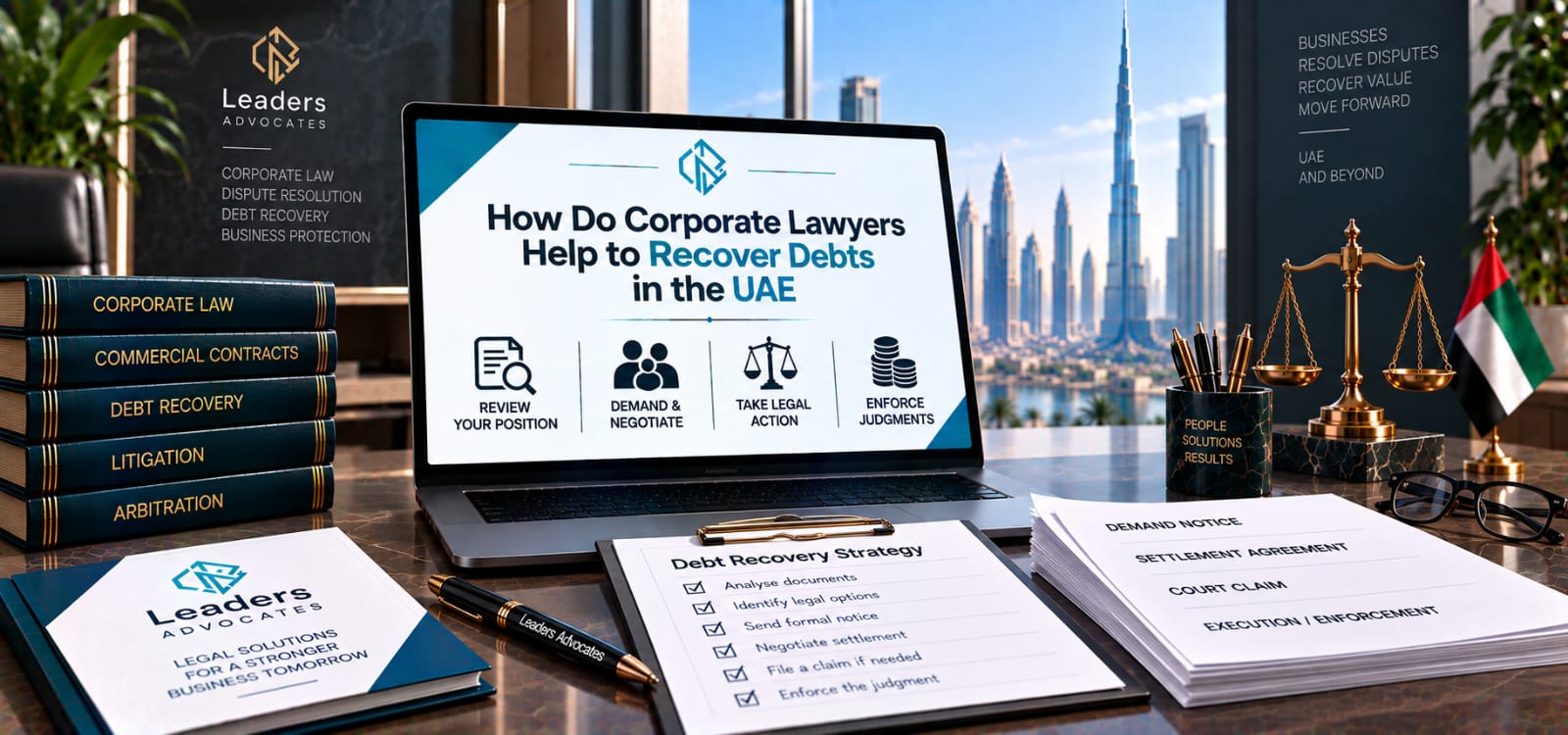

Your finance team has overdue invoices, but sales still grants extensions and delivery records are incomplete. How do Corporate Lawyers Help to Recover Debts in the UAE? They connect contract design, credit decisions, evidence, and enforcement so the business can act coherently.
Quick Answer
Corporate lawyers help recover debts in the UAE by improving contracts before default and coordinating the response when payment stops. They review the contracting entity, payment terms, authority, security, and dispute-resolution arrangements.
After default, they help preserve records, reconcile the balance, assess deadlines, and advise on demands, settlement, payment orders, cheque execution, ordinary claims, conciliation, or arbitration where the requirements are met.
Where insolvency, cross-border assets, or court proceedings are involved, corporate counsel coordinates the relevant specialist advice. Recovery still depends on the facts, documents, available assets, and applicable legal procedure.
Articles 143 to 150 of Federal Decree-Law No. 42 of 2022 provide the payment order framework. Article 667 of Federal Decree-Law No. 50 of 2022 concerns qualifying cheque execution. Any five-day demand must satisfy the applicable service and procedural requirements.
Prevention Recovery Starts in the Contract
- Clear payment dates, milestones and late payment terms.
- A jurisdiction or arbitration clause that suits how you would enforce.
- Signature and authority requirements, so the contract binds the right entity.
- Acceptance and delivery procedures that generate evidence.
- Security for trade credit, such as guarantees, parent company undertakings or cheques.
Contract drafting for payment is not just about the rate. It is about what you will be able to prove and where you will be able to sue.
Working With In-House Counsel
In-house counsel decides which accounts to escalate and keeps documentation consistent. They also review proposed sales variations that could undermine the contract. External counsel then handles court representation, since onshore court appearances are made by registered advocates under Federal Decree-Law No. 34 of 2022.
Overdue Invoices Starting to Pile Up?
Do not wait until the evidence is incomplete or the debt becomes harder to recover. Get the contract, balance, delivery records, security, and recovery route reviewed early.
Choosing the Right Action
- Payment order: fixed, due and documented debts, after a five-day demand.
- Cheque execution: qualifying cheques returned for unavailable or insufficient funds. Closed-account returns require review of the applicable judicial principle.
- Ordinary claim: where amounts, scope or quality are disputed.
- Conciliation: where Dubai Law No. 18 of 2021, as amended, applies.
- Arbitration: where the contract requires it.
Protecting Value When a Customer Fails
Bankruptcy proceedings can stay individual enforcement and require claims within the collective process. The effect depends on the procedure, orders, and applicable exceptions. Corporate lawyers monitor for filings, prepare claims with supporting documents, advise on any security held and assess whether guarantees give a route outside the insolvency.
Cross-Border Elements
Articles 222 to 225 of the Civil Procedure Law address recognition and enforcement in the UAE of foreign judgments and relevant foreign instruments. Foreign arbitral awards also engage applicable treaty rules, including the New York Convention. Enforcement of a UAE judgment abroad depends on the destination’s law and applicable treaties.
Planning for this at the contract stage is far easier than solving it after default.
Measuring Whether It Is Working
- Average age of receivables before escalation.
- Proportion of accounts settled before filing.
- Recovery rates by customer type and by route.
- Cost of recovery against amounts collected.
- Repeat defaults by the same customers.
Assign ownership of credit decisions
Finance knows which invoices are overdue, while sales knows the customer relationship and operations holds performance records. Corporate counsel connects those sources. Recovery slows when each team assumes another department has preserved the evidence.
Set written rules for approving credit limits and exceptions. Identify who may extend payment dates or accept deductions. Staff should understand when a proposed commercial concession needs legal review.
The escalation policy should reflect exposure and risk, not just the number of days overdue. A small routine delay and a substantial disputed account require different attention. Signs of insolvency or expiring deadlines justify earlier intervention.
Draft payment terms that produce usable evidence
A payment clause should explain when the amount becomes due and what documents establish completion. For milestone work, identify who approves each stage. Avoid leaving acceptance entirely dependent on an undefined internal customer process.
Document variations before additional work begins where possible. Identify the revised scope, price, and payment consequences. A project team’s informal understanding may be difficult to reconstruct after employees leave.
Review the dispute clause alongside the likely location of assets. A convenient forum can still produce an expensive enforcement problem. Cross-border advice is more useful before execution difficulties arise.
Security should also be documented precisely. A personal guarantee, parent undertaking, or security cheque requires analysis of its wording, authority, scope, and enforceability. The label alone does not establish a reliable recovery right.
Create an evidence handover after default
The handover should explain the transaction in chronological order and identify the unpaid amount. Counsel needs the original agreement and later changes. A finance ledger without performance records may leave important questions unanswered.
Include purchase orders, delivery confirmations, service acceptance, invoices, credit notes, and bank records. Preserve correspondence concerning defects or delayed performance. Adverse documents should be reviewed early rather than discovered during proceedings.
Where records sit in personal mailboxes or messaging accounts, arrange lawful preservation. Keep the original context and relevant attachments. Federal Decree-Law No. 35 of 2022 provides the relevant evidence framework.
Identify the employees who can explain the records. Their factual account can help counsel assess the case. It does not replace any documentary proof required for the particular obligation.
Practical steps when an account passes agreed terms
- Reconcile the account and confirm that payment has actually fallen due.
- Ask operations whether performance complaints remain unresolved.
- Review any extension or concession already given by sales.
- Check security, limitation, jurisdiction, and formal demand requirements.
- Choose a proportionate recovery route and approve its budget.
- Record who must act next and when the decision will be reviewed.
A demand should accurately reflect the documents and outstanding balance. If settlement discussions begin, clarify who may make binding commitments. Keep proposed terms distinct from the final signed agreement.
Protect the position when insolvency intervenes
A customer’s financial distress requires a different assessment from ordinary late payment. Obtain reliable information about any formal proceedings. Federal Decree-Law No. 51 of 2023 provides the relevant bankruptcy framework.
Counsel should review stays, claim submission requirements, security, and potential guarantee claims. The effect depends on the procedure and orders made. Do not assume either that every enforcement step stops or that existing security permits unrestricted action.
The company should also review further supply and any proposed preferential arrangement. Legal and commercial teams need a coordinated decision. Trying to recover through informal pressure can create additional risk.
Measure collected value and improve the next contract
Track actual receipts alongside judgments and settlement agreements. A signed promise is not collected cash. Compare recoveries with legal spend, internal time, and any continuing exposure to the same customer.
Investigate recurring evidence gaps across files. Missing delivery signatures, ambiguous entities, and undocumented variations may point to a process problem. Fixing the source of the gap can improve future recovery more than stronger reminder wording.
After closure, update standard terms and credit guidance where justified. Keep the changes practical for the teams that use them. An elaborate policy has little value if staff cannot follow it during ordinary transactions.
Missing Delivery Records or Signed Variations?
Weak documentation can slow recovery. Bring the contract, invoices, purchase orders, delivery evidence, account records, extensions, and correspondence together before the dispute escalates.
Common Mistakes
- Treating recovery as a finance-only function.
- Signing contracts with entities that hold no assets.
- Taking security cheques without documenting what they secure.
- Allowing sales teams to agree informal payment extensions.
- Escalating only when a debt is years old.
Coordinate internal and external legal roles
In-house counsel can manage instructions, evidence, budgets, and commercial approvals. External specialists may advise on a particular procedure or jurisdiction. Court representation requires the appropriate authorization and registration under the applicable professional rules.
Federal Decree-Law No. 34 of 2022 regulates the relevant legal professions. A corporate job title alone does not establish rights of audience. Confirm who will conduct the proceedings and who will report to the business.
Provide external counsel with both the legal objective and the commercial constraints. For example, preserving a distributor relationship may influence settlement options. It cannot justify ignoring deadlines or misrepresenting the evidence.
About the Legal Contributor
Faris Raian of Leaders Advocates advises on UAE corporate disputes, debt recovery, contracts, and enforcement strategy.
His practical approach focuses on identifying evidence gaps early, including missing delivery confirmations, unsigned variations, unclear payment records, and inconsistent internal documentation.
That review can help businesses improve both the immediate recovery file and the contract and credit processes used for future transactions.
Relevant Legal Services
The appropriate service depends on the dispute and the stage reached. The following practice areas address different parts of the file.
- Corporate Lawyers in Dubai: Checking contracting entities, authority, credit arrangements, and business exposure.
- Contract Drafting and Review: Reviewing payment terms, variations, guarantees, and settlement obligations.
- Debt Recovery Lawyers in Dubai: Assessing the unpaid balance, recovery procedure, and available execution options.
Relevant Success Story
The firm’s Success Stories page lists a successful loan recovery matter in Dubai. It offers a relevant example of a reported recovery outcome.
Every matter depends on its own facts, documents, and legal circumstances. A previous outcome does not guarantee a similar result.
Frequently Asked Questions
Final Takeaway
Corporate lawyers improve recovery by connecting prevention with timely action. Review the contract, evidence, and escalation process before exposure grows. The next step should reflect the documents, the correct forum, and realistic enforcement options.
Not Sure Which Debt Recovery Route Fits Your Business?
Payment order, cheque execution, ordinary claim, conciliation, arbitration, or insolvency may lead to different strategies. Get a route matched to your documents, debtor, and assets.