


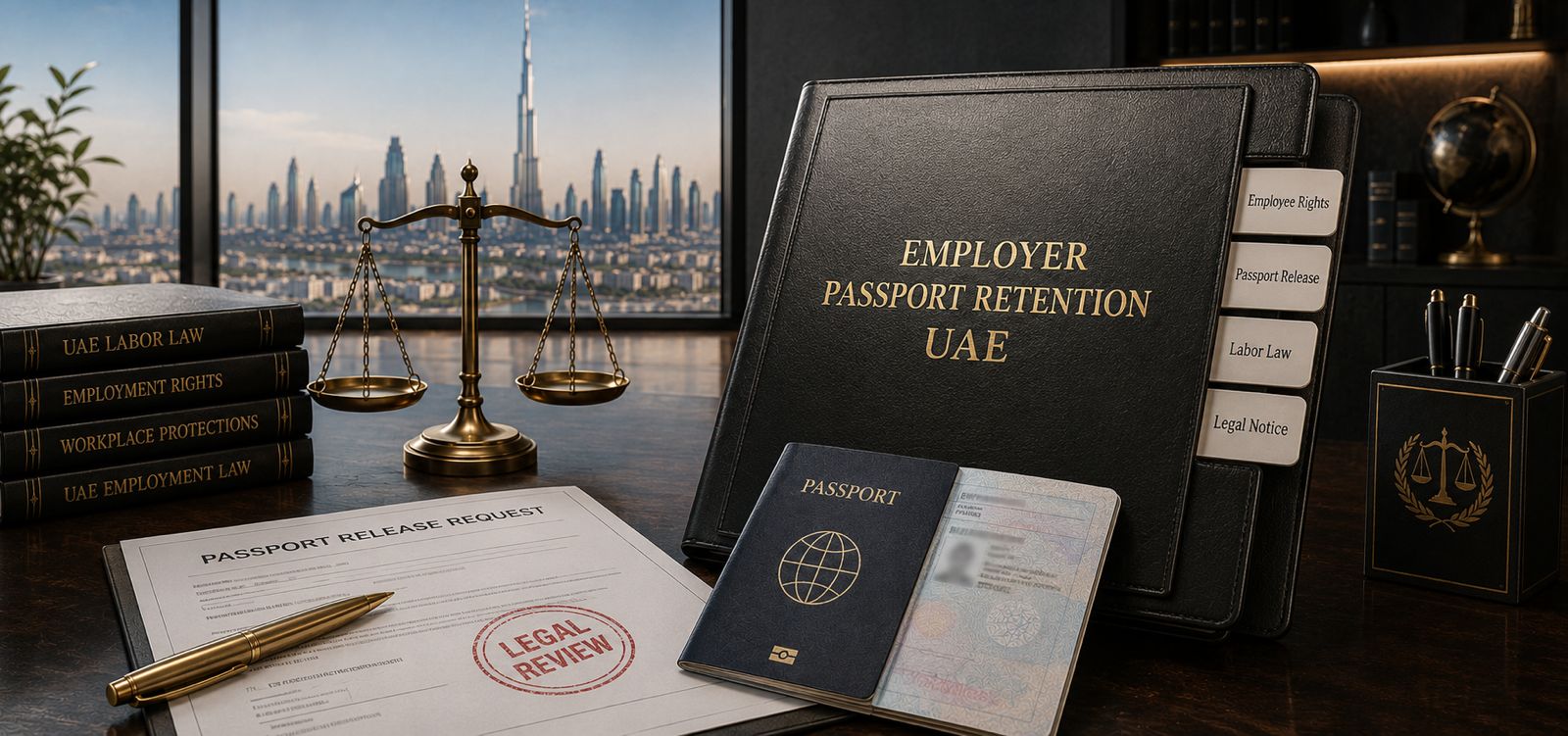

On your first day, HR asks for your passport “for the file.” Months later, it still has not come back.
So can an employer keep your passport in the UAE?
No. Your passport is your personal document, and UAE law is unusually clear on this point. An employer may hold it briefly for visa processing, then must hand it back. Keeping it as company policy, as security for a debt, or to stop you from leaving is unlawful.
The practice still happens, usually because workers assume they have no choice. This article sets out the actual legal position, the court rulings behind it, and the practical steps that get a passport returned, often within days.
No. Article 13(2) of Federal Decree-Law No. 33 of 2021 prohibits employers from seizing a worker’s official documents, and Ministry of Interior Circular No. 267 of 2002 confirms that only official authorities may confiscate a passport, under a judicial order. The Dubai Court of Cassation ruled as far back as 2001 that an employer cannot seize a worker’s passport, whatever the nature of their relationship.
The only acceptable custody is temporary, for visa stamping or renewal, or genuine safekeeping at your own request, returnable whenever you ask. If your employer refuses to return your passport, start with a written request, then file a MOHRE complaint, and if needed, apply to the labour court, which typically orders the return of a passport within about 3 to 5 working days. Our employment lawyers in Dubai can accelerate each step.
The Legal Basis: What the Law Actually Says
In cases like this, it is worth speaking with employment lawyer in dubai.
Several instruments combine to make passport retention unlawful. Together they leave no room for a contrary company policy.
| Legal Source | What It Provides |
|---|---|
| Article 13(2), Federal Decree-Law No. 33 of 2021 | The employer must not seize the worker’s official documents, and must not force the worker to leave the UAE after the employment ends. |
| Article 14, Federal Decree-Law No. 33 of 2021 | The employer may not use any means to force or compel the worker, or threaten them with any penalty, to work against their will. Holding a passport to trap someone in a job falls squarely within this prohibition. |
| Ministry of Interior Circular No. 267 of 2002 | A passport is a personal document that its holder is obliged to keep and produce. No party may detain it except the official authorities, under a judicial order. |
| Article 11(11), Federal Decree-Law No. 9 of 2022 | Employers of domestic workers must ensure the worker’s right to keep their own identification documents. |
| Civil Procedures Law (travel ban provisions) | Restricting a person’s travel is a judicial power. Only a judge may order a travel ban or the deposit of a passport, following the procedures set by law. |
Notice the pattern. Every route to holding someone’s passport runs through a court, never through an HR department. The wider framework is set out in this overview of labour law in the UAE.
When Can an Employer Lawfully Hold a Passport?
This connects closely with our guide on how to find the best employment lawyer UAE.
There are only two situations, and both are narrow.
| Lawful Temporary Custody | Unlawful Retention |
|---|---|
| Holding the passport briefly to process a residence visa, work permit, renewal, or cancellation. | Keeping the passport after the visa procedure is complete. |
| Safekeeping at the employee’s own genuine, written request. | “Safekeeping” imposed as a condition of the job or extracted under pressure. |
| Custody that ends the moment the employee asks for the passport back. | Refusing or delaying return because of a resignation, a dispute, or money allegedly owed. |
The test is simple. Lawful custody is temporary, purpose-bound, and ends on demand. Anything else is retention, and retention is unlawful.
Even where you genuinely agreed to safekeeping, that consent is not a waiver. You can demand the passport back at any time, and the employer must comply.
UAE Court Judgment
Our related guide on how to cancel an employment visa in the UAE goes into this further.
The leading authority on this question is old, famous, and still applied today.
In Cassation No. 268 of 2001 (Rights), dated 27 October 2001, the Dubai Court of Cassation held that it is not permissible for an employer to seize a worker’s passport and deny their natural right to travel and movement, whatever the nature of the relationship between them.
The court’s reasoning went further. Seizing a passport amounts to preventing a person from travelling, and under the Civil Procedures Law, only a judge can impose a travel ban, following the formal procedures the law prescribes. An employer holding a passport is, in effect, imposing a private travel ban with no legal authority to do so.
The Dubai Court of Cassation reaffirmed the principle in a 2003 appeal, confirming that passport confiscation violates the right to freedom of movement and is prohibited under UAE law.
Two decades on, courts still order employers to return passports and to bear the costs of the case. The principle has never softened. The same court’s approach to worker protection is illustrated in this analysis of how the Dubai Court of Cassation confirms employment rights without formal MOHRE contracts.
Is Your Passport Sitting in Someone Else’s Drawer?
You do not need permission to get it back. The law settled this in 2001, and most employers return the document the moment a lawyer puts the request in writing. Send us the details and we will start today.
Common Excuses That Do Not Work
We cover this in more detail in our guide on how to file a complaint against employer in UAE.
Employers who hold passports usually offer a justification. None of these has any legal weight.
- “You owe us the visa costs.” Visa and recruitment costs are the employer’s responsibility by law. They cannot be charged back to you or secured against your passport.
- “You have a debt with the company.” The Cassation ruling addressed this directly. Even a genuine debt does not entitle the employer to hold your passport. Debts are enforced through courts, not through document seizure.
- “It is company policy.” A policy cannot override the Labour Law. Article 13(2) applies to every employer.
- “You resigned before the contract ended.” Early resignation may have financial consequences, but they are claimed through a labour case, never through your passport.
- “You signed a consent letter.” Consent to safekeeping is revocable at any time. The moment you ask, the passport must come back.
How to Get Your Passport Back: Step by Step
Most passports are returned at step one or two. The later steps exist for employers who dig in.
- Ask in writing. Email or message your employer requesting the return of your passport, and keep the record. Many employers back down once they see a paper trail forming.
- File a MOHRE complaint. Use the MOHRE app, website, or call centre on 80084. Passport retention is treated as a serious violation, and the ministry contacts the employer directly.
- Apply to the labour court. If the employer still refuses, an urgent petition can be filed asking the court to order the return of the passport. These applications are typically dealt with within about 3 to 5 working days, and the order can be enforced through the police.
- Involve the police if needed. With a court order in hand, or in serious cases even without one, the police can require the employer to hand the document over.
- Notify your embassy or consulate. They can issue travel documents in an emergency and add diplomatic pressure while the legal process runs.
If the retention is part of a wider dispute over salary or termination, the passport claim and the money claims can run together. Our guide on how to file a complaint against your employer in the UAE covers the full MOHRE process.
What If You Signed a Consent Letter?
You can still get your passport back.
Courts treat consent to safekeeping as valid only while it remains genuinely voluntary. Once you request the document, continued retention becomes unlawful, whatever you signed on day one.
If you do agree to safekeeping for convenience, protect yourself. Get a stamped, signed letter from the employer confirming it holds the passport at your request and will return it on demand. That letter turns a risky arrangement into a documented one.
What Employers Risk by Holding Passports
For employers and HR teams, the risk calculation is entirely one-sided.
Courts order the return of the passport and load the case costs onto the employer. Where the worker proves damage, for example a missed job opportunity or forced overstay, compensation can be awarded on top. UAE courts have issued exactly such verdicts.
The exposure gets worse in aggravated cases. Holding documents to compel someone to keep working engages the forced labour prohibition in Article 14, and in the most serious scenarios, document confiscation is recognised internationally as an indicator of human trafficking. No administrative convenience is worth that file landing on a prosecutor’s desk.
The compliant alternative costs nothing: process the visa, return the passport, keep a copy.
Employer Refusing to Return Your Passport?
The legal position is firmly on your side, and the process moves quickly once it starts. A UAE employment lawyer from our team can send the demand, file the MOHRE complaint, and obtain a court order for the passport’s return, usually within days.
Evidence Worth Gathering
You do not need much, but each item below strengthens the complaint.
- Your written request for the passport and any reply, or the absence of one.
- The consent letter or undertaking, if you were made to sign one.
- Your employment contract and work permit details.
- Messages or emails where the employer admits holding the passport or attaches conditions to its return.
- Proof of urgency, such as a booked flight, a family emergency, or a new job offer, which supports an expedited court order.
Common Mistakes to Avoid
A few missteps regularly weaken otherwise straightforward cases.
- Handing over the passport indefinitely without any written record of who holds it and why.
- Negotiating for months instead of filing a complaint. The process exists precisely for this situation.
- Paying “visa costs” or other sums just to get the passport back. That money is usually recoverable, but it is better not to pay it at all.
- Signing new undertakings under pressure in exchange for the document.
- Assuming a free zone or domestic work arrangement changes the rule. It does not. The prohibition applies across the UAE.
Frequently Asked Questions
The answer to “can an employer keep your passport in the UAE?” has been settled for over two decades. Outside of brief visa processing or genuine safekeeping at your request, the answer is no, and every legal authority points the same way.
What keeps the practice alive is silence. Workers who know the rule, put their request in writing, and use the MOHRE process almost always get their document back quickly.
If your passport is being held right now, or you are an employer wanting to fix a risky document policy before it becomes a case, a UAE employment lawyer from our team can resolve the situation quickly and quietly, and put the paperwork right for the future.
Stop Waiting and Start the Process
Every week your passport stays with your employer; it is a week you cannot travel, change jobs, or handle an emergency at home. Leaders Advocates sends the demand, files the MOHRE complaint, and takes it to court if needed, usually finishing in days.

1 Comment