


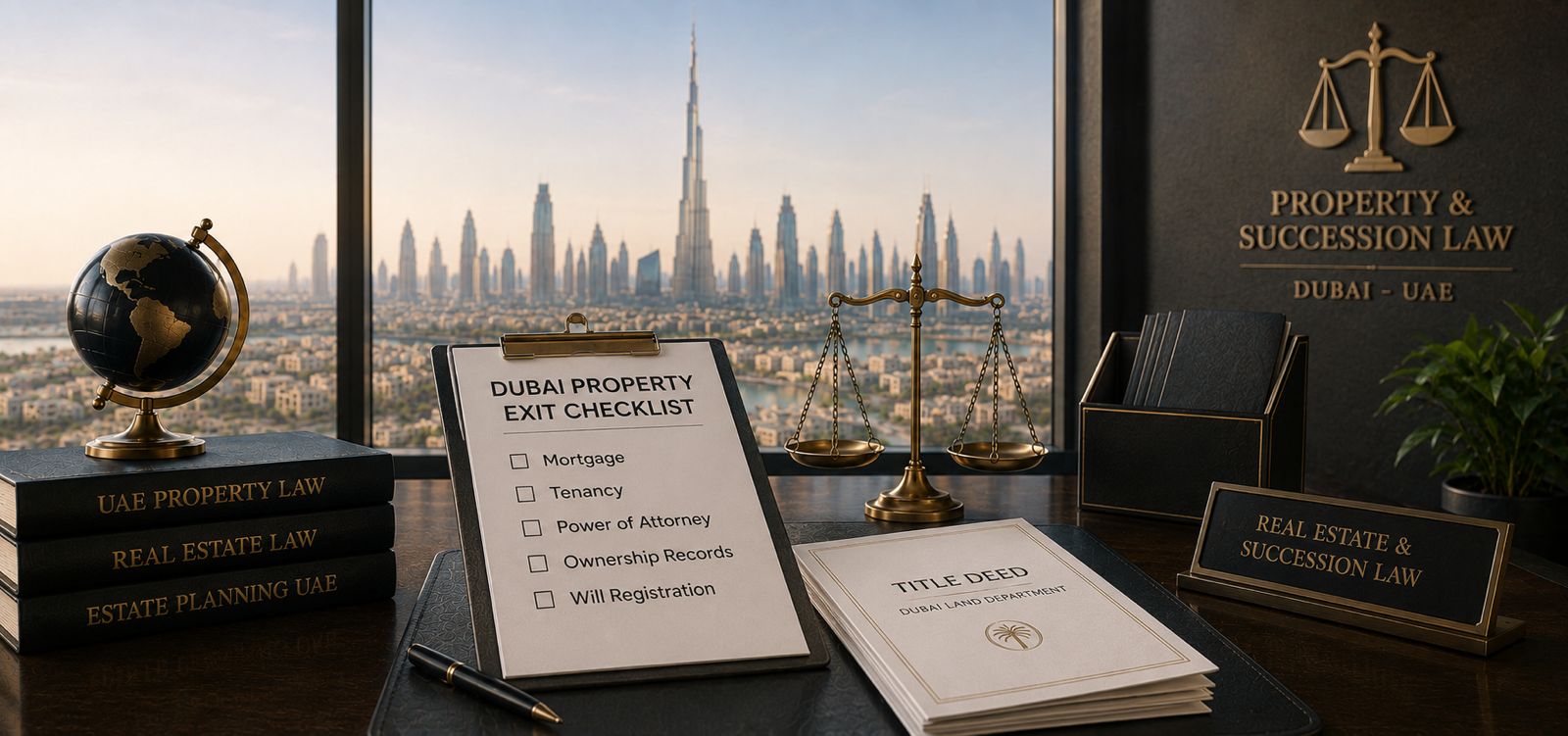
What happens to your Dubai property if you leave or die depends on whether you are simply becoming a nonresident or whether an estate transfer is required. Leaving the UAE does not itself cancel a registered Dubai title, end a mortgage, terminate a lease, or remove ongoing owner obligations.
Death creates a different legal process. The property cannot be treated as though the heirs already hold registered title. The estate, any valid will, the applicable succession framework, debts and mortgages, and the required court and Dubai Land Department procedures must be completed before an heir can deal with the property as registered owner.
Leaving Dubai does not by itself take away ownership of property that you lawfully own and that remains registered in your name. You can usually retain, lease, manage, or sell it from abroad through properly structured arrangements, including a specific and valid power of attorney where appropriate. You remain responsible for mortgages, service charges, insurance, lease duties, and compliance. If you die, the property forms part of the estate subject to its ownership structure and encumbrances. A will can direct distribution and appoint an executor, but it does not eliminate the probate or estate process. The competent court must establish the succession authority, and Dubai Land Department transfers registered title to heirs or beneficiaries on the required legal documents. Muslim and qualifying non-Muslim estates may follow different succession frameworks.
What Happens to Your Dubai Property If You Leave or Die: Two Routes
Working with real estate lawyer in dubai can help you avoid costly mistakes here.
Departure and death should never be placed in one procedural category. A living owner remains able to make decisions, sign documents, appoint representatives, receive rent, pay liabilities, and sell, subject to identity, authority, registry, lender, and contract requirements. The management problem is mainly one of access, compliance, and control.
After death, the person who was the registered owner can no longer sign. A prior ordinary power of attorney should not be used as though it continues to authorize post-death transactions. The executor, administrator, heirs, beneficiaries, and guardians of any minor heir must act only through the authority recognized by the court and the relevant registry.
- Leaving the UAE: title remains registered, but remote management and ongoing obligations must be organized.
- Death: the estate route, succession documents, liabilities, and registration must be completed.
- In both situations: check the mortgage, co-ownership, lease, company structure, and exact DLD record.
- A will and a power of attorney serve different purposes and should not be treated as substitutes.
- Foreign probate or estate documents may require recognition, authentication, and Arabic translation before use in Dubai.
Leaving the UAE Does Not Cancel Registered Ownership
For a closer look at this, see our guide on how to choose the best real estate lawyer in dubai.
A change of visa, employment, tax residence, or physical address does not automatically transfer a DLD-registered title. The owner should nevertheless confirm that the asset is lawfully owned under the applicable Dubai ownership rules, including designated area restrictions where relevant to a foreign owner.
Keep the title information, Emirates ID history, passport records, contact details, purchase agreement, mortgage documents, and any developer or owners association account current. An expired UAE residence card does not mean the property disappears, but identity verification for a future transaction may depend on a valid passport and the documents accepted by the current DLD service.
The owner should update the lender, developer, building management, insurer, property manager, and tenant as required. Notices sent to an old UAE address can create missed payment, insurance, renewal, or legal deadlines. A reliable service address and monitored email are basic risk controls.
Confirm the Property and Ownership Structure
Before leaving, obtain an up-to-date picture of what is registered and what is owed. A sale contract or payment receipt is not always the same as final registered title. Off-plan rights, completed freehold title, jointly owned property, usufruct, musataha, company ownership, and mortgaged ownership can require different steps.
- Check the title deed or current electronic title record and the owner’s name exactly.
- Identify whether the property is completed, off-plan, jointly held, mortgaged, or company-owned.
- Review developer restrictions, community rules, service charge statements, and pending disputes.
- Confirm the lease, security deposit, rent payment method, maintenance duties, and notice dates.
- List every bank account, utility account, insurance policy, and management contract connected to the property.
- Record the property location, unit details, parking, storage, keys, access cards, and inventory.
If a spouse, nominee, business partner, or family member believes they have an unregistered beneficial interest, obtain advice before departure or estate planning. Later succession proceedings may need to determine ownership before they can calculate what belongs to the estate.
Leaving the UAE and Own Property?
Mortgage, service charges, insurance, and the tenancy do not pause because you moved. We set up the remote management structure before you go, so nothing falls through the gap.
Ongoing Costs Do Not Stop When You Move
A nonresident owner must continue to meet contractual and statutory obligations. Mortgage instalments, property insurance, service charges, maintenance, district cooling, utilities, management fees, and tenant-related expenses may continue according to the relevant contracts and active accounts.
Under Dubai Law No. 6 of 2019 concerning jointly owned real property, the owner is responsible for service charges unless the lease provides that the tenant will pay them. Even where the lease allocates payment to the tenant, the owner should monitor the account because registry, management, and enforcement consequences may still affect the property.
Do not state that a Dubai Municipality housing fee always applies to every vacant, rented, or owner-occupied unit in the same way. Billing can depend on occupancy, tenancy, utility setup, and current rules. Confirm the active account position when closing utilities, starting a lease, or leaving a unit vacant.
Managing the Property From Abroad
Our guide on mollak system dubai explains this further.
Remote ownership works best when authority and reporting are documented. A professional property management agreement can cover marketing, tenant communication, inspections, maintenance, rent collection, renewals, and periodic statements. It should state spending limits, reserve funds, emergency authority, conflicts, termination, and access to original records.
Use a UAE bank account or another compliant payment arrangement that the parties and relevant institutions accept. Plan for two-factor authentication, expiring mobile numbers, bank compliance checks, and access if the owner loses a device. Do not give a manager unrestricted credentials to personal banking or government accounts.
- Update all contact and service addresses before departure.
- Prepare an inventory, condition report, keys register, and current photographs.
- Reconcile mortgage, service charge, utility, insurance, and lease balances.
- Appoint a manager or representative under a written scope.
- Set approval thresholds and a documented emergency procedure.
- Arrange regular statements, inspections, and evidence of completed repairs.
- Calendar lease notices, licence renewals, insurance expiry, and payment dates.
- Review the arrangement after any passport, address, family, or ownership change.
Using a Power of Attorney
A power of attorney can allow a representative to complete defined acts while the owner is alive. The document should name the property or authority precisely and state whether the agent may lease, manage, collect rent, sign forms, obtain an NOC, deal with a mortgage, or sell. A general phrase may be inadequate for a registry or bank transaction.
Execution outside the UAE may require notarization, legalization or apostille treatment where applicable, consular or Ministry of Foreign Affairs steps, and certified Arabic translation. The accepting authority’s current requirements should be confirmed before signing because form, age, and authentication rules can change.
Choose the attorney carefully, prohibit self-dealing where appropriate, set a term, require accounting, and establish revocation and return-of-documents procedures. A POA is not estate planning. Authority generally ends on the principal’s death, after which only the recognized estate representative can act. Our contract lawyers in Dubai draft powers of attorney that match what the DLD and lenders will actually accept.
Renting the Property After You Leave
A lease should identify the legal landlord, payment method, term, renewal and notice rules, maintenance allocation, deposit, permitted use, occupancy, and management contact. Register the tenancy through the applicable Dubai process and ensure that the manager’s authority matches what the lease requires.
The owner remains exposed to landlord duties and disputes even when a manager handles communications. Review rent notices, maintenance requests, access, eviction grounds, and settlement proposals before deadlines. Avoid giving instructions that conflict with Dubai tenancy law or an existing Rental Disputes Center order. Our tenancy lawyers in Dubai can review the lease and manager authority before departure.
If the owner dies during a lease, the tenancy does not become a free asset for one relative to collect informally. Rent, deposit, notices, maintenance, and future management should be directed through the estate authority and eventual registered ownership. Tenants should receive verified instructions rather than competing demands.
Selling From Outside the UAE
A nonresident owner may be able to sell through a properly authorized representative or by using the remote procedures accepted for the transaction. Identity, passport validity, title, mortgage, developer or management requirements, sale contract, payment controls, and the precise DLD route must be checked.
Real estate lawyers in Dubai can review a remote management or sale structure before a power of attorney is signed or used with the Dubai Land Department.
Do not hand an agent unrestricted power to set price, receive the entire sale price into a personal account, or transfer to a connected person without safeguards. The POA, brokerage agreement, memorandum, escrow or bank arrangements, and settlement statement should work together.
A foreign owner should also obtain tax advice in the country of residence. The UAE property transfer can create reporting, capital gains, inheritance, or wealth consequences elsewhere even when there is no equivalent Dubai tax at the transaction level.
What Changes When the Owner Dies
You can read more about this in our guide on RERA law in dubai.
On death, the property is dealt with as part of the deceased’s estate to the extent of the deceased’s legal ownership. No heir should advertise, lease, mortgage, or sell as sole owner merely because family members agree informally. The court must establish the legally authorized persons and the distribution route.
The estate must identify funeral and administration expenses, debts, mortgages, unpaid service charges, taxes or foreign claims where relevant, valid wills, and heirs or beneficiaries. A lender’s security and a co-owner’s registered share do not disappear. Only the deceased’s interest passes through succession.
Dubai Land Department has a title transfer to heirs service based on legal inheritance documentation and the required identities and applications. The exact bundle depends on the estate, any will, representation, minors, foreign documents, and the asset. Obtain the current checklist before filing rather than relying on an old generic list.
Muslim Succession and Wills
Federal Decree-Law No. 41 of 2024 contains the Muslim inheritance and will framework. The net estate is determined after the legally prioritized expenses and debts. Heirs and shares depend on the surviving family, and a Muslim will is generally executed within one third of the net estate unless the heirs approve more under the statutory rules.
A Muslim owner should not assume a will can freely give the entire Dubai property to one person while defeating mandatory heir rights. The property value, mortgage, other assets, debts, beneficiaries, and family structure must be reviewed together. A will may still be valuable for permitted dispositions, executorship, guardianship wishes, and administrative clarity.
An inheritance lawyer in Dubai can assess the will, heirs, debts, mortgage, executor role, and title-transfer route as one estate plan. How to revoke or update an existing will is explained in our guide on how to revoke or cancel a will in the UAE.
A distribution calculation should use the family existing at death, not only the family known when the will was signed. Marriage, divorce, births, deaths, parentage, conversion, acquisition, sale, and mortgage changes can all require a new review.
No Will and Own Dubai Property?
Without a will, the rules decide who gets what. Those rules may not match what you want. A one-hour review can close the gap.
Non-Muslim Owners and the Civil Succession Framework
Federal Decree-Law No. 41 of 2022 supplies a civil personal status framework for non-Muslims within its scope. Article 11 provides a default distribution where a qualifying person dies without a will, including half to the surviving spouse and the remaining half equally among the children in the stated situation, with further rules where those heirs do not exist.
The law also recognizes the ability to make a will for UAE assets within its scope. A non-Muslim owner’s nationality, residence, choice of law, place of will registration, and estate connections must still be checked. It is unsafe to say that every non-Muslim estate follows one Dubai rule automatically.
DIFC Wills Service provides a will-registration route for eligible non-Muslims and can cover UAE assets, including real property. Registration should be selected according to asset scope and eligibility. A registered will can improve clarity but does not bypass the need for a grant, court authority, debt administration, or DLD transfer.
What a Will Can and Cannot Do
- It can record legally permitted distribution instructions.
- It can nominate an executor and express guardianship wishes where relevant.
- It can reduce uncertainty about intended beneficiaries and asset administration.
- It cannot transfer registered title while the owner is alive merely by being signed.
- It cannot remove a mortgage, service charge debt, or another person’s ownership.
- It does not make probate, court, and registry procedures unnecessary.
- It cannot guarantee a fixed completion time for the estate.
- It should be reviewed after family, residence, asset, or legal changes.
The executor named in a will does not simply become registered owner. The executor must obtain the authority required by the relevant court and then act within that authority. Beneficiaries receive title or sale proceeds only after the estate route and liabilities are handled.
Mortgaged, Jointly Owned, and Company-Owned Property
Mortgaged property
The mortgage remains attached according to its terms and registry status. Insurance may cover some risks but should never be assumed to clear the loan automatically. The estate representative must communicate with the lender, maintain payments where required, and determine redemption, continuation, or sale options.
Joint ownership
Only the deceased’s registered share enters the estate unless another ownership claim is established. Joint ownership should not be confused with an automatic survivorship rule. The title, purchase agreement, financing, and governing succession rules must be reviewed.
Company ownership
If a company owns the unit, the deceased may have owned shares in the company rather than the land directly. The company documents, licence, shareholder agreement, ultimate ownership rules, and succession of the shares may control the route. Do not apply an individual DLD heir transfer without checking the registered owner. Our corporate lawyers in Dubai can trace the ownership chain before filing.
Minor Heirs and Guardianship
A child can inherit property, but a minor cannot manage or sell it like an adult. The court-supervised guardian or estate representative must protect the child’s share, and a sale, mortgage, distribution, or use of proceeds may require specific authority. The child’s interest controls the decision.
Where a minor receives a property share, a guardianship lawyer in Dubai can identify the court authority required to manage, mortgage, retain, or sell that share. When guardianship ends and what replaces it is explained in our guide on when guardianship ends in the UAE.
Parents should coordinate the will, property ownership, life insurance, debt plan, and guardianship wishes. Naming a desired guardian in a will is relevant planning but does not allow private contracting around the court’s duty to determine authority and welfare under the applicable law.
Where several heirs include minors, consider how service charges, mortgage payments, rent, repairs, and decision-making will operate during administration. A property can lose value while adults dispute who should pay. The estate plan should include liquidity and temporary management.
Documents to Organize Now
- Current title deed or electronic title details and purchase contract.
- Passport, Emirates ID history, visa, address, and contact records.
- Mortgage, insurance, valuation, and lender correspondence.
- Lease, Ejari record, deposit ledger, rent schedule, and tenant notices.
- Service charge statements, utilities, maintenance contracts, and keys inventory.
- Marriage, divorce, birth, adoption, and family-status documents.
- Every current or revoked will and its registration details.
- Any power of attorney and proof of revocation or expiry.
- Company, trust, co-ownership, nominee, or shareholder documents.
- A secure asset list and contact details for advisers and representatives.
A real estate lawyer in Dubai can review title, mortgages, leases, powers of attorney, remote sale arrangements, and the interaction between the property record and an estate plan.
Common Mistakes
- Believing an expired residence visa cancels Dubai title.
- Leaving service charges, mortgage, insurance, and notices unmonitored.
- Giving a representative wider authority than the transaction requires.
- Assuming a power of attorney can still be used after death.
- Treating a will as an immediate title transfer or a substitute for probate.
- Applying Muslim succession language to every non-Muslim estate.
- Ignoring co-ownership, company ownership, and minor heirs.
- Promising that a will guarantees a fast or dispute-free transfer.
- Selling or collecting rent after death without recognized estate authority.
Final Owner Planning Checklist
- Verify registered title, ownership percentage, and permitted ownership area.
- Reconcile mortgages, service charges, insurance, utilities, and lease obligations.
- Update addresses and create reliable remote reporting and payment controls.
- Use a specific, accepted, and properly executed power of attorney if needed.
- Map assets, debts, heirs, beneficiaries, and the applicable succession framework.
- Prepare or update an appropriate will without overstating its legal effect.
- Plan liquidity and temporary management for the estate period.
- Collect authenticated family and ownership documents.
- Coordinate UAE succession steps with any foreign probate and tax advice.
- Review the plan after every major family, residence, loan, or property change.
For advice on a particular property and family structure, contact Leaders Advocates.
Frequently Asked Questions
Own Dubai Property and Not Sure What Happens Next?
Whether you are leaving, planning your estate, or handling someone else’s property after death, the steps are specific to your title, mortgage, family, and chosen succession route. Leaders Advocates handles all of it.

1 Comment