


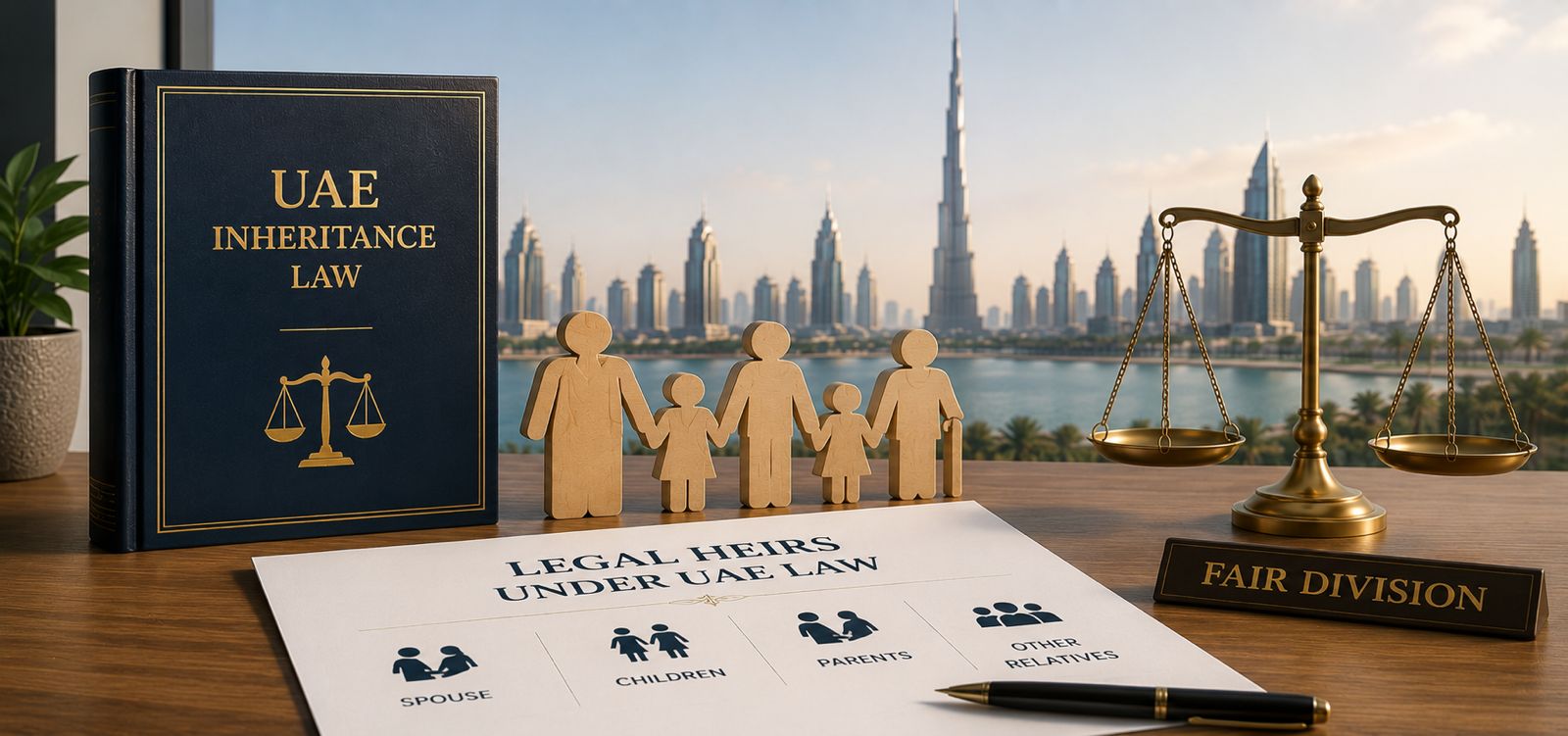
Who are the legal heirs under UAE law depends on the deceased’s religion, the applicable inheritance framework, the surviving family structure, and any valid registered will.
A relative may qualify for a fixed share, receive a residue, be excluded by a closer heir, or fall outside the default framework entirely.
Who are the legal heirs under UAE law? For Muslim estates, Faraid divides potential heirs into fixed-share heirs, residuary heirs, and distant kindred. Spouses, children, and parents are central, but closer relatives can exclude more distant relatives.
A non-Muslim relative generally cannot inherit from a Muslim relative through the default Sharia tiers, although a registered will may use the discretionary one-third portion for a non-heir.
Non-Muslim estates follow a separate civil framework. The default division commonly gives 50% to the surviving spouse and 50% equally among children, unless a registered will directs a different distribution.
Every family structure requires its own calculation.
Who Are the Legal Heirs Under UAE Law by Framework?
If you need professional guidance, inheritance lawyer in dubai can help you understand your options.
The starting point is the framework governing the estate. The legal rules and practical file steps are set out below.
The Two Tracks: Sharia Heirs and Civil Heirs
Not sure who to choose? Our guide on who is the best inheritance lawyer in dubai breaks down what matters most.
For a Muslim estate, Faraid and its fixed-share, residuary, and distant-kindred structure governs the analysis. A will does not replace that framework beyond the discretionary one-third portion described below.
For a non-Muslim estate, Federal Decree-Law No. 41 of 2022 provides a separate civil framework. The default position commonly gives 50% to the surviving spouse and divides the remaining 50% equally among children, unless a registered will directs the estate differently.
- Muslim estate: identify the qualifying Faraid heirs and apply the fixed and residuary hierarchy.
- Non-Muslim estate: apply the separate civil framework or the terms of a valid registered will.
Who qualifies as a legal heir in the UAE depends entirely on which framework governs the estate, and that split runs along religious lines.
The Three Tiers of Sharia Heirs
Our guide on how to register a will in dubai explains this further.
Faraid organizes potential heirs into three distinct categories, and understanding the hierarchy between them matters as much as knowing who is on the list at all.
- Fixed-share heirs (Ashab al-Furud). Their portions are set directly by the Quran, the spouse, children, and parents primarily, and cannot be altered by personal choice.
- Residuary heirs (‘Asaba). Typically male agnatic relatives, sons, grandsons, and paternal uncles among them, who receive whatever remains once fixed shares have been paid out.
- Distant kindred (Dhawil al-Arham). More remote relatives, who only inherit where no fixed-share or residuary heir exists at all.
A single relative can sometimes hold a role in more than one tier at once. A father, for example, can receive his fixed one-sixth share as a Quranic heir and additionally take a further portion as a residuary heir, depending on which other relatives survive.
Fixed Shares for the Core Family
You can read more about this in our guide on how to revoke or cancel a will in the UAE.
These portions are not discretionary, and they apply regardless of what a will might otherwise say, subject only to the one-third rule covered elsewhere in our guides on Sharia inheritance.
- A wife generally receives one eighth of the estate where children survive, or one quarter where they do not. A husband’s share follows the same logic at a higher rate, generally one quarter with children, or one half without.
- A son generally receives double the share of a daughter, reflecting the Quranic 2:1 ratio between male and female heirs of the same degree.
- A father generally receives a fixed one sixth where children survive, potentially alongside a further residuary share. A mother’s share also varies depending on the presence of children or multiple siblings.
- Inherit only where no children or parents survive, illustrating the exclusion principle covered next.
How Exclusion Actually Works
Under Faraid, closer relatives generally exclude more distant ones from inheriting at all, not just from a larger share, from any share whatsoever.
The presence of a son, for example, can prevent siblings of the deceased from inheriting anything at all, even though those siblings would otherwise qualify as heirs if no children existed. This exclusion principle is exactly why identifying the full surviving family structure correctly, not just the immediate assumption of who “should” inherit, is the necessary first step in any Sharia estate.
Before Calculating Shares
Not Sure Who Qualifies as a Legal Heir?
Inheritance shares cannot be calculated correctly until the full family structure, religion, applicable succession framework, and any registered will have been reviewed. Our UAE inheritance lawyers can help identify the qualifying heirs first.
Can a Non-Muslim Inherit From a Muslim Relative?
This is a point that catches many mixed-faith families in the UAE genuinely off guard, and it is worth stating plainly.
Under the default Sharia framework, only Muslim heirs are entitled to inherit. A non-Muslim spouse, child, or other relative is generally excluded from the fixed-share and residuary tiers entirely.
The one route available is the discretionary one-third portion of the estate, which a Muslim testator can direct to a non-Muslim family member, or anyone else who does not already qualify as a Sharia heir, through a properly registered will. Without that will, a non-Muslim relative may receive nothing at all from a Muslim family member’s UAE estate, regardless of the closeness of the relationship in practice.
Legal Heirs Under the Non-Muslim Civil Framework
For non-Muslim estates, the governing logic is genuinely different, built around gender-neutral, proportionate shares rather than the fixed Quranic ratios.
- A surviving spouse commonly receives 50% of the estate under the default civil intestacy position.
- The remaining 50% is divided equally among surviving children, regardless of gender, a clear departure from the Sharia 2:1 male-to-female ratio.
Where a non-Muslim registers a will through DIFC, ADJD, Dubai Courts, or ADGM, this default civil position can be overridden entirely, naming whichever beneficiaries the testator actually chooses.
Assets People Assume Bypass the Estate, But Do Not
A recurring and costly misconception among Muslim residents specifically: joint bank accounts, gratuity nominations, and life insurance beneficiary designations are often assumed to pass automatically outside the formal estate. UAE courts have repeatedly drawn all of these back into the Sharia estate in contested cases.
Relying on an informal nomination or a joint account structure as a substitute for proper estate planning is a genuine risk, not a reliable workaround.
Common Mistakes
- Assuming close family members automatically qualify as heirs, when the specific surviving family structure can exclude relatives who would otherwise inherit.
- Not realizing a non-Muslim spouse or child may receive nothing from a Muslim relative’s estate without a properly registered will.
- Assuming a joint account or life insurance nomination bypasses the Sharia estate automatically.
- Confusing the non-Muslim civil framework’s gender-neutral shares with the Sharia system’s fixed, unequal ratios.
- Overlooking that a single relative, a father in particular, can hold both a fixed share and a residuary share simultaneously.
Who Are the Legal Heirs Under UAE Law in Practice?
The answer cannot be calculated from one relationship alone. The full family structure, religion, applicable framework, and any registered will must be identified before shares are discussed.
- Confirm whether the Muslim Faraid framework or the non-Muslim civil framework applies.
- Prepare a complete family tree as at the date of death.
- Record the surviving spouse, descendants, parents, grandparents, and siblings.
- Identify the religion of relevant family members where the Muslim framework applies.
- Check for a registered UAE will and confirm its scope.
- Prepare an inventory of UAE assets and the way each asset is owned.
- Identify liabilities and documents needed for the succession file.
- Obtain the competent authority’s confirmation of heirs before distribution.
This sequence prevents a premature assumption that a familiar relative must receive a share. Under Faraid, a closer heir can exclude a more distant relative entirely.
Documents Used to Identify Legal Heirs
The exact court requirements depend on the estate and available records. A coherent file should prove identity, death, family relationships, and any registered testamentary instructions.
- The death certificate and any required attestation or Arabic translation.
- The deceased’s passport, Emirates ID, and available residency records.
- Marriage certificates and divorce records relevant to spousal status.
- Birth certificates or family-book records showing parent-child relationships.
- Death certificates for relatives who predeceased the deceased.
- A registered will and its registry details, if one exists.
- Identification documents for each potential heir or beneficiary.
- Asset and liability records connected to the UAE estate.
Names, dates, and relationships should match across the documents. Any inconsistency should be identified before the file is submitted.
Legal Heirs, Beneficiaries, and Executors Are Different
These roles are often confused. A legal heir receives rights under the applicable inheritance framework. A beneficiary is named to receive a gift under a will. An executor is appointed to administer the testamentary instructions and estate process.
- Legal heir: entitlement arises under the law governing the estate.
- Beneficiary: entitlement is stated in a valid will, subject to the applicable limits.
- Executor: responsible for carrying out the will and the required administration.
- Guardian: may be nominated for minor children, but that role is separate from inheriting assets.
One person may hold more than one role, but each role should be analysed separately.
For the wider distribution framework, read Sharia law for property distribution in the UAE or consult an inheritance lawyer in Dubai.
How to Build a Family Tree for an Inheritance Review
A useful family tree should record both relationships and status at the date of death. Begin with the deceased and work outward without omitting relatives who may later be excluded.
- Record the current or surviving spouse and any earlier marriage relevant to children.
- List every son and daughter, including the supporting birth record.
- Record whether either parent survived the deceased.
- Add grandparents and siblings even when closer heirs may exclude them.
- Mark any relative who died earlier and retain the supporting death record.
- Identify mixed-faith relationships where the Muslim framework may affect eligibility.
- Use full legal names and avoid family nicknames in the working schedule.
Mixed-Faith Families and the One-Third Portion
The applicable framework states that a non-Muslim relative generally does not inherit from a Muslim relative through the default fixed-share or residuary tiers. A properly registered will may direct the discretionary one-third portion to a non-heir.
Planning should therefore happen before death. A family relationship alone does not replace the legal eligibility rules, and an informal promise does not create a registered testamentary direction.
- Identify family members who would not qualify as Sharia heirs.
- Map the intended gift against the discretionary one-third portion.
- Check whether the intended recipient is already a legal heir.
- Draft and register the will through the appropriate UAE route.
- Coordinate the UAE document with any foreign will or estate plan.
- Review the plan after marriage, divorce, birth, death, or a major asset change.
Asset Records to Prepare Before Distribution
Identifying heirs and identifying the estate are separate tasks. A complete heir list does not show which assets exist, where they are held, or whether ownership records create another issue.
- Real estate title documents and current ownership shares.
- Bank and investment account records.
- Company shares, partnership interests, and corporate documents.
- Employment benefits and gratuity records.
- Insurance policies and beneficiary nominations.
- Joint-account mandates and the account-opening documents.
- Liabilities, secured debts, and pending claims.
- Any asset specifically addressed in a registered will.
Do not assume that a nomination or joint-account label decides the inheritance treatment by itself. Such arrangements have been brought into the Sharia estate in contested cases.
Mixed-Faith Family?
Could Someone Close to You Be Excluded From the Estate?
Family relationship alone does not always create inheritance rights. Where religion or the one-third discretionary portion matters, careful will planning can be essential. Our lawyers can review the intended beneficiaries and the applicable UAE inheritance framework.
Questions to Resolve Before Calculating Shares
- Which legal framework governs the estate?
- Was the deceased Muslim or non-Muslim?
- Is there a valid registered will?
- Who survived the deceased on the relevant date?
- Does a closer relative exclude a more distant one?
- Does religion affect a potential heir’s eligibility?
- Which assets are actually part of the UAE estate?
- Are any family or asset documents missing or inconsistent?
How to Review Exclusion Before Distribution
Exclusion should be considered only after the complete family tree is prepared. Starting with a short list of expected recipients can hide a closer heir whose presence changes the result.
- List all potential heirs by relationship without removing anyone at the first stage.
- Confirm who survived the deceased and support each relationship with documents.
- Place closer relatives before more distant relatives in the working family tree.
- Apply the fixed-share and residuary hierarchy to the verified structure.
- Record why any relative is excluded rather than silently deleting the name.
- Use the confirmed heir record before any asset is distributed.
A written explanation of the hierarchy helps family members understand that exclusion follows the applicable legal structure rather than a personal decision by another relative.
Final Legal-Heir File Checklist
- The applicable Muslim or non-Muslim framework has been identified.
- The family tree is complete and supported by civil-status documents.
- Every potential heir is listed before exclusions are applied.
- A registered will has been located and its scope checked.
- Mixed-faith eligibility issues have been identified.
- The UAE asset and liability inventory is current.
- Joint accounts, nominations, and insurance records have been reviewed.
- No distribution is based only on an informal family assumption.
Related planning guidance is available in the firm’s article on inheritance tax and estate planning in the UAE.
Frequently Asked Questions
Heir identification must come before share calculation. Contact Leaders Advocates for a family-specific review.
UAE Inheritance Review
Need to Calculate and Distribute an Estate Correctly?
Our UAE inheritance lawyers can review the family tree, identify exclusions, verify wills and relationship documents, examine joint accounts and nominations, and help determine the correct distribution before assets are transferred.


5 Comments