


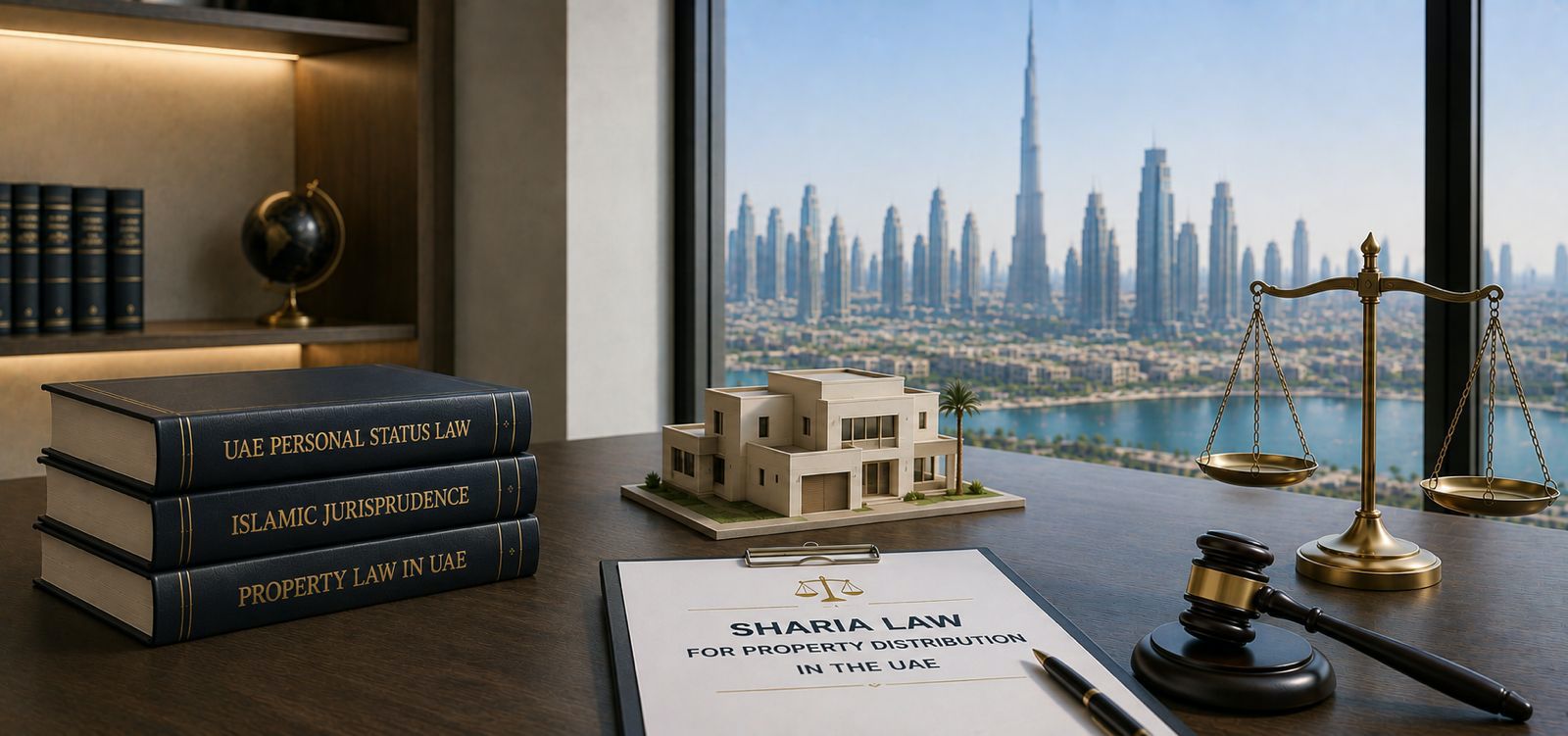
For years, a widely repeated warning circulated among UAE expats: die without a will here, and your property gets distributed under Sharia law, regardless of your religion. That warning used to be accurate. Since February 2023, it no longer is.
So how does property distribution actually work under Sharia law in the UAE today?
For Muslims, UAE-based property is distributed according to Faraid, the Quranic fixed-share system under Federal Decree-Law No. 41 of 2024, applying to all Muslim estates regardless of nationality. Shares are strictly fixed by law: a surviving wife receives one-eighth if there are children or one-quarter if not, while a son receives double a daughter’s share. At most one-third can be directed by will to non-heirs. For non-Muslims, Federal Decree-Law No. 41 of 2022 established a separate civil framework: Sharia principles no longer apply by default. Without a will, a civil default applies (50% to the spouse, 50% split equally among children), or a registered will (via DIFC, ADJD, or Dubai Courts) can govern.
Determine which framework governs your legal status. Non-Muslim property owners should formally register a will with the DIFC, ADJD, or Dubai Courts to specify beneficiaries and guardians, while Muslim asset owners should review their estate structure under mandatory Faraid allocations to avoid asset freezes or transfer delays.
Myth: “Non-Muslim Estates Automatically Fall Under Sharia Law Without a Will”
You can read more about this in our guide on UAE property law.
This is the single most common outdated belief regarding UAE inheritance.
Before February 2023, Sharia principles applied by default to non-Muslim estates in the absence of a registered will. Under Federal Decree-Law No. 41 of 2022, Sharia no longer applies by default. A separate civil framework governs non-Muslim estates instead, whether or not a registered will exists.
Want Your UAE Property Distributed Your Way?
The inheritance rules depend on whether you are Muslim or non-Muslim and whether a valid will is registered. Get your estate structure reviewed before relying on the statutory default.
Myth: “A Muslim Can Leave Their Entire Estate to Whichever Beneficiary They Choose”
If your situation involves this, it helps to speak with real estate lawyer in dubai.
Under UAE personal status law, testamentary freedom for Muslims is strictly capped.
A Muslim can direct at most one-third of their estate by will to beneficiaries who are not already entitled Quranic heirs. The mandatory Faraid fixed shares for legal heirs cannot be altered or overridden by personal choice beyond that limit.
Myth: “Recent Reforms Altered the Fundamental Sharia Fractional Allocations”
This connects closely with our guide on what happens to your dubai property if you leave or die.
While procedural updates occurred recently, core religious distribution rules remained intact.
Federal Decree-Law No. 41 of 2024 modernized the procedural, administrative, and court mechanics for succession without changing the underlying fixed-share formulas set by traditional Islamic jurisprudence.
Myth: “Registering a Will Is Unnecessary If the Statutory Default Appears Fair”
Relying on statutory default succession without formal registration exposes estates to administrative friction.
Even where the non-Muslim civil default aligns with family wishes, dying intestate causes immediate freezing of personal and corporate bank accounts and delays property transfers until courts issue succession certificates.
Myth: “DIFC Is the Exclusive Registry for Non-Muslim Wills in the UAE”
Multiple government forums handle non-Muslim estate registration across different fee structures.
While the DIFC Courts hold exclusive jurisdiction over wills registered specifically with them (under Dubai Law No. 2 of 2025), the Abu Dhabi Judicial Department (ADJD) and Dubai Courts both offer full will registration options, generally at lower government administrative fees.
Unsure whether your UAE property would fall under Faraid, the civil default, or a will you have not yet registered? A UAE inheritance lawyer from our team can confirm your position and register a will that reflects your actual wishes.
Why Estate Distribution Frameworks Function This Way in the UAE
If you are trying to decide who to hire, our guide on who is the best real estate lawyer in dubai explains what to look for.
Strip away the misconceptions, and the legal foundations governing UAE property succession are cleanly defined:
• Dual Legal Basis: Federal Decree-Law No. 41 of 2024 governs Muslim succession (Faraid), while Federal Decree-Law No. 41 of 2022 governs non-Muslim civil personal status.
• Mandatory Faraid Rules: Quranic fixed shares apply to all Muslim UAE assets regardless of expat nationality.
• Civil Non-Muslim Default: Equal gender split among children and 50% spouse allocation in the absence of a non-Muslim will.
• Registration Options: Non-Muslim wills can be registered across DIFC, ADJD, or Dubai Courts.
Proof: Application in Judicial Practice
The enforceability of UAE succession laws is clearly demonstrated through actual probate proceedings.
| Venue | Typical Registration Cost | Jurisdictional Notes |
|---|---|---|
| DIFC Wills Service Centre | AED 5,500 – AED 15,000 + VAT | Exclusive jurisdiction over wills registered directly with them (Dubai Law No. 2 of 2025). |
| ADJD (Abu Dhabi) | AED 950 – AED 1,900 | Lower registration fees, administered through the Abu Dhabi Judicial Department. |
| Dubai Courts | ~AED 2,020 | Dedicated non-Muslim inheritance division within Dubai Courts. |
Courts strictly enforce probate freezes on accounts upon notice of death until succession certificates or registered probate orders are produced. In Muslim probate cases, judicial orders strictly divide verified assets according to court-calculated Faraid certificates.
Common Mistakes to Avoid
• Assuming pre-2023 advice about automatic Sharia application to non-Muslims still applies.
• Attempting to write a Sharia-compliant will that excludes designated Quranic heirs.
• Neglecting to register a non-Muslim will, causing temporary account freezes and probate delays.
• Confusing government will registration fees with private legal drafting fees.
Frequently Asked Questions
So, how does Sharia property distribution actually work in the UAE? For Muslims, through the mandatory Faraid formula, largely unchanged in substance by recent reforms. For non-Muslims, through an entirely separate civil framework since February 2023, one that offers real choice and no longer defaults to Sharia at all.
The single most common mistake is applying outdated advice, assuming Sharia governs every UAE estate regardless of religion. If you want clarity on how your UAE property would actually be distributed, a UAE inheritance lawyer from our team can guide you through the right process.
Protect Your UAE Property Before It Becomes an Estate
A properly structured and registered will can help reduce uncertainty, probate delays, and disputes after death. Get advice on the right registration route and how UAE inheritance law applies to your assets.


1 Comment