


A resident receives a message claiming a large fine because a VPN was detected, an employee connects to a corporate VPN from home, or a user turns on a privacy service to reach an app that is restricted in the UAE. All three use similar technology, but the legal risk is not the same.
The correct analysis starts with purpose and conduct. A criminal defense lawyer in Dubai can help assess the specific facts and evidence, while those facing cyber-related allegations may also consider whos the best cybercrime lawyer in Dubai for their circumstances. The analysis should also distinguish between types of identity theft in the UAE and common cyber security threats in the UAE, because the underlying service, content, offence, authorisation, and evidence can determine the applicable legal position. Article 10 of the UAE Cybercrime Law does not punish the label VPN by itself; it targets use of a fraudulent protocol address for the purpose of committing a crime or preventing its discovery.
Quick Answer
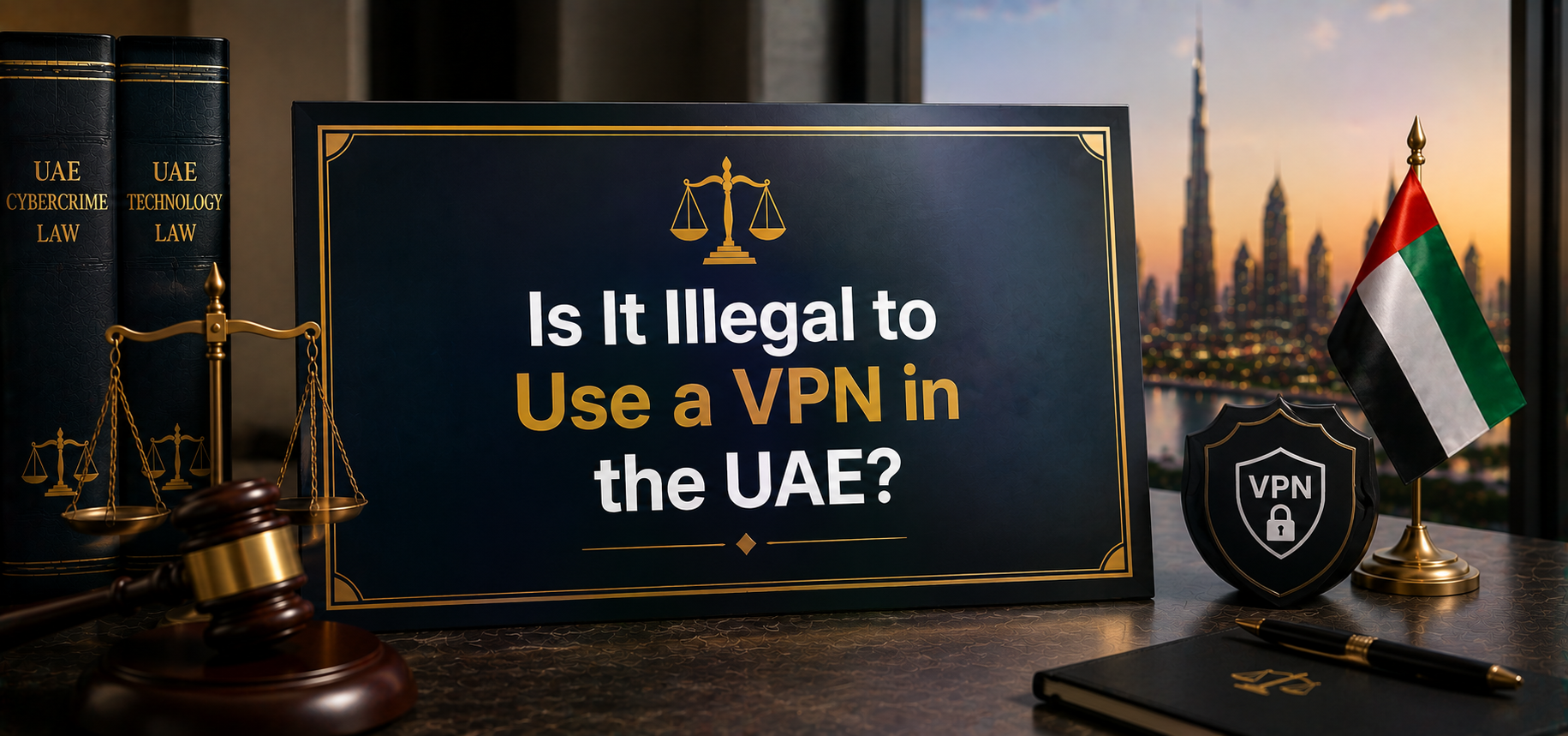
Using a VPN is not illegal in the UAE merely because it is a VPN. Article 10 applies when a fraudulent network address is used to commit or conceal a crime, with temporary imprisonment and an AED 500,000 to AED 2,000,000 fine, or either penalty. Lawful security use is different from enabling prohibited conduct.
Identify the actual purpose, service, content, and policy involved. Use approved security tools, avoid circumvention for unlawful activity, preserve any notice without clicking it, and verify a claimed penalty through the named authority’s official channel.
Stop Asking “Is a VPN Legal” and Start Asking This Instead
The more useful question is what you’re actually using it for.
A VPN protecting your banking session on public Wi-Fi and a VPN masking activity meant to defraud someone are the same technology, applied in two situations the law treats completely differently.
Everything else follows from that distinction.
Where VPN Use Genuinely Stays Legal
• Securing a connection on public Wi-Fi or while travelling.
• Corporate and banking security, standard practice for businesses operating in the UAE.
• General privacy protection, keeping your own browsing data private.
Received a VPN Fine Message or Cybercrime Notice in the UAE?
Do not click the link, pay immediately, or assume the notice is genuine. Our team can review the sender, reference, alleged conduct, Article 10 issue, and available digital evidence before you respond.
Where It Actually Crosses the Line
Concealing a Crime
Article 10’s core provision concerns using a fraudulent IP address specifically to commit or hide an offence.
Circumventing Restrictions to Use an Unauthorised Telecommunications Service
The legal risk depends on the service, applicable telecom rules, and whether the VPN is being used to commit or conceal a separate offence.
Accessing or Facilitating Gambling, Prohibited Content, or Another Unlawful Activity
Any exposure arises from the underlying conduct and may be compounded if a disguised address is used to commit or conceal the offence.
Downloading Copyrighted Material
Using a VPN to conceal unauthorised torrenting does not make the underlying copyright activity lawful and may add a separate layer of exposure depending on the facts.
The Detail Almost Nobody Mentions: “VPN Fines” Are Often a Scam
Article 10 does not create a standalone penalty merely for switching on a VPN.
A message demanding payment only because a VPN was detected should therefore be verified independently through the named authority’s official channel.
Do not click the notice, call the number in it, or send identity or bank details until its source and legal basis are confirmed.
Why the Enforcement Gap Doesn’t Mean the Law Doesn’t Apply
Many people use VPNs for legitimate security and privacy reasons without encountering any problem. That does not mean unlawful conduct becomes safe simply because enforcement has not occurred in a particular situation.
The law still applies where the required elements are present, including the purpose of committing or concealing a crime.
What Article 10 Actually Requires
Federal Decree-Law No. 34 of 2021 describes the offence as circumventing a network protocol address by using a false address, another person’s address, or another method for the purpose of committing a crime or preventing its discovery.
That final purpose element is essential.
The provision prescribes temporary imprisonment and a fine of not less than AED 500,000 and not more than AED 2,000,000, or either penalty.
It should not be reduced to a headline suggesting that anyone who installs or activates a VPN automatically owes AED 2 million.
A case may turn on evidence such as:
• Account activity.
• Messages.
• Connection logs.
• The underlying website, service, or platform.
• Payment records.
• Devices.
• Steps taken to conceal or continue an offence.
A technical VPN connection by itself does not answer the legal question.
Questions That Matter in a VPN Case
• Was a false, third-party, or otherwise disguised network address used?
• What underlying act was being carried out or concealed?
• Was that act itself criminal or otherwise prohibited?
• What evidence shows the user’s purpose, knowledge, and control?
• Do another law, telecom rule, employment policy, or contract also apply?
Examples of Legitimate VPN Use
Businesses commonly use private networks to protect internal systems, remote work, banking, professional communications, and sensitive data.
A corporate environment may require approved access, multi-factor authentication, device controls, logging, and restricted privileges. Those controls are consistent with authorised security use rather than criminal purpose.
Individuals may also use VPNs or other privacy tools to protect traffic on public Wi-Fi or reduce exposure of personal browsing activity.
The user should still comply with UAE law, the provider’s terms, employer policies, data requirements, and any restrictions affecting the destination service.
VPN Use in the Workplace
A company should document:
• Why remote access is required.
• Which VPN tool is approved?
• Who is authorised to use it.
• Which systems or data can be accessed?
• How authentication is controlled.
• Where connection logs are retained.
• How access is revoked when employment or authorisation ends.
Using an unapproved consumer VPN on a corporate device can create security, contractual, or disciplinary problems even where Article 10 itself is not engaged.
When VPN Use Can Add Legal Risk
Risk rises where a disguised address is used as part of fraud, hacking, extortion, unauthorised access, illegal gambling, copyright infringement, prohibited content, impersonation, or another offence.
In that situation, the VPN may become one part of the evidence showing that the activity was enabled or concealed.
Potential examples include:
• Using a disguised address during fraud, hacking, or account takeover.
• Concealing the operation, promotion, or use of an illegal gaming service.
• Downloading or distributing protected material without authorisation.
• Evading an access restriction to reach prohibited content or services.
• Breaching corporate access controls or using another person’s credentials.
Telecommunications Services Need Separate Analysis
Telecommunications services require their own review.
The TDRA regulates licensed telecom services, including VoIP. Circumventing restrictions to use an unauthorised service can raise telecom or contractual issues.
Article 10 still depends on its own statutory criminal-purpose test.
The safest approach is therefore not to treat every blocked service as creating the same legal consequence. Identify the underlying rule, conduct, purpose, and connection between the disguised address and the activity.
How to Respond to a Claimed VPN Fine
Do not pay directly from the message.
Preserve:
• The sender’s number or email.
• Email headers where available.
• The URL.
• Screenshots.
• The exact wording.
• Payment instructions.
• Any reference number.
Then find the authority’s official contact details independently and ask whether the notice and reference are genuine.
A real legal notice should be assessed by checking:
• The issuing authority.
• Case or transaction reference.
• Legal basis.
• Recipient details.
• Method of service.
• Official payment channel.
Common Signs of a Scam VPN Fine
Scammers may:
• Create extreme urgency.
• Threaten immediate arrest or deportation.
• Demand payment to a personal bank account or wallet.
• Ask for card details or one-time passwords.
• Request remote access to the user’s device.
• Refuse independent verification through an official authority.
If money or credentials have already been provided, contact the relevant bank, card issuer, exchange, employer security team, or other provider immediately.
Change compromised credentials from a trusted device and preserve the original messages before deleting anything.
A VPN Evidence Checklist for Users and Businesses
The record should distinguish the VPN connection from the underlying activity.
Useful evidence may include:
• Approved VPN tool.
• Account owner.
• Device used.
• Authentication record.
• Connection date and time.
• IP information.
• Destination service.
• Employer approval or legitimate business purpose.
• Relevant messages, downloads, transactions, or activity.
• The original notice.
• Independent verification with the alleged issuing authority.
Why Preserving Logs Matters
Incomplete logs can create uncertainty about who connected, when, and for what purpose.
Businesses should preserve access records lawfully, restrict them to authorised personnel, and follow applicable data-retention and privacy requirements.
Individuals should avoid editing screenshots, deleting messages, wiping devices, or creating a new explanation after an allegation has already arisen.
Worried Your VPN Use Could Create Legal Risk in the UAE?
The legal question depends on what the VPN was actually used to access, do, or conceal. Get the underlying service, activity, account, device, connection records, and purpose reviewed before assuming the technology itself decides the case.
Practical Rules for Safer VPN Use in the UAE
Use your employer’s approved service for work.
Keep devices updated.
Enable multi-factor authentication.
Do not share credentials.
Avoid unknown free VPN services that may collect data, inject advertising, or expose the device to malware.
Do not treat privacy technology as permission to access anything. If the underlying activity would be unlawful without the VPN, hiding the connection does not make it lawful.
For a live investigation, avoid public explanations, deleting evidence, contacting alleged victims, or responding to informal payment demands.
Preserve the record and obtain advice based on the actual allegation.
Received a VPN-related notice or facing a cybercrime allegation? The team at Leaders Advocates can review the alleged underlying conduct, Article 10, digital evidence, notice authenticity, corporate access records, and the appropriate police, prosecution, or defence response.
Common Mistakes
• Assuming VPN use itself is illegal, when the law actually focuses on how it is used.
• Believing a claimed “VPN fine” is genuine simply because the message mentions Article 10.
• Assuming years of trouble-free VPN use prove that prohibited underlying conduct carries no legal risk.
• Paying a message claiming a VPN fine without verifying the authority and legal basis.
• Assuming a blocked service is automatically lawful simply because it can technically be accessed.
• Deleting logs, chats, or device information after an allegation instead of preserving evidence.
Relevant Legal Services
A Cybercrime Lawyer in Dubai can assess Article 10, digital evidence, scams, and online allegations. A Criminal Defense Lawyer in Dubai can address police, prosecution, and defence strategy where an offence is alleged. A Litigation Lawyer in Dubai can evaluate connected civil, employment, or commercial disputes and evidence.
People Also Ask
Conclusion
The useful UAE question is not whether VPN technology exists on a device, but what it was used to do.
Legitimate security and privacy use is different from using a disguised address to commit or conceal an offence.
Verify notices independently, preserve the complete record, and obtain advice tied to the actual conduct and applicable rule.
Facing a Cybercrime Allegation Connected to VPN Use?
Article 10 issues can depend on purpose, the alleged underlying offence, network records, account activity, and evidence of concealment. Leaders Advocates can assess the notice, logs, devices, corporate approvals, and the appropriate police, prosecution, or defence response.