

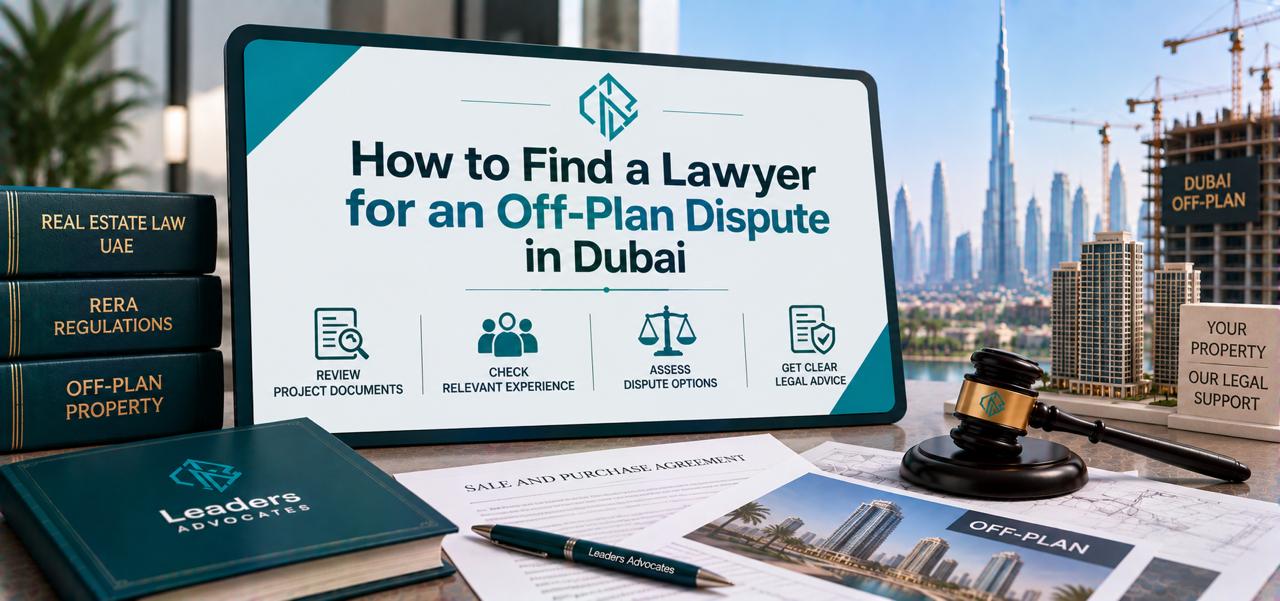

An off-plan dispute can involve delay, cancellation, changed specifications, payment demands, or escrow concerns. A general property background may not be enough. The lawyer must understand the project documents and the correct dispute route.
The wrong choice can waste time on a complaint that cannot deliver the requested remedy. It can also miss a notice requirement, contract deadline, or important project-status check.
The goal is not to find the loudest promise. It is to find counsel who can test the SPA, project status, payments, evidence, and remedy before recommending action.
Quick Answer
Start with focused off-plan experience. Ask whether the lawyer has handled delayed handover, developer default, project cancellation, escrow, Oqood, specification, and refund disputes.
Give the lawyer the SPA, payment record, Oqood certificate, notices, project updates, and marketing materials. Ask for a written issue map before choosing a complaint, negotiation, or court claim.
Confirm who will handle the file, how fees are calculated, which authority may have jurisdiction, and what evidence is still missing. Avoid any guaranteed outcome.
The right lawyer should explain the practical route in plain language. The advice should connect each requested remedy to the contract, project status, and available proof.
Faris Raian emphasizes that an off-plan dispute should begin with classification. A delayed project, an officially canceled project, a buyer payment default, and a specification claim do not follow one identical route.
He also recommends testing the remedy before drafting the complaint. A buyer seeking a refund needs a different evidence plan from a buyer seeking handover, defect correction, or delay compensation.
Use a document-led selection process. The lawyer should identify the dispute type, legal objective, forum, evidence gaps, cost structure, and next deadline before the engagement begins.
Define the Off-Plan Problem Before Searching
Write the problem in one sentence. State what the developer promised, what happened, and what result you now want. This prevents a general consultation from replacing a focused case review.
Separate delay from cancellation. Separate construction defects from changed specifications. Separate a disputed payment demand from an escrow or registration concern.
Also identify the current project stage. A project still under construction requires different checks from an officially canceled project or a unit already handed over.
- Delayed handover beyond the contractual date or stated extension.
- Project cancellation, suspension, or unclear construction status.
- Refund, termination, compensation, or specific-performance request.
- Oqood, escrow, payment-credit, or registration discrepancy.
- Unit-size, layout, finishing, facility, or defect dispute.
Confirm Focused Experience, Not a General Label
Ask for examples of the issues the lawyer has handled. The answer should distinguish developer disputes from ordinary sale, lease, or title work.
Relevant experience may include SPA analysis, RERA complaints, Dubai Land Department records, interim registration, canceled projects, expert evidence, and civil claims. Not every file needs every element.
A useful answer explains how the lawyer would classify your case. A vague statement about broad real estate experience does not show that the person understands your specific problem.
Do not ask only how many cases were won. Ask which facts changed the strategy, which documents mattered, and why a particular route was selected.
Facing an Off-Plan Property Dispute in Dubai?
Whether your dispute involves delayed handover, cancellation, payment demands, changed specifications, or developer default, Leaders Advocates can review your SPA, project status, payments, and available remedies.
Test Knowledge of the SPA
The sale and purchase agreement is the starting point. It may define the handover date, extension language, payment schedule, default process, notice method, specifications, and dispute clause.
Ask the lawyer to identify the clauses that control your immediate decision. A complete review should compare the contract with the payment history and project record.
The lawyer should not rely on one clause in isolation. Definitions, schedules, annexes, amendments, side letters, and signed acknowledgments can change the meaning of the main text.
Request a short clause map. It should state the promise, alleged breach, evidence, available response, and any deadline tied to the clause.
Ask About the Regulatory and Civil Dimensions
Some off-plan matters include a regulatory issue, a civil claim, or both. The correct combination depends on the facts and the remedy sought.
A regulatory complaint may address project or developer compliance. A civil claim may seek termination, repayment, compensation, or another enforceable order.
Ask what the selected route can actually produce. A complaint that encourages compliance may not replace a judgment for money. A court claim may not replace a required project-status or jurisdiction check.
The lawyer should explain whether the routes can proceed together, must follow a sequence, or should not be combined. That answer should be based on the current project record.
Check Oqood, Escrow, and Project Status
Off-plan files often turn on records outside the SPA. Confirm whether the unit appears on the Interim Property Register and whether the payment trail matches the transaction documents.
Ask which project-status records should be obtained. Construction progress, registration, developer status, and any cancellation decision can affect the available forum and remedy.
Escrow concerns should be stated precisely. Identify each payment, recipient account, date, receipt, and the contractual milestone connected to it.
A lawyer should separate a suspected irregularity from a proven record. The strategy should use official documents where available and avoid assumptions based on sales messages alone.
- SPA, annexes, amendments, and reservation documents.
- Oqood certificate and available registration records.
- Receipts, bank transfers, statements, and payment demands.
- Project updates, construction reports, and handover notices.
- Marketing materials tied to a disputed specification.
Ask for a Remedy Map
A strong consultation should end with options, not a slogan. Each option should identify the requested result, legal basis, evidence, likely sequence, and major risk.
Possible objectives include handover, completion, contract termination, refund, payment defense, compensation, specification correction, or defect repair. The file may support one objective more strongly than another.
Ask for the primary route and a fallback route. The lawyer should explain what new fact or document would cause the recommendation to change.
Be careful with absolute predictions. Off-plan outcomes depend on contract language, project status, performance history, expert evidence, and the authority hearing the matter.
Evaluate the Evidence Plan
The lawyer should organize evidence by issue and date. A large folder is not the same as a usable case file.
For delay, the file may need the contractual date, extension wording, notices, progress record, and proof of loss. For specifications, it may need the agreed schedule, marketing representation, inspection record, and expert material.
For payments, use complete statements and receipts. Cropped screenshots can hide the sender, date, surrounding conversation, or transaction reference.
Ask how Arabic translation, certification, expert review, and original-document production will be handled. These steps can affect cost and timing.
Understand Who Will Run the Case
Confirm the responsible lawyer, supervising partner, and day-to-day contact. Ask who will review the evidence and who will attend meetings or hearings.
A polished first meeting is not enough if the file is then passed without a clear handover. Request a communication plan and realistic response times.
Ask how strategy decisions will be approved. Important choices may include settlement authority, expert appointment, amendments, appeal, and enforcement.
The engagement should state the scope. It should distinguish advisory work, correspondence, regulatory filing, litigation, translation, experts, appeal, and enforcement.
Compare Fees by Scope and Stage
Compare proposals using the same scope. One quote may cover only an initial notice. Another may include pleadings, hearings, experts, judgment, and enforcement.
Ask which court fees, translation costs, expert fees, registration charges, and administrative expenses are excluded. A low headline fee can be misleading when the scope is narrow.
Stage-based fees can improve clarity. The client can see the cost of investigation, pre-action work, filing, hearings, appeal, and enforcement separately.
Also ask how settlement affects fees. The agreement should explain what remains payable if the dispute resolves early.
Prepare for the First Consultation
Send a one-page chronology before the meeting. List the booking date, SPA date, payments, promised handover, extensions, notices, project updates, and the current dispute.
Add a one-page objective note. State whether you want the property, a refund, compensation, corrected specifications, or a defense to a developer demand.
Do not hide missed payments, signed waivers, side agreements, or difficult messages. Early disclosure allows counsel to assess the real risk.
Finish with five questions. Ask about classification, forum, remedy, missing evidence, first deadline, and cost through the next defined stage.
Use a Final Selection Checklist
Choose the lawyer who gives the clearest supported analysis. The best fit should connect the facts to a practical plan without overstating certainty.
Record the recommendation after each consultation. Compare experience, issue identification, document requests, remedy logic, team structure, fees, and communication.
Before signing, read the engagement terms. Confirm conflicts checks, confidentiality, scope, billing, termination, document return, and responsibility for external costs.
- Focused off-plan and developer-dispute experience.
- Clear SPA, Oqood, escrow, and project-status review.
- Reasoned choice between complaint, negotiation, and claim.
- Defined evidence plan, team, scope, cost, and next deadline.
- No guaranteed result or pressure to file before review.
Final Takeaway
How to find a lawyer for an off-plan dispute in dubai starts with the dispute type and requested remedy. Focused experience matters more than a general property label.
Seeking a Refund or Termination of an Off-Plan Contract?
Your options can depend on the SPA, payment history, project status, Oqood records, notices, and the remedy requested. Leaders Advocates can assess the documents before you choose negotiation, a regulatory complaint, or court proceedings.
Choose counsel who can explain the SPA, official project record, evidence gaps, forum, costs, and next deadline in a short written plan.
Related Success Story
The firm’s Real Estate Commission Dispute in Dubai Success Story shows how organized transaction records can support a property recovery strategy. The result is case-specific and does not predict an off-plan outcome.
Common Mistakes
- Choosing a lawyer based only on a general real estate title.
- Filing before confirming the project status and requested remedy.
- Sending screenshots without the complete SPA and payment record.
- Assuming every RERA complaint can produce a monetary judgment.
- Comparing legal fees without comparing the included scope.
- Accepting a guaranteed outcome before the evidence is reviewed.
Relevant Legal Services
An Off-Plan Property and Developer Dispute Lawyer in Dubai can assess delay, cancellation, refund, payment, and specification issues.
A RERA Lawyer in Dubai can review the regulatory dimension.
A Real Estate Lawyer in Dubai can coordinate connected property and contract issues.
People Also Ask
Not Sure Which Legal Route Fits Your Off-Plan Dispute?
Faris Raian and the Leaders Advocates team can assess your contract, Oqood and escrow records, project status, evidence, and requested remedy to identify the appropriate next procedural step.