


A creditor’s law firm has sent a demand, started a claim, or opened execution. The debtor wants to settle but may not know the correct balance or sustainable payment terms.
The legal importance lies in acknowledgments, security cheques, guarantees, pending proceedings, default clauses, releases, and the enforceability of the final agreement.
Quick Answer
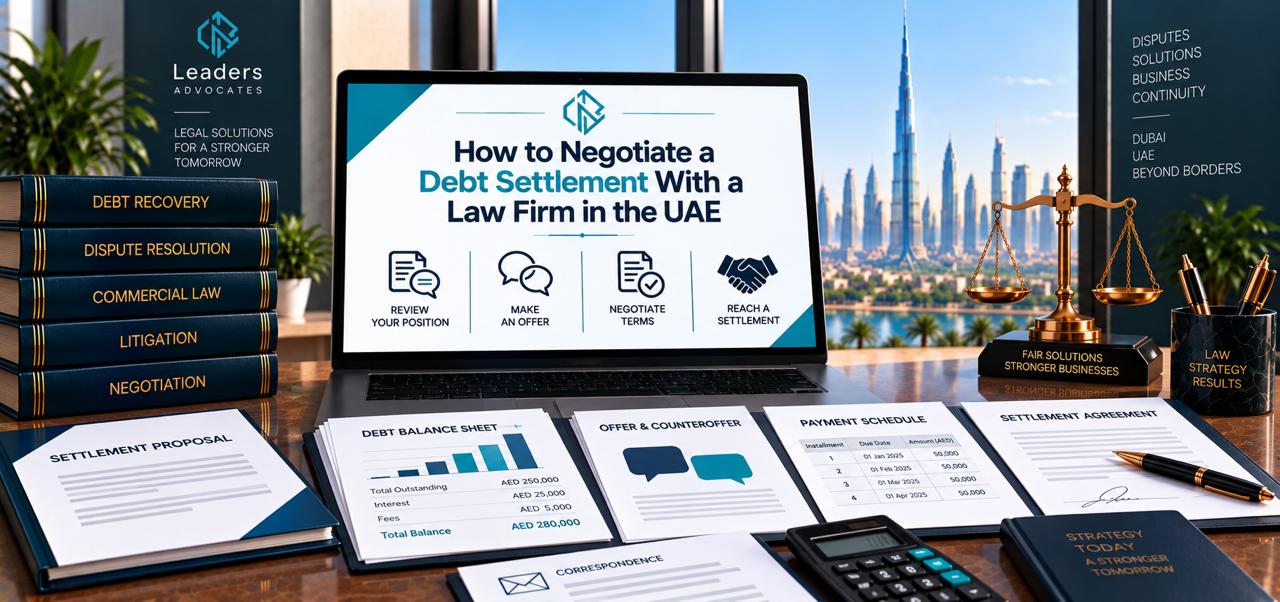
To understand how to negotiate a debt settlement with a law firm in uae, first verify the firm’s authority and request a full statement of account. Separate principal, credited payments, interest, fees, and disputed items.
Prepare a realistic offer supported by current financial information. It may be a discounted lump sum, installments, or both. Address security cheques, guarantees, pending claims, execution files, default consequences, and final release.
Do not pay before the terms are confirmed in writing. Request a clearance letter after completion. The outcome depends on the creditor’s instructions, the documents, available funds, security, and procedural stage. Independent review may be appropriate.
Understand Who the Law Firm Represents
The firm contacting you represents the creditor. Its duty is to advance the creditor’s interests and follow the authority given by its client.
You may request verification of the firm’s role, the creditor’s identity, the account reference, and the current procedural position.
Do not treat informal guidance from the creditor’s lawyer as independent advice. Significant debt, guarantees, cheques, or pending execution may justify separate counsel.
Verify the Debt Before Making an Offer
- Request principal, interest, fees, and costs separately.
- Check that every payment and credit was applied.
- Compare added charges with the contract.
- Identify admitted and disputed parts of the balance.
- Ask whether a judgment or execution file exists.
- Review cheques, guarantees, and other security.
Avoid a broad acknowledgment merely to open negotiations. The wording of admissions, part payments, or signed balance confirmations can affect legal rights.
If the claim is old, limitation and interruption issues require specific advice before signing or paying.
Not Sure the Balance Being Claimed Is Correct?
Send us the demand or statement on WhatsApp and we’ll help you check what’s actually owed before you respond.
Calculate a Settlement You Can Actually Perform
Prepare a realistic cash-flow summary. Include reliable income, essential expenses, current obligations, available savings, and funds that can genuinely be raised.
Do not offer installments based on expected income that has not materialized. A failed settlement can place the creditor in a stronger enforcement position.
Identify a maximum sustainable monthly payment and any immediate lump sum. Retain a buffer for essential expenses and unavoidable changes.
Choose the Right Offer Structure
- Discounted lump sum for rapid final payment.
- Short extension followed by payment in full.
- Fixed installments with clear due dates.
- Initial lump sum followed by installments.
- Settlement secured by an agreed guarantee or other lawful security.
Explain why the offer gives the creditor a better practical result than continued proceedings. Certainty and speed may matter more than a larger uncertain promise.
A creditor has no obligation to accept a discount or payment plan. The response depends on instructions, security, evidence, costs, and expected enforcement.
Negotiate More Than the Headline Amount
- Whether the sum is full and final settlement.
- Whether interest and legal costs stop accruing.
- Exact payment dates, account, and reference.
- Grace period and consequences of late payment.
- Whether one default accelerates the entire balance.
- Treatment of security and post-dated cheques.
- Release of guarantors, if agreed.
- Status of claims, judgments, and execution measures.
- Timing and wording of the clearance letter.
- How account status will be updated where applicable.
A reduced amount can still be a poor settlement if default terms are unrealistic or existing security remains available after completion.
Document the Agreement Before Paying
The written agreement should identify the parties, original obligation, disputed position if relevant, settlement consideration, payment schedule, security, and releases.
If court or execution proceedings already exist, state whether they will be suspended, adjourned, withdrawn, or closed, and at what stage.
A settlement through the Dubai Centre for Amicable Settlement of Disputes may obtain enforceable status under the applicable legal framework.
An enforceable settlement can protect both sides, but default consequences must be understood before signing.
Ready to Put an Offer in Writing?
Message us on WhatsApp now and we’ll help you draft terms that actually protect you before you sign anything.
Make Payments Safely and Preserve Proof
Use only verified payment instructions contained in or confirmed under the agreement. Be cautious about last-minute changes to bank details.
Keep bank confirmations, receipts, emails, and a running schedule showing every installment and the remaining settlement balance.
After final payment, obtain the agreed clearance letter and written confirmation about cheques, guarantees, proceedings, and execution files.
Settlement Risks to Avoid
- Paying before the written terms are agreed.
- Offering installments that are not sustainable.
- Failing to address existing execution measures.
- Leaving security cheques or guarantees unresolved.
- Accepting an unclear full-debt revival clause.
- Assuming a receipt equals a final release.
- Relying on verbal promises about credit reporting.
How Independent Counsel Can Help
Your lawyer can review the claimed balance, identify defenses, compare settlement with litigation risk, and negotiate terms that accurately reflect the agreement.
Counsel can also coordinate court filings and ensure that releases, security, and clearance obligations are completed at the proper stage.
How Procedural Stage Changes Negotiating Leverage
Before filing, the creditor may value speed and reduced cost. After judgment, the discussion may focus more heavily on assets, execution risk, and immediate payment.
During an expert stage, uncertainty about calculations can encourage compromise. During execution, an attachment may reduce the creditor’s willingness to discount.
Ask for the case number and current orders rather than relying on general statements that proceedings have started.
Negotiating Disputed and Undisputed Amounts
Identify the amount you accept and the amount you dispute. Explain the dispute with documents rather than using a blanket refusal.
A payment toward the undisputed part should state how it is to be applied and whether the remaining balance remains contested.
Do not sign a full-balance acknowledgment if the settlement is intended to preserve a genuine dispute, unless independent advice supports that choice.
Disputing Part of the Claimed Balance?
Don’t sign a full acknowledgment by mistake. WhatsApp us your documents and we’ll help you separate what’s owed from what’s disputed.
Security Cheques, Guarantees, and Collateral
List every cheque, guarantee, pledge, deposit, or other security connected to the debt. Record who holds it and what the original document permits.
The settlement should state whether security remains valid during installments and when it must be canceled, returned, or released.
If new security is requested, review its value and legal consequences. A settlement should not create disproportionate exposure without informed agreement.
Default Clauses Require Careful Review
Some agreements revive the full original debt after one missed installment, even when most of the settlement has been paid.
Check any grace period, notice requirement, acceleration clause, default interest, costs, and right to proceed immediately with execution.
Propose a short cure period for administrative or banking delay. The creditor may accept limited flexibility when the overall plan remains reliable.
Negotiation Conduct and Confidentiality
Keep communications factual and consistent. Do not conceal assets, submit false financial information, or make promises you know cannot be met.
Marking a communication “without prejudice” does not automatically determine its legal treatment in every context. Obtain advice on sensitive admissions.
Limit disclosure of personal information to what is necessary for the proposal. Use secure channels for bank records, identification, and financial statements.
After the Last Payment
Request a final account statement showing a zero settlement balance. Obtain the agreed clearance letter on the creditor’s letterhead or verified channel.
Collect written confirmation that relevant cheques, guarantees, claims, and execution steps were handled as promised.
Keep the agreement and proof permanently. Future collection contact can be answered quickly when the complete closure record is available.
How to Present the Offer
Open with a short statement that identifies the account and confirms the purpose of the communication. Avoid unnecessary background or emotional argument.
State the proposed amount, payment dates, source of funds, and requested treatment of the remaining balance, security, and proceedings.
Attach only the financial information needed to support the offer. Label sensitive documents and use a secure delivery method.
Set a reasonable acceptance period because funding may be time-limited. Clarify that payment is subject to a signed agreement.
Compare the Offer With Continued Proceedings
Estimate what the creditor may recover after legal costs, time, objections, competing creditors, and asset uncertainty. This frames the commercial value of certainty.
The debtor should compare settlement with defenses, likely judgment exposure, execution measures, credit impact, and the risk of default under the new agreement.
Both sides benefit from accurate information. A settlement based on false assumptions is more likely to fail and return the matter to enforcement.
Final Signing Checklist
- Correct creditor and debtor named.
- Authority of signatories confirmed.
- Full amount and currency stated.
- Schedule is affordable.
- Default and cure terms understood.
- Security treatment recorded.
- Proceedings addressed.
- Release and clearance obligations included.
Keep a fully signed copy before making the first payment.
About to Sign a Settlement Agreement?
Get it checked before you sign. WhatsApp us the draft and we’ll flag anything missing or risky within the hour.
Relevant Legal Services
The appropriate service depends on the claim, the contract, the forum, and the enforcement position.
- debt settlement and recovery lawyers in Dubai
- civil dispute lawyers in Dubai
- litigation lawyers in Dubai
Relevant Success Story
See our debt recovery success stories for an example of how documented recovery work may progress.
Past results do not guarantee a similar outcome. Every matter depends on its own facts, documents, assets, and legal circumstances.
Follow Leaders Advocates on LinkedIn or Leaders Advocates on Facebook for more UAE legal updates.
Frequently Asked Questions
Final Takeaway
Verify the debt and negotiate only around a payment structure you can sustain. The written terms must address security, proceedings, default, release, and clearance.
The safest next step is to review the claim, financial position, and draft settlement before paying. Every result depends on the documents and creditor instructions.
Received a Debt Demand From a Law Firm?
Don’t respond or pay until you know where you stand. WhatsApp Leaders Advocates now for a fast, confidential read on your options.