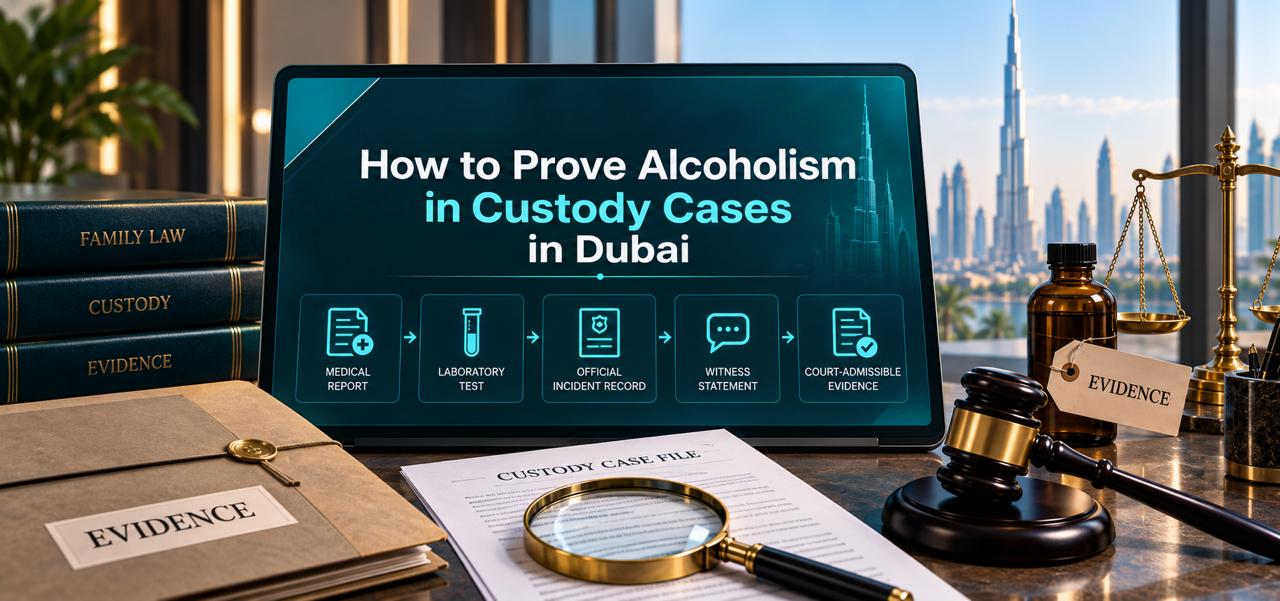

A parent may believe alcohol misuse makes the child unsafe. The court still needs lawful, reliable evidence. General accusations are rarely enough.
The current Personal Status Law creates two related routes. Addiction can affect eligibility directly. Alcohol-related failure of custody duties can also matter.
The evidence should match the route. It should protect the child without illegal surveillance, public accusations, or pressure on the child.
Quick Answer
Article 113 of Federal Decree-Law No. 41 of 2024 requires a custodian not to be addicted to alcohol, drugs, or psychotropic substances. Addiction can therefore directly affect a person’s eligibility to retain custody.
Article 115 also addresses loss of custody where a statutory condition is no longer satisfied or the custodian cannot perform custody duties. Evidence showing how the issue affects the child can support that route.
Strong evidence may include medical records, lawful test results, police or court records, credible witnesses, school records, and a dated incident chronology. Avoid unlawful recordings, hacked accounts, staged confrontations, or social media allegations. Seek targeted, child-centered court relief supported by current evidence.
Choose the legal route first. Then collect evidence that proves addiction, a failure of care, or both without putting the child at greater risk.
Two Legal Routes Can Apply
The first route focuses on addiction itself. Article 113 lists non-addiction as a condition that a custodian must meet.
The second route focuses on custody performance. Article 115 addresses loss of custody when conditions fail or the custodian cannot perform the required duties.
One file may support both routes. A medical diagnosis may address addiction. Missed school, unsafe driving, or neglect may address impact on care.
State each route separately in the case plan. Mixing every allegation into one paragraph makes the evidence harder to evaluate.
- Route 1 asks whether addiction is established.
- Route 2 asks whether care duties failed.
- Both routes require lawful and reliable evidence.
- The requested order must protect the child’s interests.
Worried Substance Abuse Is Putting Your Child at Risk?
Do not rely on accusations alone. Get legal advice on the evidence, existing custody arrangements, and child-centered court measures that may be available.
Article 113 and Custodian Eligibility
Federal Decree-Law No. 41 of 2024 is the current federal Personal Status Law. Article 113 lists the conditions for a custodian.
Those conditions include adulthood, sanity, trustworthiness, ability, and freedom from a dangerous contagious disease. The article also addresses conviction history and other circumstances.
It expressly requires the custodian not to be addicted to drugs, psychotropic substances, or alcohol. This is not merely a moral allegation.
The case still needs proof. A statement that someone drinks does not establish addiction. The evidence must address the statutory condition.
Article 115 and Failure of Custody Duties
Article 115 addresses situations in which the right to custody may lapse. One ground is failure of a required Article 113 condition.
Another ground concerns inability to carry out custody duties. The court can therefore examine how alcohol misuse affects actual care.
Focus on specific events. Identify the date, conduct, child impact, witness, and supporting record for each incident.
Avoid broad character attacks. The legal question is whether the statutory condition or custody duty is affected.
Build an Evidence Hierarchy
Not all evidence has equal weight. Start with objective records created close to the event. Add witnesses who observed conduct directly.
Use messages and photos only when they are authentic, lawful, and relevant. A dramatic screenshot may be weak without date, source, or context.
Corroboration matters. A school record and a neutral witness may support the same missed pickup. A police record may support a safety incident.
Create a short evidence note for each item. State what it proves, where it came from, and which legal route it supports.
- Official court, police, or government records.
- Medical assessment and authorized test results.
- School, nursery, or health-care records.
- Neutral witness evidence based on direct observation.
- Authenticated communications, photos, or video.
- The parent’s own dated incident notes.
Medical Evidence of Addiction
Medical evidence may address diagnosis, treatment, relapse, intoxication, withdrawal, or a related condition. The court decides relevance and weight.
A single result may prove recent consumption. It may not prove a continuing addiction by itself. The test type and detection period matter.
An expert may need a full history. Treatment notes, prescriptions, prior testing, and clinical assessment can provide context.
Medical privacy still applies. Obtain records through consent, lawful disclosure, or a court-directed process. Do not impersonate the other parent.
Police, Criminal, and Official Records
Police reports can document a crash, disturbance, threat, public intoxication, or another incident. A report is more useful when the event connects to the child.
A report does not automatically prove every allegation. Obtain the final status, related test result, judgment, or official disposition when available.
Criminal records should be described accurately. An allegation, investigation, charge, and conviction are different stages.
Avoid public accusations. Use official channels. Keep certified copies and translations for the family case.
Witness Evidence That Helps the Court
A useful witness describes what they personally saw, heard, or did. A witness should not repeat rumor or diagnose addiction without expertise.
Neutral witnesses can be valuable. Teachers, caregivers, building staff, drivers, doctors, or family friends may have direct observations.
Ask each witness to prepare a chronology. Include dates, place, conduct, child presence, and immediate response.
Do not coach identical wording. Independent detail improves credibility. Preserve original messages that show when the witness reported the event.
- What did the witness observe directly?
- When and where did it happen?
- Was the child present or affected?
- Was emergency help requested?
- Is there a matching document or message?
School and Medical Records About the Child
The child’s records can show impact without asking the child to take sides. Examples include repeated late arrivals, missed pickups, absences, or untreated needs.
Medical records may document an injury, missed appointment, medication problem, or anxiety symptom. The record should not be stretched beyond what the clinician wrote.
Ask the school or provider for records through the proper channel. Do not pressure staff to give opinions outside their role.
Link each event to a custody duty. Explain how the order requested would prevent recurrence and maintain stability.
Digital Evidence and UAE Privacy Risks
Messages, photos, location data, and videos may be relevant. The method used to obtain them matters.
Do not access a password-protected account without authority. Do not install tracking software. Do not take another person’s device secretly.
Do not record private conversations without first obtaining legal advice about UAE law. A family dispute does not cancel privacy rules.
Preserve the original file, device, date, sender, and full conversation. Cropped screenshots can hide important context.
Create a Child-Centered Incident Chronology
A chronology turns scattered concerns into a reviewable record. Use one entry for each event. Keep the language factual.
Record date, time, location, observed conduct, child impact, immediate response, witnesses, and supporting documents. Note uncertain details as uncertain.
Separate alcohol evidence from parenting disagreements. A late handover caused by traffic is not proof of addiction.
Update the chronology promptly. Do not rewrite earlier notes after litigation begins. Preserve the original version when possible.
- Describe the event in neutral language.
- Identify who observed it.
- State how the child was affected.
- Attach the matching record.
- State which legal route the event supports.
- Identify the protective order requested.
Ask for Targeted Protective Measures
The requested relief should match the proven risk. The court may need a temporary arrangement before the final custody decision.
Possible requests depend on law and facts. They may address supervised contact, handovers, testing, treatment evidence, travel, communication, or temporary care.
Do not ask for the broadest restriction by default. Explain why each measure is necessary, workable, and centered on the child.
Include a safe alternative plan. State where the child will live, attend school, receive medical care, and maintain appropriate family contact.
Be Ready for Defenses and Changed Circumstances
The other parent may deny addiction, challenge the evidence, or show treatment and recovery. The court can examine current circumstances, not only past conduct.
Article 115 states that custody may be requested again when the reason for its lapse is removed. Recovery evidence can therefore become important.
Test the reliability of both sides’ evidence. A lawful current assessment may be more useful than old accusations.
Keep the child’s stability at the center. The goal is a safe arrangement, not punishment through family proceedings.
Respond Safely to an Immediate Incident
If the child faces immediate danger, prioritize safety. Contact the appropriate emergency, police, medical, or child-protection channel for the facts.
Do not create a confrontation to obtain evidence. Move the child only within the law and any existing court order, unless an emergency authority directs otherwise.
Document the immediate condition. Record the time, location, witnesses, medical response, and official reference number.
Tell counsel about current custody, travel, and handover orders. An urgent application must explain both the risk and the temporary arrangement requested.
After the emergency, preserve routine. Inform the school or health provider only to the extent needed for safety and compliance.
An urgent event can support the wider case. It should still be presented with accurate records and a child-centered solution.
Do You Have Evidence of Addiction or Unsafe Parenting?
Medical records, lawful test results, police records, witnesses, school evidence, and documented incidents may be important. Have your evidence reviewed before filing or confronting the other parent.
Final Takeaway
Knowing how to prove alcoholism in custody cases dubai starts with the correct legal route. Prove addiction, failed care duties, or both with lawful evidence.
Keep the file factual and child-centered. The strongest request offers the court a safe and workable plan.
Related Success Story
The firm’s Successful Child Custody & Divorce Case in Dubai shows how organized evidence can address serious allegations in a custody dispute. The result is case-specific and does not guarantee another outcome.
Building a Child-Safety Evidence File?
Leaders Advocates can identify the correct legal route, preserve lawful evidence, and prepare targeted custody relief.
Common Mistakes
- Treating ordinary drinking as automatic proof of addiction.
- Using one isolated event without corroboration or context.
- Hacking accounts, tracking devices, or making unlawful recordings.
- Asking a child to collect evidence or choose sides.
- Using public accusations instead of official procedures.
- Requesting broad restrictions without a safe alternative care plan.
Relevant Legal Services
A Child Custody Lawyers in Dubai can connect the evidence to Articles 113 and 115. A Family Lawyers in Dubai can coordinate protection, support, visitation, and expert issues. A Divorce Lawyers in Dubai can address the custody evidence within a wider divorce case.
People Also Ask
Need to Protect Your Child Through a Custody Application?
Leaders Advocates can assess the custody conditions, evidence of substance abuse, impact on the child, existing orders, and the appropriate court relief for your circumstances.