

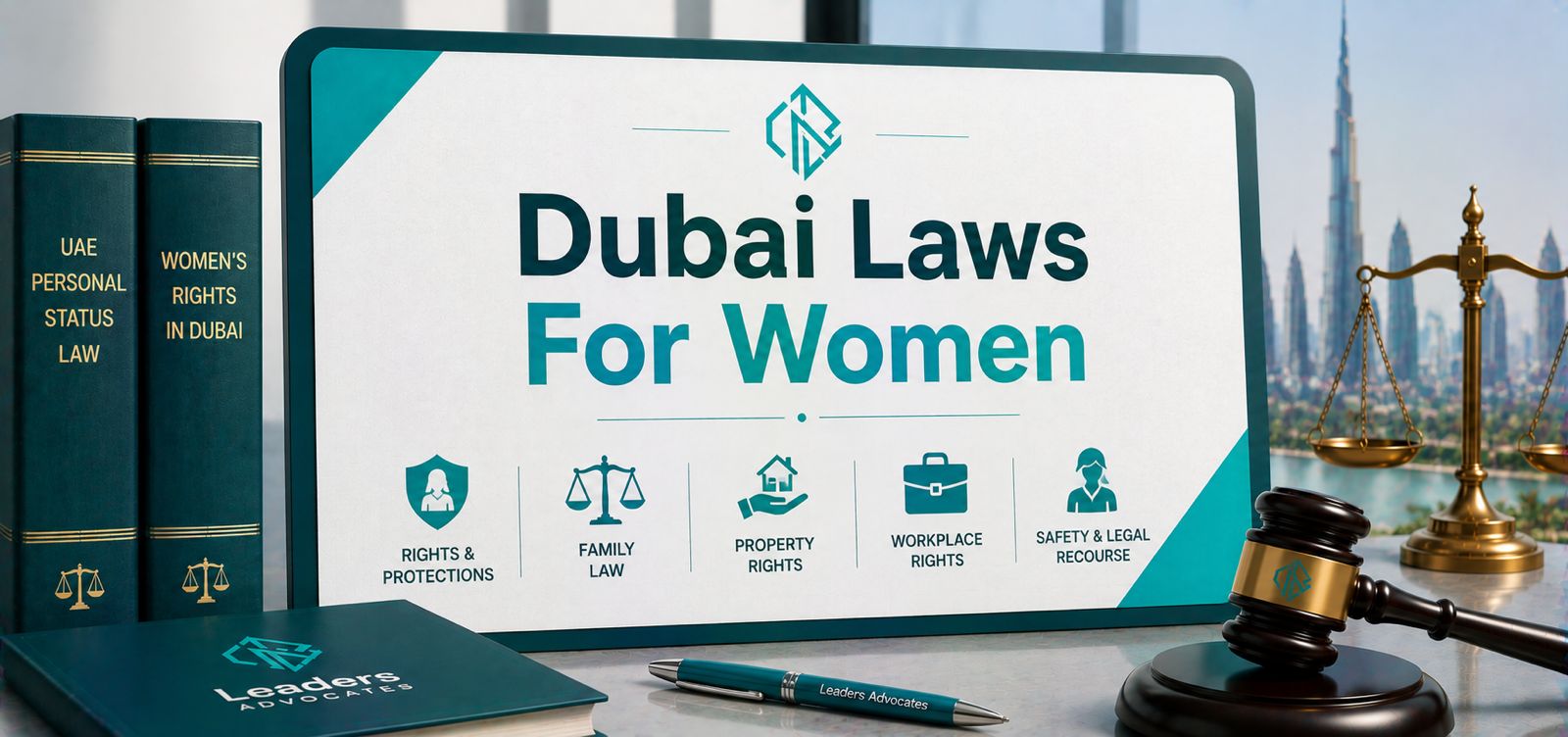

A woman searching for her rights in Dubai may find explanations drawn from different legal regimes, older statutes, or another country’s family law.
Statements about equal inheritance, unilateral civil divorce, joint custody, or the end of old custody ages can each be accurate in context but misleading when presented as one rule for every family.
The first legal task is therefore not to collect isolated rights.
It is to identify the governing personal-status framework, nationality and religion factors, any valid choice of law, the court or authority involved, and the exact relief needed.
A woman planning divorce, custody, inheritance, or evidence strategy should not assume that a reform applying to one category automatically controls another.
Quick Answer
Dubai Laws For Women reflect more than one UAE personal-status framework.
Under Federal Decree-Law No. 41 of 2022 on Civil Personal Status, which applies within its defined scope, a woman’s testimony has the same evidentiary value as a man’s, inheritance is distributed equally between men and women, spouses have an equal unilateral right to request civil divorce, and joint custody is the stated post-divorce starting point until the child reaches 18.
Separately, Federal Decree-Law No. 41 of 2024 governs families within its scope and replaced the former automatic custody end ages of 11 for a boy and 13 for a girl with custody continuing to age 18, while preserving separate rules on custodian conditions, welfare, and the child’s choice at age 15.
These rights must be applied to the correct legal regime and facts.
Current orders, foreign documents, safety, support, and property issues may require separate steps.
Identify the applicable legal regime first, then map testimony, divorce, custody, inheritance, support, safety, and cross-border issues as separate questions. Experienced family lawyers in Dubai can help determine which legal framework applies, while how to choose best criminal lawyer for your case in Dubai may become an important question where the matter also involves criminal allegations or proceedings.
Use current law and the actual court order rather than relying on an old summary. This is particularly important when assessing practical remedies, including how can a truck accident lawyer help your case in Dubai where a separate injury or liability claim is involved, or determining how do report false accusations in a court case when disputed allegations affect the proceedings.
Why the Governing Personal-Status Framework Comes First
Federal Decree-Law No. 41 of 2022 on Civil Personal Status applies to the non-Muslim persons and situations defined by that law.
Federal Decree-Law No. 41 of 2024 provides the broader Personal Status Law for families within its scope.
The two laws use different structures, so an answer about divorce, inheritance, or custody should state which framework it is describing.
Nationality, religion, residence, marriage documents, foreign judgments, and any legally available choice-of-law question can affect the analysis.
The client should bring identity documents, the marriage certificate, children’s records, existing judgments, and any foreign agreement or order.
The lawyer can then identify what Dubai courts can decide and whether foreign-law advice or document legalization is also needed.
Testimony Under the Civil Personal Status Law
The Civil Personal Status Law states that a woman’s testimony has the same evidentiary value as a man’s without discrimination.
That principle is important, but it does not mean every statement automatically proves the case.
Relevance, consistency, authenticity, supporting documents, and the ordinary rules governing evidence and procedure still matter.
A woman preparing for a dispute should organize contemporaneous records rather than rely only on memory.
Contracts, bank records, messages, school and medical documents, photographs, official reports, and witness information may each serve a different purpose.
Evidence should be preserved lawfully and presented through the correct procedural route, especially where private communications or foreign documents are involved.
Inheritance Equality Within the Civil Regime
Under the Civil Personal Status Law, inheritance is distributed equally between men and women.
This is a rule of that civil regime and should not be presented as replacing every inheritance framework in the UAE.
Muslim inheritance and estate matters can follow different rules, while wills, jointly owned assets, beneficiary arrangements, debts, and foreign estates may also affect the practical distribution.
Planning should identify the deceased’s legal status, assets, liabilities, registrations, family relationships, will, and jurisdictions involved.
Property title and bank ownership should not be confused with the final inheritance analysis.
Cross-border families may need coordinated advice so that a UAE step does not conflict with probate, tax, or succession proceedings elsewhere.
Need Clarity on Your Legal Rights in Dubai?
Divorce, custody, inheritance, support, and evidence rules can differ depending on the personal-status framework that applies to your family. Leaders Advocates can review your circumstances and explain the legal route that fits your case.
Equal Access to Civil Divorce
The Civil Personal Status Law gives both spouses an equal, unilateral right to request divorce through the court within that regime.
The right to ask for divorce should be separated from the financial, parenting, housing, and enforcement questions that follow.
A simple civil divorce application does not automatically resolve every related issue between the spouses.
Before filing, a woman should identify immediate safety or housing concerns, children’s arrangements, financial support, assets and debts, foreign proceedings, and documents that may be needed.
Negotiation or mediation may be suitable in some cases, but any agreement should be clear, lawful, and capable of recognition or enforcement where the family and assets are located.
Custody Under the Civil Personal Status Law
The civil framework states joint custody as the post-divorce starting point and continues it until the child reaches 18.
The principle is designed around shared parental responsibility, but a court can still need to address residence, schedules, education, health, travel, communication, and a dispute about what arrangement serves the child.
A parent should propose a workable plan rather than repeat the word joint custody without operational detail.
School calendars, handovers, distance, work schedules, passports, travel consent, medical decisions, and communication methods should be considered.
Evidence should stay child-focused and should not use the child as a messenger or witness in the parents’ personal conflict.
• Confirm the law and current order governing the family.
• Separate legal custody, daily care, residence, contact, and travel questions.
• Document school, medical, housing, payment, and caregiving arrangements.
• Prepare a realistic parenting proposal with clear decision-making steps.
• Seek urgent protection through lawful channels where immediate risk exists.
What the 2024 Personal Status Law Changed for Custody
For families governed by Federal Decree-Law No. 41 of 2024, the old automatic end ages of 11 for a boy and 13 for a girl were removed, and custody now continues to age 18.
This change should be distinguished from Article 122, under which a child who has reached 15 may choose between parents unless the court finds that the choice conflicts with the child’s interests.
Duration does not eliminate the other custody provisions.
Conditions for a custodian, legal grounds for loss or change of custody, relocation, welfare, existing orders, and evidence remain relevant.
A mother should not assume that custody is guaranteed until 18 regardless of conduct, and another parent should not rely on the repealed age cutoffs to demand an automatic transfer.
Ekaterina Butseva, Founder and Partner at Leaders Advocates, said that the reforms change the practical position for women navigating family matters in the UAE, particularly those with cross-border connections. She explained that a woman relying on an older understanding of custody, inheritance, or divorce rights should confirm her position under the current framework.
That is especially important where advice found online describes how the law worked years ago or assumes that a foreign marriage and foreign assets will be handled exactly as they are in another jurisdiction. A current legal map should identify the UAE issue, any foreign-law component, the immediate decision, the responsible professional, and the documents required for both systems.
Practical Protection, Support, and Enforcement
Rights on paper may require urgent or follow-up procedure.
A woman may need interim support, a parenting or travel order, protection from domestic violence, enforcement of an existing judgment, or a modification when circumstances change.
These are separate requests and should be presented with the correct evidence and authority rather than combined into one general complaint.
Safety concerns should be handled through competent police, prosecution, protection, or court channels suited to the facts.
Financial and parenting records should be preserved, and existing orders should not be breached through self-help without advice.
A focused strategy distinguishes immediate protection from the longer divorce, custody, inheritance, or enforcement case.
Cross-Border Documents and Decisions
Foreign marriages, divorces, custody orders, wills, and asset records may need legalization, certified Arabic translation, recognition, or a separate proceeding.
Translation alone does not establish that a foreign judgment is enforceable or that a foreign document has the same legal effect in Dubai.
The applicable treaties, law, and procedure should be checked.
The client should keep a chronology of residences, proceedings, travel, children, and assets and should disclose any existing order before seeking a new one.
Parallel cases can create inconsistent obligations if lawyers in different countries are not coordinating.
Clear role allocation prevents the client’s story from changing as it moves between languages and legal systems.
Planning Divorce or Facing a Custody Issue?
The correct strategy depends on which UAE personal-status law applies, the current court orders, the children’s circumstances, and any support, travel, or safety concerns. Get a case-specific legal assessment before taking the next step.
Related Success Story
The firm’s Successful Child Custody & Divorce Case in Dubai involved connected custody, support, travel, and evidence issues.
It illustrates why a woman’s legal strategy may require coordinated requests rather than one general claim.
The reported result is case-specific and does not guarantee the same outcome for another family.
Need a Current Map of Your Rights in Dubai?
Leaders Advocates can identify the governing personal-status framework and coordinate divorce, custody, inheritance, support, safety, evidence, and cross-border document issues.
Common Mistakes
• Applying a Civil Personal Status rule to every family without checking scope.
• Relying on the former custody ages of 11 for a boy and 13 for a girl.
• Assuming equal testimony means supporting evidence and procedure no longer matter.
• Treating divorce as automatically resolving custody, support, property, and enforcement.
• Using a translated foreign order without checking legalization or recognition.
• Breaching a current parenting, passport, travel, or residence order through self-help.
Relevant Legal Services
A Family Lawyers in Dubai can identify the governing framework and coordinate connected personal-status issues.
A Divorce Lawyers in Dubai can advise on civil or other divorce routes, filings, agreements, support, and enforcement.
A Child Custody Lawyers in Dubai can address residence, contact, joint custody, travel, evidence, and child welfare.
People Also Ask
Conclusion
Dubai Laws For Women provide important rights and reforms, but the correct result depends on applying the right personal-status framework.
Testimony, civil inheritance, divorce, custody, safety, support, and cross-border enforcement should be mapped separately.
Current legal advice prevents an older rule or a rule from another regime from controlling the strategy by mistake.
Does Your Family Matter Involve More Than One Country?
Foreign marriages, custody orders, inheritance documents, assets, and judgments may require recognition, legalization, translation, or coordinated legal advice. Leaders Advocates can help map the UAE and cross-border issues before conflicting steps are taken.