


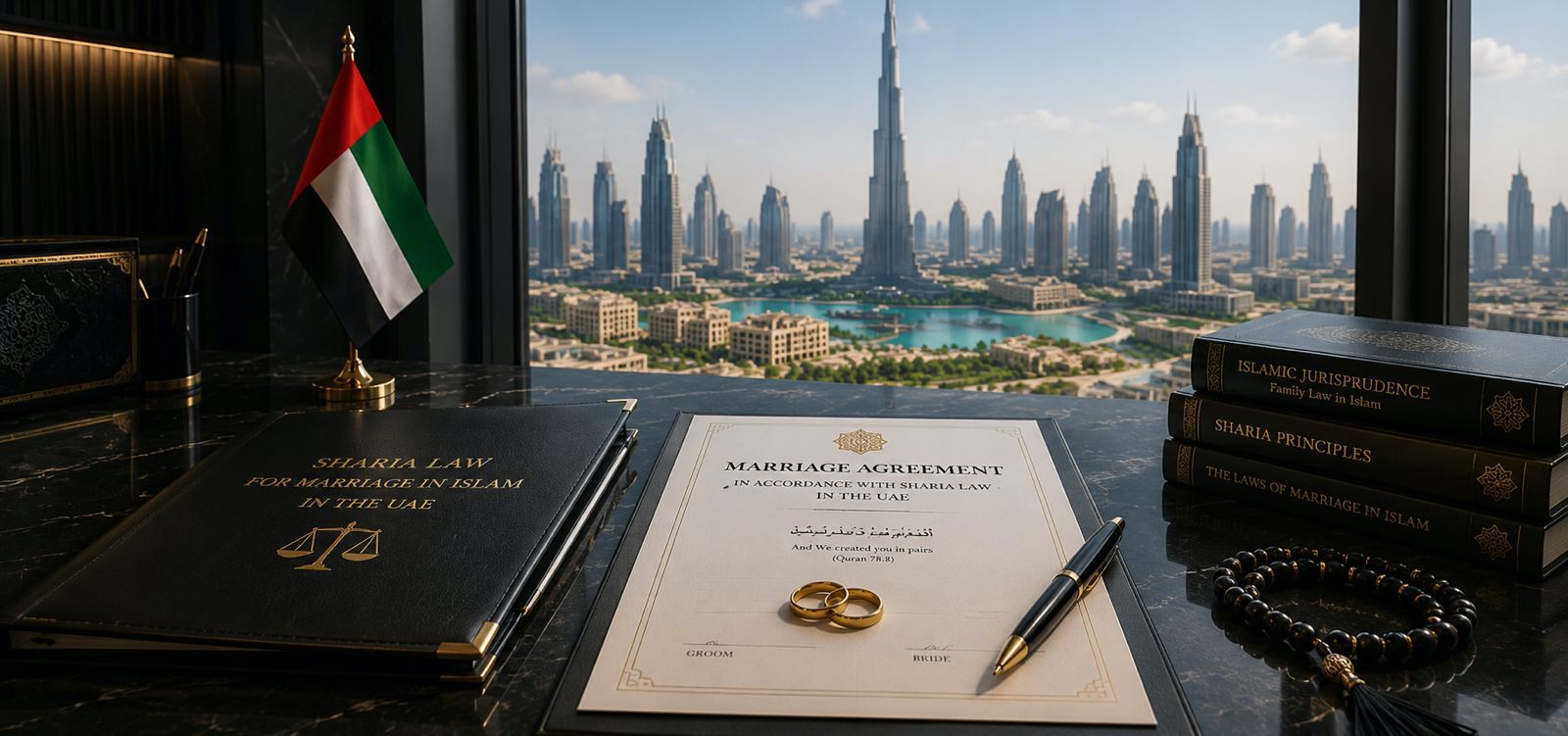

What makes a Muslim marriage legally valid in the UAE? The answer is not simply that a Nikah ceremony took place. The contract must satisfy the current Personal Status Law and the official documentation process.
Federal Decree-Law No. 41 of 2024 governs Muslim personal status and took effect on 15 April 2025. A valid marriage requires matching offer and acceptance, a guardian when the wife is Muslim subject to legal exceptions, two qualified witnesses, legal capacity, and no legal impediment. The marriage contract must be documented by the court.
Confirm each party’s religion, nationality, age, marital status, and emirate. Use the judicial authority’s official marriage service, complete medical screening and attestation, and verify the guardian, witnesses, and dowry terms before the appointment.
Myth: “A Private Nikah Is Enough for UAE Legal Purposes”
You can read more about this in our guide on how to get a prenuptial agreement in the UAE.
A private Nikah can express religious commitment, but it does not replace UAE court documentation.
Article 41 requires the marriage contract to be documented under the applicable court procedures. An interested person may later ask a court to prove an undocumented marriage, but that remedy is not a sensible substitute for using the official process from the beginning.
A court-issued certificate protects both spouses in visas, birth registration, inheritance, property matters, and any later family case.
Is Your Muslim Marriage Legally Valid in the UAE?
A Nikah ceremony alone may not be enough. Our UAE family lawyers can review your marriage requirements, guardian position, witnesses, dowry terms, and court documentation before you proceed.
Myth: “Every Muslim Woman Always Needs the Same Wali Rule”
This connects closely with our guide on is child marriage legal in dubai.
The default rule requires a guardian when the wife is Muslim, but the current law contains important qualifications.
A foreign Muslim woman does not need a guardian when the law of her nationality does not require one. A guardian also cannot block a suitable marriage without valid reason. The woman may ask the court to address an unjust refusal or an unavailable guardian under the statutory rules.
The exception depends on proof and the applicable law. It is not a general waiver for every Muslim bride.
Myth: “Mahr Replaces Consent, a Guardian, or Witnesses”
Dowry is the wife’s legal financial right, but it is not a substitute for the contract’s core elements.
Article 18 focuses on offer and acceptance, guardianship where required, and two qualified witnesses. Dowry should still be recorded clearly, including any prompt and deferred portions, because it belongs to the wife and can become important in a later dispute.
A clear dowry term strengthens the financial record; it does not cure a missing element of the marriage contract.
Myth: “Turning 18 Is the Only Age Rule That Matters”
Marriage capacity normally begins at 18 Gregorian years, and a younger person needs court permission.
A separate court-approval rule applies when a virgin bride and her intended husband have an age difference exceeding 30 years. Capacity, consent, and the absence of legal impediments must all be checked before the contract is concluded.
Age can trigger more than one legal check. The marriage authority should review the facts before a date is fixed.
Myth: “A Muslim Expat Can Never Choose Civil Marriage”
Working with marriage lawyer in dubai can help you avoid costly mistakes here.
The Abu Dhabi Judicial Department states that its civil-marriage service is available regardless of religion, except for UAE Muslim citizens.
Muslim applicants who are not UAE citizens may use the service if they meet its civil-law conditions. That route does not require a guardian or witnesses and bars an existing marriage. The federal civil law has a different stated scope, so the correct route must be confirmed.
Religion, citizenship, emirate, and the chosen legal route can change the requirements and later family-law consequences.
Why a Muslim Marriage Is Legally Valid in the UAE
For help choosing the right professional, see our guide on who is the best marriage lawyer in dubai.
The current rules can be reduced to a short legal checklist.
• Offer and acceptance: Both spouses must express matching consent in one contract session and understand what is being accepted.
• Guardian where required: Confirm the proper wali or prove that a statutory exception applies.
• Two qualified witnesses: They must hear and understand the offer and acceptance and meet Article 27’s conditions.
• Capacity and eligibility: Normally both parties must be at least 18, legally capable, and free from a prohibited relationship or other impediment.
Proof: The Current Personal Status Law and Court Process
Federal Decree-Law No. 41 of 2024 replaced the 2005 Personal Status Law and took effect on 15 April 2025. Articles 18 to 27 address the contract elements, consent, guardianship, capacity, and witnesses. Article 41 requires court documentation, while Article 45 protects the wife’s dowry.
The official process also requires the parties to prepare identity and marital-status documents, complete the relevant medical screening, confirm the guardian and witnesses, state the dowry terms, and complete any attestation needed for use abroad.
The ceremony, legal elements, and court record work together. None should be treated as optional simply because the others exist.
Foreign nationality, guardian requirements, medical screening, attestation, and marital-status documents can affect the process. Get your documents and legal route checked before your marriage appointment.
Common Mistakes to Avoid
Most avoidable problems begin with relying on a familiar religious label instead of the current legal process.
• Treating a private Nikah certificate as automatic UAE court documentation.
• Listing dowry as a substitute for consent, a guardian, or witnesses.
• Assuming every foreign Muslim woman needs a guardian under UAE law.
• Assuming a guardian’s refusal ends the matter without court review.
• Using the repealed 2005 law instead of the current 2024 law.
• Ignoring the special court approval for a qualifying 30-year age gap.
Frequently Asked Questions
So, what makes a Muslim marriage valid in the UAE? Consent, the required guardian, qualified witnesses, legal capacity, eligibility, and court documentation under the current law.
Dowry remains the wife’s legal right, and the court can address an unjust guardian refusal. Some noncitizens may also have a different guardian rule or a civil-marriage option.
A UAE family lawyer from our team can confirm the correct route, document list, and legal effect before the contract is signed.
Religion, nationality, citizenship, and emirate can change the legal requirements. Speak with our UAE family law team to confirm whether the Muslim marriage or civil-marriage route is appropriate for your circumstances.


3 Comments