


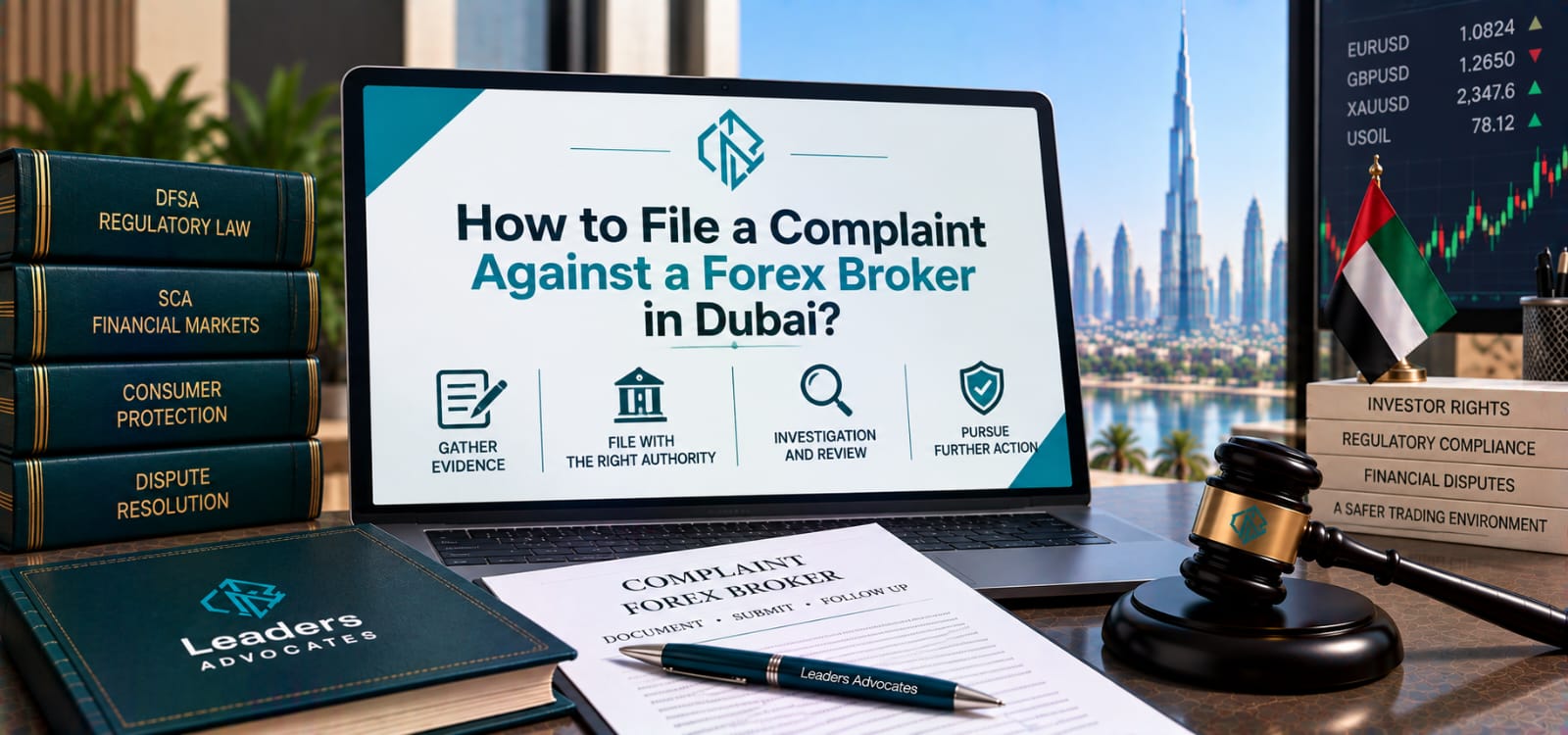

A client may know that a forex broker acted unfairly but not know where to complain. The brand can use a Dubai address, an offshore company, a DIFC reference, and a different payment beneficiary.
Sending the same short allegation to several authorities rarely solves the identification problem. A stronger complaint shows the entity, jurisdiction, event sequence, evidence, and requested outcome.
Quick Answer
Identify the broker’s exact legal entity, regulator, and approved activity before filing. A trading brand, office address, or license badge may not identify the responsible company.
Send a written complaint through the broker’s official channel. Include your account, transactions, dates, disputed conduct, amount, supporting documents, and the result you request.
Escalate to the UAE Capital Market Authority for relevant mainland activity or the DFSA for a firm operating in or from the DIFC. Check each authority’s jurisdiction first.
Keep the complaint reference and every submission. A regulatory complaint may address misconduct, but repayment can still require settlement, litigation, or enforcement against identified assets.
Verify the broker before drafting. Use the official register, compare the approved activity with the service offered, and confirm the contact channel independently.
Complain to the broker in writing when appropriate. Then escalate to the competent authority with an indexed, factual file while preserving any private recovery claim.
How to File a Complaint Against a Forex Broker in Dubai
The process begins with identity and jurisdiction. A regulator can normally act only within its legal authority and against a person or firm it supervises.
Do not use only the brand name. State the full legal entity, registration or license number, trading name, website, account number, and known address.
Step One: Identify the Responsible Entity
Read the client agreement, website footer, account statement, payment instruction, privacy notice, and complaint policy. These documents may name different companies.
Record the entity that signed the agreement, received the money, executed trades, controlled the platform, and answered withdrawal requests.
If names differ, explain the relationship instead of choosing one silently. Attach the records that show each role.
Step Two: Check the Regulator
The UAE Capital Market Authority, or CMA, is the current name of the body formerly known as SCA. It covers relevant mainland capital-market activity.
The DFSA regulates financial services in or from the DIFC. It maintains its own public register and complaint framework.
The broker’s use of Dubai in its marketing does not decide the regulator. The entity, location, permission, and conduct must be matched.
Not Sure If It’s CMA or DFSA?
Send us your broker’s name on WhatsApp and we’ll tell you the right authority and process in minutes.
Step Three: Check the Approved Activity
A firm may appear on an official register but hold a limited permission. Review the activity and restrictions, not only the status line.
Ask whether the permission covers spot-forex or derivatives execution. An advisory, promotion, introduction, or Category 5 permission may not authorize the service offered.
Save a dated copy of the register entry. The status or public page can change after the complaint.
Step Four: Use the Broker’s Internal Complaint Process
Find the official complaint email or form on the verified website or regulatory record. Do not send sensitive material to a social-media account.
Mark the document as a formal complaint. State your name, account number, contact details, disputed events, total amount, and requested resolution.
Ask for acknowledgment, a reference number, and the response timetable. Keep proof of submission and any automatic reply.
Write a Clear Chronology
Begin with account opening and end with the current status. Use dates, short descriptions, and supporting document numbers.
Include deposits, trades, calls, withdrawal requests, charges, account restrictions, and written representations. Separate what you saw from what another person told you.
If you disagree with a transaction, identify it precisely. State the instrument, date, size, price, authority issue, and resulting loss.
Define the Complaint Issue
A complaint can concern delayed withdrawal, unauthorized trading, misleading statements, execution, fees, client-money handling, account access, or another specific act.
Avoid saying only that you lost money. Markets can cause losses without misconduct. Explain the rule, agreement, instruction, or representation you believe was breached.
If fraud is suspected, describe the facts supporting dishonesty. Do not overstate what the evidence proves.
Suspect Fraud, Not Just a Trading Loss?
Message us on WhatsApp with the key facts. We’ll tell you honestly whether this looks like misconduct or a market loss.
Organize the Supporting Documents
- Account-opening and client agreements.
- Risk disclosures and fee schedules.
- Account statements and trade history.
- Deposit and withdrawal records.
- Bank, card, exchange, or wallet proof.
- Emails, chats, and call records.
- Advertisements and promised-return statements.
- Register entries and claimed licenses.
Number the documents and refer to them in the chronology. A short index saves the reviewer from guessing what each file shows.
State the Remedy Requested
Ask for a specific response. That may include an explanation, statement correction, transaction review, withdrawal, fee refund, document release, or other appropriate action.
Do not request an impossible result from the wrong authority. A regulator’s function differs from a court’s power to enter and enforce a private money judgment.
Reserve your rights where appropriate. A complaint should not unintentionally waive a contractual or legal claim.
Escalating a DFSA Matter
The DFSA accepts written complaints about matters within its jurisdiction. Its public guidance recommends approaching the authorized firm first and keeping a written record.
A DFSA submission should identify the complainant and respondent. It should include a chronology, the issue, the response received, and relevant documents.
If the entity is not DFSA-authorized or the activity falls outside the DIFC framework, the DFSA may not be the correct destination.
Escalating a Mainland Matter
For relevant mainland capital-market activity, review the CMA complaint service and current licensed-company information. Use the exact legal name and permission.
Explain how the broker’s service relates to the approved activity. Attach the internal complaint and response, if available.
If the firm had no relevant authorization, a standard broker complaint may be insufficient. Police reporting and recovery advice may be necessary.
Ready to Submit Your Complaint the Right Way?
Let us build your chronology, index your evidence, and file with the correct authority the first time.
When the Broker Is Overseas
An overseas license does not automatically create UAE regulatory jurisdiction. Read the agreement’s governing law, dispute clause, and entity details.
The complaint may need to go to the foreign regulator or dispute body. UAE steps can still matter where local conduct, payments, representatives, or victims are involved.
Coordinate the sequence. Multiple complaints should use the same accurate chronology and document set.
When to Contact the Police
Consider police reporting where the evidence suggests impersonation, unlicensed fraud, dishonest inducement, unauthorized access, document fabrication, or misappropriation.
Present the facts and payment trail. A commercial disagreement should not be labeled criminal without a proper basis.
Keep the police reference and follow directions about statements, devices, translations, and originals. Do not post allegations online while the matter is being assessed.
Notify the Payment Provider
Contact the bank, card issuer, regulated exchange, or other provider promptly. Ask about its formal dispute or fraud process.
Provide the beneficiary, reference, date, amount, and complaint number if available. Keep a written record of the response.
A recall or chargeback depends on the method and facts. Filing a request does not guarantee reversal.
Complaint Versus Civil Recovery
A regulator can investigate conduct and take action within its powers. That does not necessarily pay the complainant’s loss.
Civil recovery may require a demand, settlement, claim, interim application, judgment, and enforcement. Contract terms and defendant location can affect the forum.
Review limitation and procedural deadlines separately. Do not assume the complaint pauses every private legal period.
Follow Up Without Creating Confusion
Use the complaint reference in every message. Send material updates rather than repeating the entire file.
Maintain a submission log with the date, recipient, documents, and response. If you correct an error, identify the correction clearly.
Do not open multiple internal complaints for the same issue unless directed. Duplicate files can fragment the record.
Protect Confidential Information
Redact unrelated account information where appropriate. Share only through verified official channels or your lawyer’s controlled system.
Never disclose passwords, one-time codes, or wallet seed phrases. No complaint process requires transferring control of your account.
If identity documents were already sent to a suspicious entity, record what was shared and monitor for misuse.
Common Mistakes to Avoid
- Naming only the trading brand.
- Using an old or unrelated license certificate.
- Ignoring the approved activity.
- Submitting a long accusation without a chronology.
- Failing to state the requested outcome.
- Waiting for a regulator while a private deadline runs.
- Paying a new release or complaint fee to the broker.
A focused correction can improve an existing complaint. Explain what has changed and attach the missing record.
Related Success Story
Leaders Advocates publishes a debt recovery case involving successful loan recovery in Dubai. The Leaders Advocates Success Stories page contains the available summary.
The outcome is not a prediction for a broker complaint. It illustrates the importance of evidence, an identified obligor, a clear payment trail, and an enforceable recovery plan.
Final Filing Checklist
- Correct complainant and respondent details.
- Verified regulator and approved activity.
- Internal complaint and response.
- Dated chronology.
- Indexed evidence.
- Exact loss calculation.
- Clear requested remedy.
- Record of submission and reference number.
Review the package for inconsistent dates or amounts. One accurate file is stronger than several rushed versions.
Final Takeaway
A strong forex broker complaint identifies the entity, regulator, activity, conduct, evidence, loss, and requested result. It gives the reviewer a clear path through the facts.
Preserve civil recovery options while the complaint is reviewed. Regulatory escalation and private enforcement solve different parts of the problem.
Relevant Legal Services
- Forex Lawyer in Dubai — for entity checks, broker complaints, and regulator strategy.
- Litigation Lawyer in Dubai — for civil claims, interim applications, and contested proceedings.
- Debt Recovery Lawyers in Dubai — for demands, settlement, repayment claims, and enforcement planning.
Follow Leaders Advocates on LinkedIn or Leaders Advocates on Facebook for more UAE legal updates.
Frequently Asked Questions
Lost Money With a Forex Broker in Dubai?
Don’t send another unanswered email. WhatsApp us your details now and get a clear next step today.