


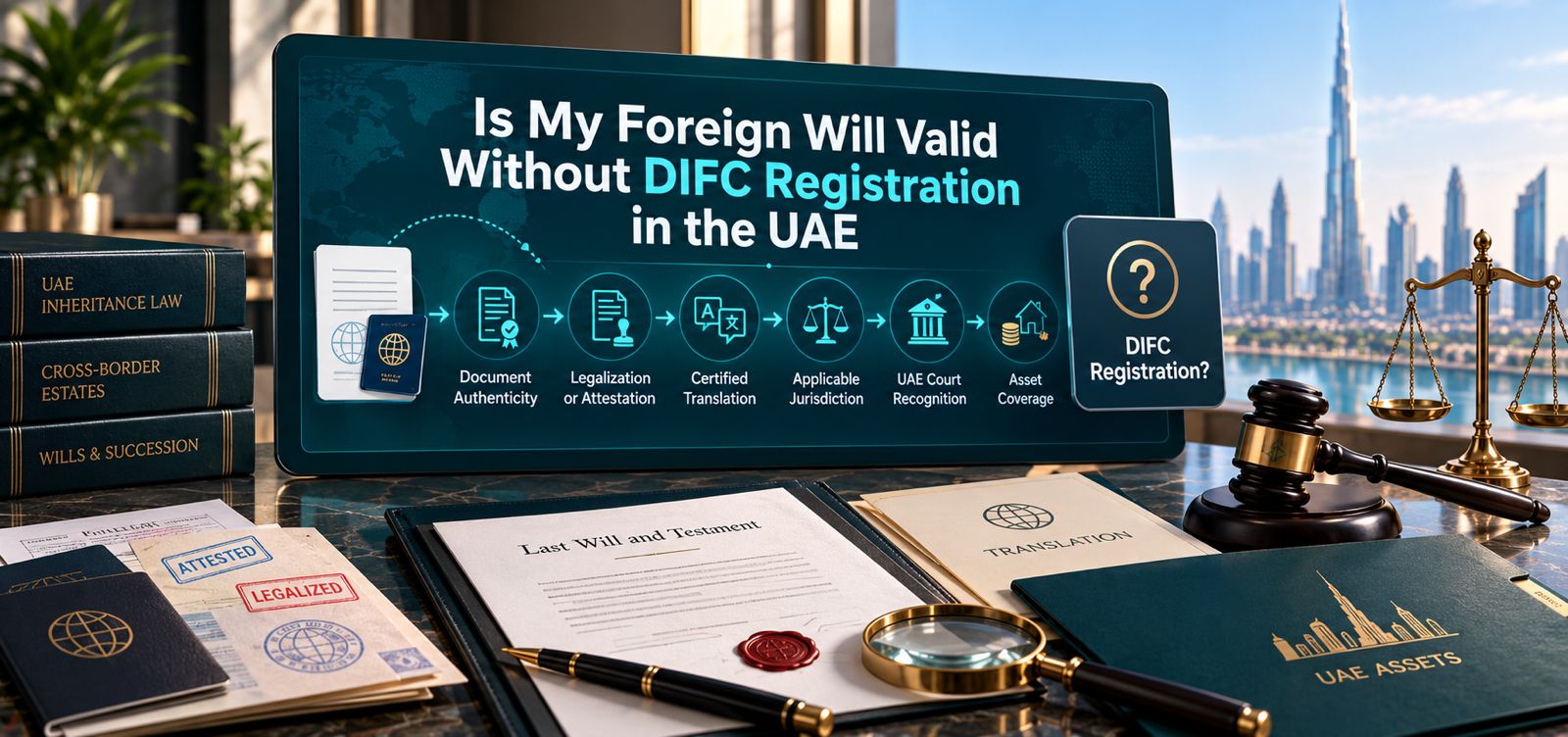

You signed a will abroad. You now own property, accounts, company interests, or personal assets in the UAE.
The will was never registered with the DIFC Wills Service Centre. You want to know whether it will control those UAE assets.
A simple yes or no is unsafe. Recognition can depend on personal status rules, the will’s validity, asset location, and required UAE procedures.
Quick Answer
A foreign will is not automatically invalid because it lacks DIFC registration. However, it may not operate automatically over UAE assets, and recognition can require additional legal and procedural steps.
The result may depend on nationality, religion, the applicable succession framework, asset type, and asset location. Translation, authentication, notarization, and proof of foreign law may also be required before the competent UAE authority can rely on the will in the estate process.
Local registration can provide a more direct route for eligible people and assets. DIFC, Dubai Courts, and Abu Dhabi channels have different scopes and requirements, so review the entire estate before choosing a route or assuming the foreign will is sufficient.
Solution
Treat validity and practical effectiveness as separate questions. First confirm the document. Then map the assets, law, forum, and recognition steps.
1. Separate Validity From Recognition
A foreign will can be valid where it was made. That does not always mean it can be used directly for every UAE asset.
Validity asks whether the will was properly made. Recognition asks whether the UAE authority will accept and apply it in the estate process.
Enforcement is another question. Banks, registries, companies, and courts may require specific orders or documents before transferring an asset.
This distinction prevents two opposite mistakes. The will should not be dismissed automatically. It should not be treated as self executing either.
2. Identify the Applicable Succession Framework
Succession in the UAE can involve more than one legal framework. Nationality, religion, domicile, asset location, and statutory scope may matter.
Non Muslim residents may have estate planning options that differ from those available under other personal status rules.
A home country law may be relevant in principle. It still needs to be properly raised, proved, and accepted within the applicable UAE process.
Do not select a framework from nationality alone. Counsel should review the deceased, family, documents, and assets before advising.
Not Sure If Your Foreign Will Works in the UAE?
Do not assume a foreign will automatically covers your UAE assets. Get the will, succession framework, property, bank accounts, and other estate assets reviewed before relying on it.
3. Review How the Foreign Will Was Made
Collect the signed original and every formal certificate. Note where it was signed, witnessed, notarized, stored, and later amended.
Confirm the testator had capacity and understood the document. Identify the witnesses, drafter, notary, or foreign authority involved.
Check whether any later will, codicil, marriage, divorce, or revocation may affect the document under the relevant law.
A UAE lawyer may need evidence from the foreign jurisdiction. This can include legal opinions, probate material, or proof of formal validity.
4. Build a Complete UAE Asset Map
List every UAE asset separately. Include real estate, bank accounts, shares, business interests, vehicles, insurance, and valuable personal property.
Record the legal owner, emirate, registry, account location, approximate value, and any joint ownership or security.
The correct route may differ by asset. A property transfer is not handled in the same way as an account or company interest.
Also list overseas assets. A coordinated plan should avoid conflicting documents and accidental revocation across jurisdictions.
5. Check Beneficiaries and Family Risks
Identify every spouse, child, dependent, intended beneficiary, and person who may challenge the estate plan.
Compare names in the will with passports and current civil records. Spelling differences can create delay during recognition and transfer.
Review whether the will addresses later born children, replacement beneficiaries, simultaneous death, and failed gifts.
Do not hide a family dispute from counsel. A potential challenge affects the recommended registration and evidence strategy.
6. Understand the DIFC Route
The DIFC Wills Service Centre offers will registration services within its current eligibility rules and service scope.
Available products can address different estate needs. Options may cover a wider estate, specific property, financial assets, business interests, or guardianship planning.
DIFC registration is not the only UAE route. It should be evaluated against the person’s status, assets, cost, language, and desired coverage.
Requirements can change. Confirm the current official rules before relying on an older checklist or a prior registration category.
7. Consider Dubai Courts Registration
Dubai Courts and its notary services provide local will related channels. Their requirements and eligible cases must be confirmed for the individual situation.
A Dubai route may be relevant where important assets sit in the emirate. It can also affect how later estate steps are organized.
Prepare identity, family, asset, and draft will information before seeking registration. Translation and formal execution requirements must be followed carefully.
Do not assume a document accepted for notarization covers every succession issue. Review its legal scope and intended assets first.
8. Consider Abu Dhabi Channels
Abu Dhabi judicial or notary channels may offer another local registration route. The best choice depends on status, residence, and asset location.
An Abu Dhabi asset should be mapped separately from Dubai property or a DIFC related plan. Local transfer procedures may differ.
Ask for the current document list and execution steps. Do not rely on a checklist prepared for a different emirate.
A coordinated lawyer can compare available routes and help avoid duplicate documents that create inconsistent instructions.
9. Prepare Translation and Authentication
Foreign documents may require certified Arabic translation. The translation should match names, dates, asset descriptions, and formal terms accurately.
Authentication, legalization, or apostille related steps may depend on the issuing country and the document being presented.
A notarized copy is not always a substitute for the original. Confirm what the receiving authority requires before sending documents abroad.
Build time for these steps. Missing seals, outdated certificates, or inconsistent spellings can delay an estate process significantly.
10. Plan for Proof of Foreign Law
A UAE court may need help understanding the foreign law relied on. A translated statute alone may not answer validity or succession questions.
The file may require an appropriate legal opinion or official material from the foreign jurisdiction.
Counsel should identify the exact proposition that needs proof. This keeps the foreign law evidence focused and easier to test.
Obtain evidence early where possible. Waiting until a contested estate begins can add cost and uncertainty for the beneficiaries.
11. Address Guardianship Separately
Parents often expect a will to decide every guardianship issue automatically. Guardianship, custody, travel, and financial management can involve separate legal questions.
Review any guardian nomination against the child’s residence, nationality, family network, and applicable UAE procedure.
Name backups and keep their contact information current. Ask whether the chosen person can realistically care for the child in the proposed location.
Do not leave guardianship language buried inside an overseas form. Obtain UAE advice about how the nomination may be considered locally.
12. Review Executors and Estate Administration
A named foreign executor may still need authority recognized in the UAE. The role should be assessed against local estate procedures.
Choose someone who can gather documents, communicate with beneficiaries, and manage cross border steps. Distance and language can affect administration.
Keep an asset inventory and contact list outside the will. A secure practical record can help the executor locate accounts and advisers.
Do not place passwords or frequently changing details inside the will. Use a secure separate system that can be updated without redoing the instrument.
13. Coordinate Multiple Wills
Some people use separate wills for separate jurisdictions. This can work only when the documents are drafted to coexist.
A broad revocation clause in a newer will may cancel an older instrument unintentionally. Cross reference and scope language require careful review.
Use the same asset map across all advisers. Each lawyer should know that another will exists and what it is intended to cover.
Review changes together after marriage, divorce, birth, relocation, or a major asset purchase. Isolated updates can create contradictions.
14. Compare Certainty Cost and Coverage
Local registration can improve procedural clarity, but it does not justify careless drafting. The document must still match the person’s estate and family plan.
Compare registration fees, drafting costs, translation needs, covered assets, amendment steps, and future administration.
Consider the cost of uncertainty. A cheaper unreviewed route may create larger recognition and dispute costs after death.
No registration should be described as an absolute guarantee. Courts and authorities still apply the governing law and facts.
15. Complete an Estate Planning Review
Give counsel the foreign will, passports, marriage records, family details, asset map, ownership documents, and any prior wills.
Ask for a written scope statement. It should identify which assets the proposed UAE instrument covers and which remain outside it.
Create an implementation list. Registration, translation, nominations, company changes, beneficiary forms, and storage may require separate steps.
Should You Register a Will in the UAE?
DIFC, Dubai Courts, and Abu Dhabi routes can have different requirements and scopes. Speak with a UAE inheritance lawyer about which option fits your assets and circumstances.
Review the plan regularly. New assets, changed residence, family events, and legal developments can make an older plan incomplete.
- Confirm the governing framework and eligible registration route.
- Verify the foreign will and any later amendments.
- Map every UAE and overseas asset by legal owner.
- Coordinate beneficiaries, executors, guardians, and backup choices.
Final Takeaway
Is my foreign will valid without DIFC registration in the UAE is not answered by registration status alone. A foreign will may exist but still require recognition steps.
Review the document, succession framework, assets, and UAE routes now. Clear planning is easier than resolving uncertainty during estate administration.
Related Success Story
Leaders Advocates publishes success stories that show its evidence led approach to sensitive matters. Estate results still depend on the governing law, documents, and assets.
Common Mistakes
- Assuming a foreign will is automatically invalid without DIFC registration.
- Assuming a valid foreign will transfers UAE assets automatically.
- Choosing a registration route before mapping every asset.
- Ignoring certified translation and authentication requirements.
- Using multiple wills without coordinating revocation clauses.
- Treating guardianship language as a complete local custody plan.
Relevant Legal Services
An Inheritance Lawyer in Dubai can assess the succession plan. A Family Lawyer in Dubai can review the personal status framework. A Guardianship Lawyer in Dubai can address child and decision making provisions.
People Also Ask
Don’t Leave Your UAE Assets to an Uncertain Will
If you own UAE property, bank accounts, company shares, or other assets, confirm whether your existing will can be relied on and what additional estate-planning steps may be needed.