


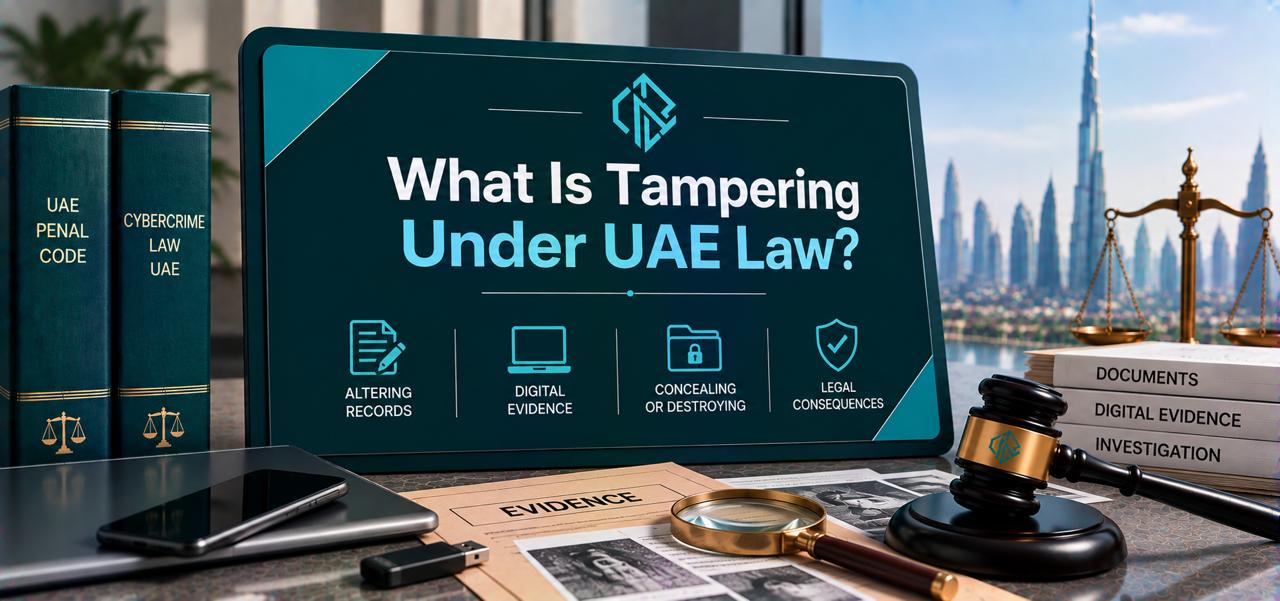

Tampering is a descriptive word, not one universal UAE charge. It may refer to altering digital evidence, changing a document, hiding an object, manipulating a product or vehicle, interfering with a meter or identifier, coaching a witness, changing records, or obstructing an investigation. Each scenario has different elements, victims, evidence, and possible penalties.
The original article stated a fixed minimum penalty under Article 18 of the Cybercrime Law for digital-evidence conduct. A final legal opinion should verify the current official text, the act alleged, purpose, connection to an offense, and whether another article or law is more specific. Using an imprecise label can lead a complainant to submit the wrong material or an accused person to respond to a charge that has not actually been identified. This makes it important to understand the applicable forgery law in the UAE, including the circumstances in which is forgery illegal in the UAE and how the specific conduct may be classified under the law.
Quick Answer
what is tampering in uae depends on the object, act, purpose, and legal context. UAE law does not create one catch-all offense called tampering. Altering, concealing, or destroying electronic evidence may engage Federal Decree-Law No. 34 of 2021 on rumors and cybercrimes where its elements are met. Creating or changing a document, signature, seal, certificate, or electronic record may fall under forgery provisions in Federal Decree-Law No. 31 of 2021, while knowingly using the forged item can be a separate issue.
Hiding physical evidence, influencing testimony, manipulating a consumer product or vehicle, changing a meter or identifier, or falsifying regulated records may fall under other criminal, procedural, consumer, transport, or sector-specific rules.
The penalty cannot be stated from the word tampering alone. Preserve the item in its original state, document chain of custody, avoid contacting witnesses about their account, and obtain advice on the precise provision before reporting or responding.
Replace the broad label with a conduct map: identify what changed or disappeared, who controlled it, when and how it happened, what purpose is alleged, which proceeding or regulated activity was affected, and which evidence proves each point. An experienced criminal defense lawyer in Dubai can help connect these facts to the relevant legal elements, while clients may also ask who is the best forgery lawyer in the UAE when selecting counsel for a document-related allegation.
Digital and Electronic Evidence
Digital tampering may involve deleting messages, editing logs, changing file content or metadata, wiping devices, altering database entries, concealing accounts, or interfering with evidence connected to an inquiry. Federal Decree-Law No. 34 of 2021 may apply where the statutory elements are satisfied. Other provisions can address unauthorized access, data damage, false electronic material, privacy, or obstruction depending on the conduct.
Do not assume every deleted file proves criminal intent. Systems overwrite data, users follow retention policies, and metadata can change through ordinary handling. The investigation should preserve devices and cloud sources, collect audit logs, maintain chain of custody, and document tools and methods. A forensic image or provider record may be more reliable than a screenshot. Exact penalties require the exact article and facts.
Retention settings should be documented before they are changed. If business continuity requires continued system use, legal and technical teams should record the preservation compromise, isolate relevant sources where possible, and retain enough information for an independent examiner to reproduce the collection method.
Forgery and Alteration of Documents
Changing a physical or electronic document so it falsely appears authentic may be assessed under the Crimes and Penalties Law’s forgery provisions rather than a generic tampering concept. Official and private documents may carry different treatment. A person who did not create the false document may still face a separate allegation if they knowingly used it.
Relevant evidence can include the original, issuing-body records, drafts, signatures, seals, printers, devices, access rights, file history, submission route, and the user’s knowledge. A mistake, unauthorized amendment, false statement, and legal forgery are not automatically the same. Counsel should identify the legal nature of the document and the precise change before addressing penalty or defense.
Facing a Tampering Allegation in the UAE?
Our experienced criminal lawyers in Dubai can identify the exact conduct, applicable legal provision, evidence issues, intent, and procedural risks before you make a statement or respond to authorities.
Physical Evidence and an Investigation
Moving, hiding, contaminating, destroying, substituting, or fabricating an object related to an investigation can affect evidence integrity and may engage criminal or procedural provisions based on the act and purpose. Examples include clothing, tools, samples, packaging, recordings, records, and property said to connect a person to an event. The legal issue is not limited to visible damage.
Anyone who discovers a relevant item should minimize handling, record where and when it was found, identify people with access, and follow lawful reporting or preservation instructions. Do not clean, test, repair, write on, or circulate it unnecessarily.
Investigators should use sealed packaging, logs, photographs, and documented transfers. A broken chain of custody may affect weight, but it does not automatically make evidence inadmissible or prove misconduct.
Products, Vehicles, Meters, and Safety Systems
Tampering with a product, vehicle, odometer, serial number, meter, safety device, label, or regulated system can fall under consumer, transport, utilities, customs, standards, or criminal rules. The applicable law depends on the item, the actor’s authority, the intended deception or benefit, and any harm or safety risk. A repair and an unlawful manipulation are not the same act.
Preserve purchase, service, inspection, ownership, calibration, and usage records. Photograph seals and identifiers and obtain an independent technical inspection where appropriate.
If immediate safety is involved, stop use and follow regulator or manufacturer instructions. Do not permit a suspected party to alter the item again before evidence is secured. Technical findings should explain method, timing, effect, and uncertainty.
Witnesses, Statements, and Records
Interfering with a witness is different from editing a file, but people sometimes call both tampering. Threats, inducements, coaching, retaliation, or pressure to withhold or change an account may engage separate offenses and procedural concerns. Legitimate witness preparation explains process and tests memory; it must not create a false version.
Organizations should preserve interview notes, identify who contacted each witness, and avoid group discussions that contaminate recollection. A witness should describe personal knowledge, distinguish memory from documents, and correct mistakes transparently.
If contact is alleged, retain messages, call data, meeting records, and any benefit or threat evidence. Counsel should advise before further communication.
The Role of Intent and Purpose
Many offenses require a particular mental element, such as knowledge, intent to deceive, intent to obstruct, or awareness that an item is false. Accidental deletion, routine disposal, authorized correction, negligent handling, and deliberate concealment can lead to very different analyses. The sequence and explanation around the act therefore matter.
Look for preservation notices, access rights, warnings, timing, concealment, benefit, repeated conduct, restoration attempts, and contemporaneous communications. A later explanation should be tested against system or third-party records.
Neither suspicious timing nor a denial alone resolves intent. The legal team should build competing fact-based explanations and test which is supported by admissible evidence.
Faris Raian, an experienced criminal lawyer in Dubai, stated in the source article that tampering is often treated as a single general concept when it is not. Correctly identifying the provision based on what was affected shapes both exposure and response. That remains the central practical lesson.
A legal assessment should use a matrix listing the object, conduct, actor, authority, mental element, harm, evidence source, possible provision, and procedural forum.
The matrix prevents a digital-evidence issue from being argued as document forgery without analysis or a product complaint from being treated as an obstruction. It also reveals when several provisions may overlap.
What to Do If You Discover Suspected Tampering
First protect people and stop ongoing loss through lawful, proportionate measures. Preserve the original item or system, suspend routine deletion where authorized, record access, and obtain legal and technical advice.
Make a verified chronology and avoid public allegations. If regulated reporting or immediate police involvement may be required, counsel should assess timing and the information needed.
Do not investigate beyond your authority, access private accounts, impersonate anyone, install unapproved monitoring, or induce further misconduct.
Companies should define scope, privilege, independence, privacy, employment, and anti-retaliation safeguards. A person accused should not delete or manufacture records and should obtain advice before giving a detailed account.
How Penalties Should Be Checked
A penalty statement must identify the law, article, version, conduct, defendant, aggravating facts, and whether imprisonment, detention, fine, confiscation, deportation, closure, or regulatory sanctions are possible.
A publicity summary about one digital-evidence scenario should not be applied to every form of tampering. Amendments and current official texts should be verified.
The final classification may depend on prosecutorial and judicial assessment. Related charges such as unauthorized access, forgery, use of a forged document, fraud, damage, privacy breach, or money laundering may carry their own consequences.
Legal advice should present ranges and uncertainty accurately and should never guarantee charge reduction or acquittal.
Concerned About Altered or Deleted Digital Evidence?
Leaders Advocates can assess deleted files, altered records, device evidence, logs, metadata, chain of custody, and potential UAE cybercrime exposure before important evidence is lost.
Related Success Story
The firm’s Success Stories page includes financial and criminal matters where disciplined evidence analysis was important.
Those outcomes were case-specific and do not determine a tampering allegation, which must be classified from its own object, intent, and proof.
Need the Correct Tampering Category?
Leaders Advocates can assess the object, conduct, intent, evidence preservation, possible criminal or sector-specific provisions, reporting route, and response strategy.
Common Mistakes
- Assuming every act described as tampering falls under one article and penalty.
- Editing, testing, repairing, or circulating the original item before preserving it.
- Relying on screenshots when native files, logs, or issuing-body records are available.
- Contacting witnesses in a way that pressures or contaminates their independent account.
- Conducting an internal investigation without authority, privacy, privilege, or chain-of-custody controls.
- Quoting a digital-evidence penalty for document, vehicle, product, or witness conduct.
Relevant Legal Services
A Criminal Defense Lawyers in Dubai can identify the alleged offense and advise through investigation, prosecution, and court.
A Cybercrime Lawyers in Dubai can address electronic evidence, unauthorized access, data, devices, and forensic preservation.
A Litigation Lawyers in Dubai can coordinate connected civil, commercial, expert, and evidentiary proceedings.
People Also Ask
Conclusion
The practical answer to what tampering in the UAE is is that the label must be replaced with a precise legal category. Preserve the original evidence, identify the object and intent, use reliable chain-of-custody and forensic methods, and verify the current article before stating a penalty or choosing a reporting or defense strategy.
Need to Preserve Suspected Tampering Evidence?
Leaders Advocates can help preserve documents, devices, physical evidence, witness records, and chain of custody while identifying the correct criminal, cybercrime, or litigation route.
1 Comment