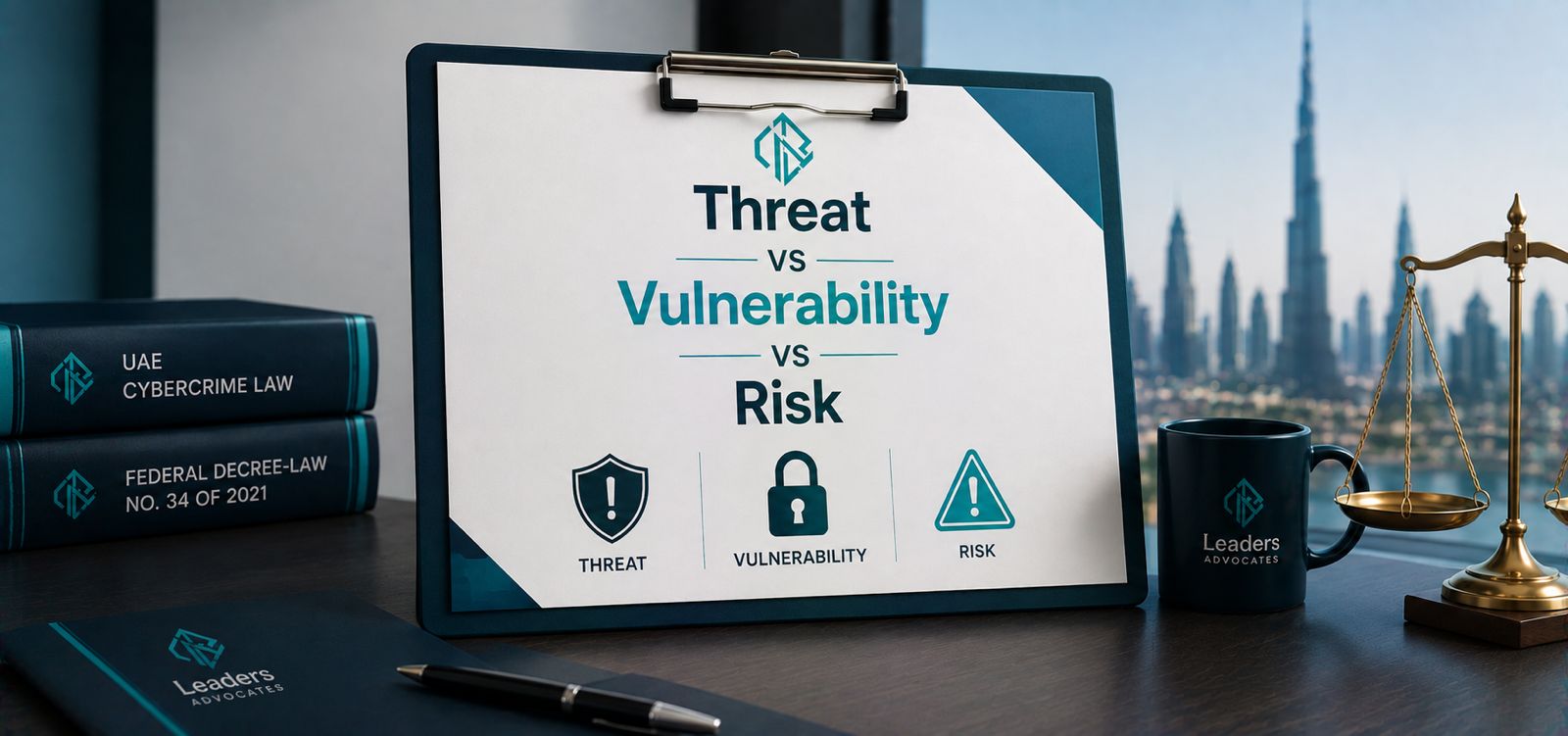

Threat, vulnerability, and risk are often used as interchangeable words in board reports, security assessments, contracts, and incident reviews. They describe different parts of one problem. When the terms are blurred, a business may spend heavily on a visible threat while leaving a more exploitable weakness and higher-impact risk untreated.
The distinction also matters to legal and compliance work. UAE data protection and cybersecurity expectations generally focus on risk-based controls and evidence that the organisation assessed its own exposure. A generic list of global threats does not show which systems, people, vendors, data, or operations are vulnerable and what the realistic impact would be.
Quick Answer
A threat is a potential source of harm, such as a malicious actor, phishing campaign, malware, insider, supplier failure, or natural event. A vulnerability is a weakness that allows the threat to succeed, such as unpatched software, excessive access, weak payment verification, poor backups, or untrained staff. Risk is the likelihood that a particular threat will exploit a particular vulnerability and the resulting legal, financial, operational, and reputational impact.
A serious threat may create low risk where effective controls remove the exploitable weakness. A smaller threat may create high risk where a critical system is exposed. A useful assessment therefore links a named threat to a real vulnerability, existing controls, residual likelihood, impact, owner, and treatment rather than presenting three separate lists.
Use one repeatable sentence for every material scenario: this threat could exploit this vulnerability, causing this impact; these controls reduce the likelihood or impact, leaving this residual risk. Assign an owner, evidence, action, and review date to that statement.
Ekaterina Butseva is a Founder and Partner at Leaders Advocates with legal experience since 2010. She is a member of the International Bar Association and a foreign member of the American Bar Association. Her practice centres on complex litigation, dispute resolution, and cross-border matters. That perspective is relevant to cyber risk because a control failure can affect contracts, regulatory obligations, personal data, evidence, insurance, and several jurisdictions at the same time.
The Three Terms, Side by Side
A threat is what could cause harm. Examples include an external attacker, deceptive email, malicious software, dishonest insider, compromised supplier, fire, power loss, or accidental deletion. A threat can exist even when it has no practical route into the organisation.
A vulnerability is the weakness that can be exploited. It may be technical, such as an unpatched server, but it can also be procedural, contractual, physical, or human. Weak approval rules, shared accounts, incomplete supplier due diligence, an unclear incident plan, and lack of training can all create vulnerabilities.
Risk is the business and legal exposure created when the threat and vulnerability meet. It considers how likely the scenario is and how serious the impact would be. Impact can include financial loss, service interruption, compromised personal data, unsafe operations, breach of contract, regulatory attention, litigation, and loss of trust.
• Threat: a potential source or event capable of causing harm.
• Vulnerability: a weakness in technology, people, process, physical security, or a third party.
• Risk: the likelihood and impact of the threat exploiting that vulnerability.
• Control: a measure designed to prevent, detect, respond to, or recover from the scenario.
• Residual risk: the exposure that remains after the controls are considered.
One Practical Example: Payment Diversion
Consider a criminal group impersonating a supplier. The threat is the attacker and the business email compromise campaign. The vulnerabilities might be weak email security, no independent verification for bank-detail changes, excessive payment authority, or staff who have not been trained to recognise urgent manipulation.
The risk is not simply that phishing exists. It is the likelihood that a false payment instruction will pass through the organisation and the impact if money is transferred. The impact may include direct loss, delayed projects, contractual disputes, bank and police reporting, recovery costs, and questions about internal controls. Some of these schemes escalate into direct threats or coercion, and our guide on is blackmail a crime in the UAE looks at how the law treats that kind of conduct.
Multi-factor authentication, domain protection, approval separation, call-back verification using a trusted number, payment limits, and rapid escalation can reduce the risk. The organisation should then assess the residual exposure rather than assuming one control removes it completely.
Why Businesses Confuse the Terms
Threat intelligence is visible and easy to discuss. News reports describe ransomware groups, phishing, artificial intelligence, or zero-day attacks, so risk registers sometimes copy those labels without identifying the organisation’s own weakness. The resulting document sounds current but gives decision-makers little basis for prioritisation. The same principle of looking past the headline applies elsewhere in UAE law; for example, our guide on is abortion legal in the UAE covers a different area readers often ask about.
Security teams may also use technical severity as a substitute for business risk. A critical software flaw on an isolated test machine may carry less organisational risk than a moderate weakness in the payment, identity, or customer-data system. Context, exposure, controls, data, and operational dependency change the answer.
Ekaterina Butseva, one of the best cybercrime lawyer in Dubai , said that businesses assessing their compliance position sometimes focus on cataloguing threats without properly evaluating their own vulnerabilities. She explained that regulators and courts increasingly expect an organization to demonstrate a real risk assessment, connecting a specific threat to a specific weakness and the resulting exposure, rather than a general awareness that threats exist.
Why the Difference Matters for UAE Compliance
A risk-based obligation asks an organisation to understand its processing, systems, people, suppliers, and impact and to choose appropriate measures. It cannot be answered by saying that cybercrime is common. The business should show why a control was chosen, which risk it addresses, how it is tested, and what evidence proves it operates. Getting this right often means bringing in the correct legal support early, and our guide on how to choose the best corporate lawyer in dubai explains what to look for.
Legal analysis must be scoped correctly. Federal data protection rules, free-zone regimes, sector-specific standards, the Cybercrime Law, contractual duties, professional obligations, and regulator expectations may apply differently to different entities and activities. A risk assessment should identify the applicable framework rather than claim one universal UAE checklist.
The assessment also supports accountability after an incident. A dated record can show what was known, how risk was evaluated, which actions were approved, who owned them, and what remained open. It does not excuse inadequate controls, but it is more useful than an undated policy copied from another company.
How to Build a Risk Scenario
Begin with an asset or activity that matters: payroll, customer records, privileged accounts, a factory control system, a legal case file, payment approval, remote access, or a cloud service. Identify the threat actors and events realistically relevant to that asset. Then identify the exact vulnerability they could exploit.
Describe impact in business terms. Ask what operations stop, which people are affected, what data is exposed, which payment is lost, which contract may be breached, and which authority or client may need notification. Estimate likelihood using available evidence and assumptions, not a false level of mathematical precision.
List preventive, detective, responsive, and recovery controls. Assess whether each is designed appropriately and actually operates. Record test results and exceptions. Then rate residual risk, choose treatment, assign an accountable owner, and set a date for completion and review.
• Asset or process: what the organisation needs to protect or keep operating.
• Threat and event: who or what could cause the harm and through which scenario.
• Vulnerability: the specific exploitable weakness, not a generic statement.
• Impact and likelihood: the consequence and realistic chance before and after controls.
• Control evidence: configuration, log, approval, test, training record, contract, or recovery exercise.
• Treatment and owner: reduce, avoid, transfer, or accept the residual risk with authority and a deadline.
Inherent Risk, Controls, and Residual Risk
Inherent risk is the exposure before the effectiveness of controls is taken into account. Residual risk is what remains after the current controls are considered. Keeping the two separate prevents a strong control environment from being rated as high risk solely because the underlying activity is sensitive, while still recognising the seriousness if the controls fail.
A control should not receive full credit merely because it appears in a policy. The organisation should test whether users follow it, exceptions are monitored, logs are reviewed, backups restore successfully, access is removed promptly, and suppliers meet the required standard. Design and operating effectiveness are different questions.
Risk transfer through insurance or contract may reduce financial impact, but it rarely transfers every legal, regulatory, operational, or reputational consequence. The policy and contract must be read for exclusions, notice, security conditions, liability caps, evidence duties, and incident cooperation.
Threat and Vulnerability Management After an Incident
An incident does not prove every feared risk was likely, but it provides evidence that the scenario and controls need reassessment. Preserve logs, devices, messages, access records, decisions, and the incident timeline. Avoid changing systems so quickly that the organisation loses evidence of how the threat entered and what it affected.
Is Your Cyber Risk Register Ready for Legal and Compliance Review?
Generic threat lists may not demonstrate how your business evaluates its actual exposure. Our team can review risk ownership, control evidence, supplier obligations, data protection issues, policies, and residual-risk documentation.
Ask which threat acted, which vulnerability was exploited, which controls failed or were bypassed, what limited the impact, and whether the same weakness exists elsewhere. Update the risk register, remediation plan, training, contracts, monitoring, backups, and response procedures based on verified findings.
Assessing your organisation’s cybersecurity or compliance position? Ekaterina Butseva and the team at Leaders Advocates can advise on the legal framework, documentation, contractual exposure, incident record, and dispute implications of the identified risks.
Need a Clear Cyber Risk Assessment?
Leaders Advocates can help connect the threat, vulnerability, control evidence, legal obligations, and potential impact so the risk register supports real decisions.
Common Mistakes
• Using threat, vulnerability, and risk as interchangeable labels in policies and reports.
• Copying a generic threat list without identifying the organisation’s own exploitable weaknesses.
• Rating technical severity without considering asset value, exposure, business dependency, and legal impact.
• Giving a control full credit because it is documented without testing whether it operates.
• Recording only inherent risk and failing to assess the residual exposure after controls.
• Failing to assign a treatment owner, evidence requirement, deadline, and review date.
Relevant Legal Services
A Cybercrime Lawyer in Dubai can advise on incident evidence, reporting, unlawful access, fraud, and Cybercrime Law exposure.
A Corporate Lawyer in Dubai can address governance, risk ownership, supplier contracts, policies, and management accountability.
A Litigation Lawyer in Dubai can assess disputes, evidence, loss, insurance, and claims that follow a control failure.
People Also Ask
Conclusion
Threat, vulnerability, and risk are three connected but separate concepts. A credible UAE cyber assessment links the source of harm to an actual weakness, evaluates likelihood and impact, tests the relevant controls, and records residual risk, treatment, ownership, evidence, and review. That structure turns a security list into a practical legal and business decision tool.
Has a Cybersecurity Control Failure Already Caused a Loss?
After an incident, identifying the exploited vulnerability and failed controls can be critical to evidence, contractual liability, insurance, regulatory issues, and potential disputes. Ekaterina Butseva and the Leaders Advocates team can assess the legal consequences and next steps.